


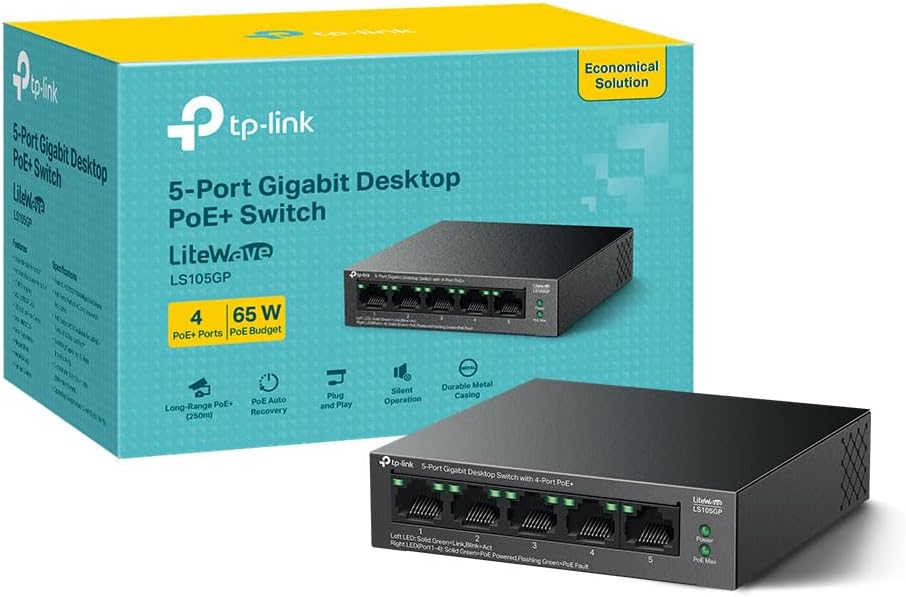
TP-Link LS105GP 5-Port Gigabit PoE+ Switch (4x PoE+) with 65W total power budget
Product description
The essentials
If you’re trying to power and connect a handful of fixed network devices without running separate power leads, the TP-Link LS105GP is built for that job. It’s a 5-port Gigabit PoE switch with 4 PoE+ outputs, so you can deliver network and power over a single Ethernet cable to compatible devices.
On paper, it hits a useful sweet spot for small setups: a few IP cameras, an access point, or an IP phone on the same network, all fed from one switch. It also leans into practicality with Plug & Play and a fanless, silent design—handy if you’re setting up in a home office, a shop floor that isn’t meant to be noisy, or any space where a fan would just be annoying.
That said, it’s not a do-everything monster. The total PoE budget is capped, and PoE-only ports need compatible devices (standard PoE behaviour applies). If you need to support lots of high-draw PoE gear at once, you may find the power budget becomes the limiting factor fairly quickly.
Key features that matter in daily use
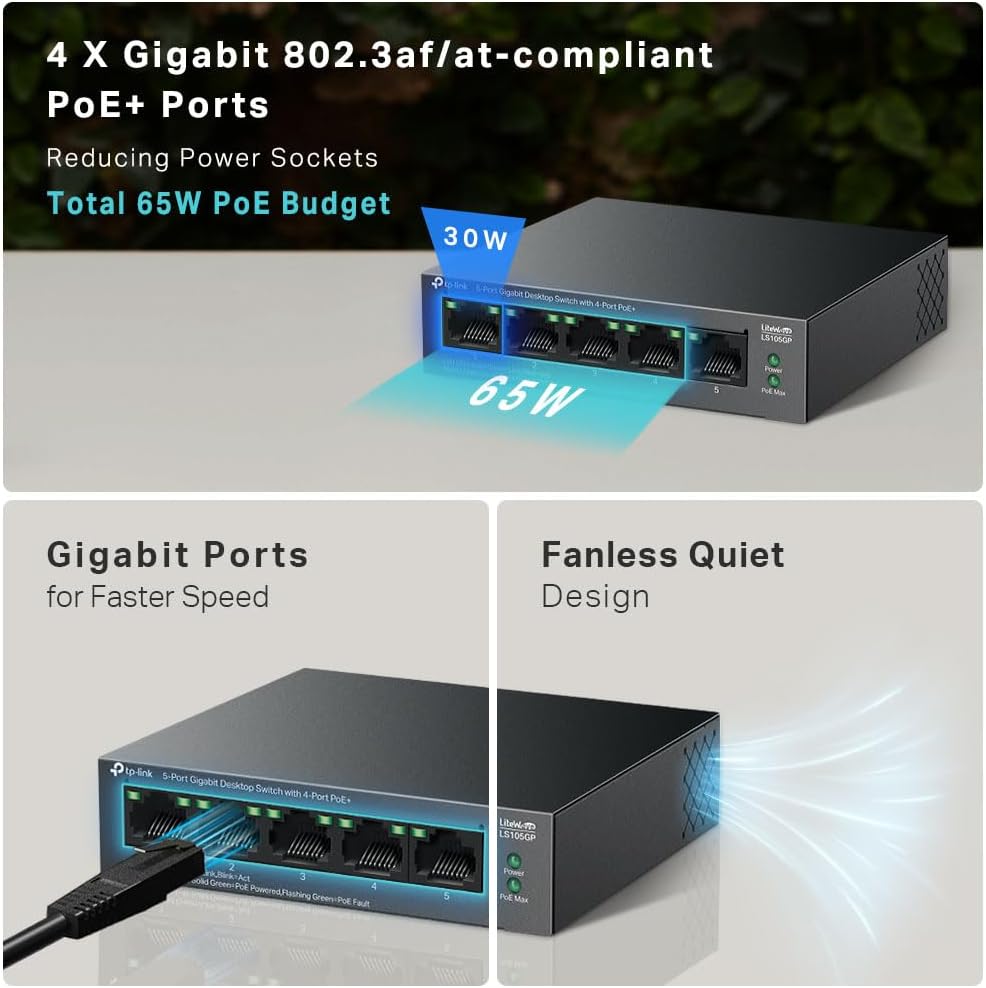
The most noticeable benefit here is the combination of five Gigabit ports and four PoE+ ports. Gigabit switching capacity is there to keep traffic moving for everyday browsing, streaming, and camera feeds—at least within the limits of your connected gear.
Because the PoE outputs are 802.3af/at compliant (PoE+ included), the switch can power compatible fixed devices like IP cameras, access points, and IP phones using a single cable. This reduces cable clutter and makes installation easier, especially in spots where running a separate mains power adapter would be awkward.
A couple of practical touches also stand out:
- PoE Auto Recovery: when a PoE-powered device drops or becomes unresponsive, the switch can automatically reboot it.
- Silent operation: the fanless design is meant to reduce power consumption and avoid audible fan noise.
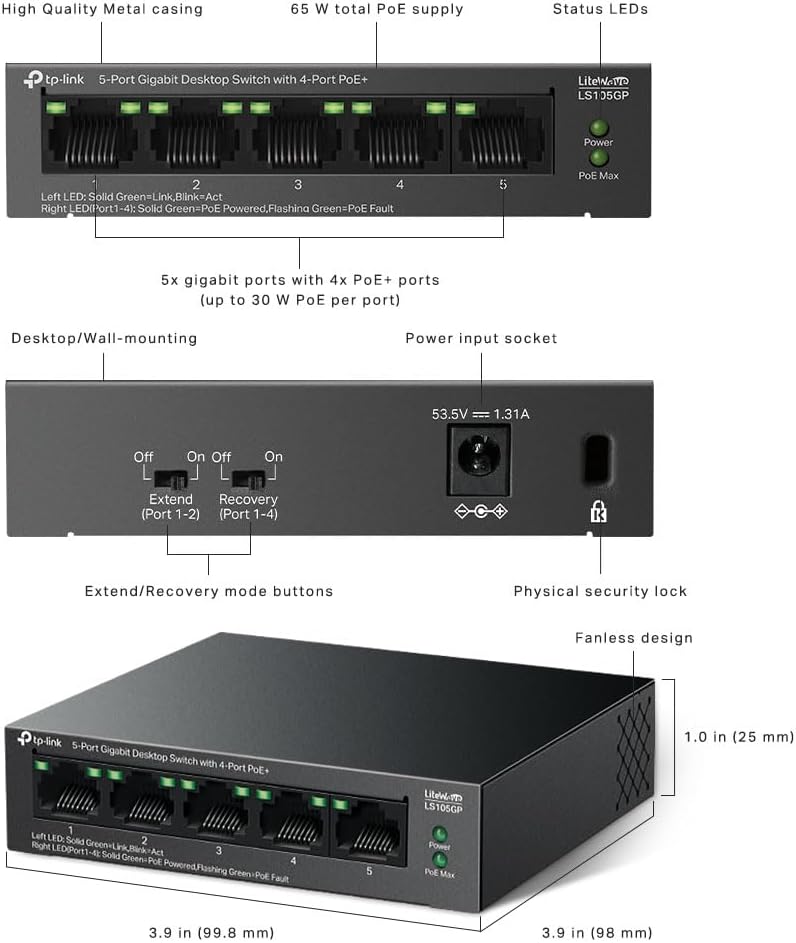
And if you’re dealing with longer runs for surveillance-style deployments, the Extend Mode is there to push PoE transmission distance up to 250m (subject to conditions and device behaviour, as always with long cable runs).
What you’ll notice when setting it up
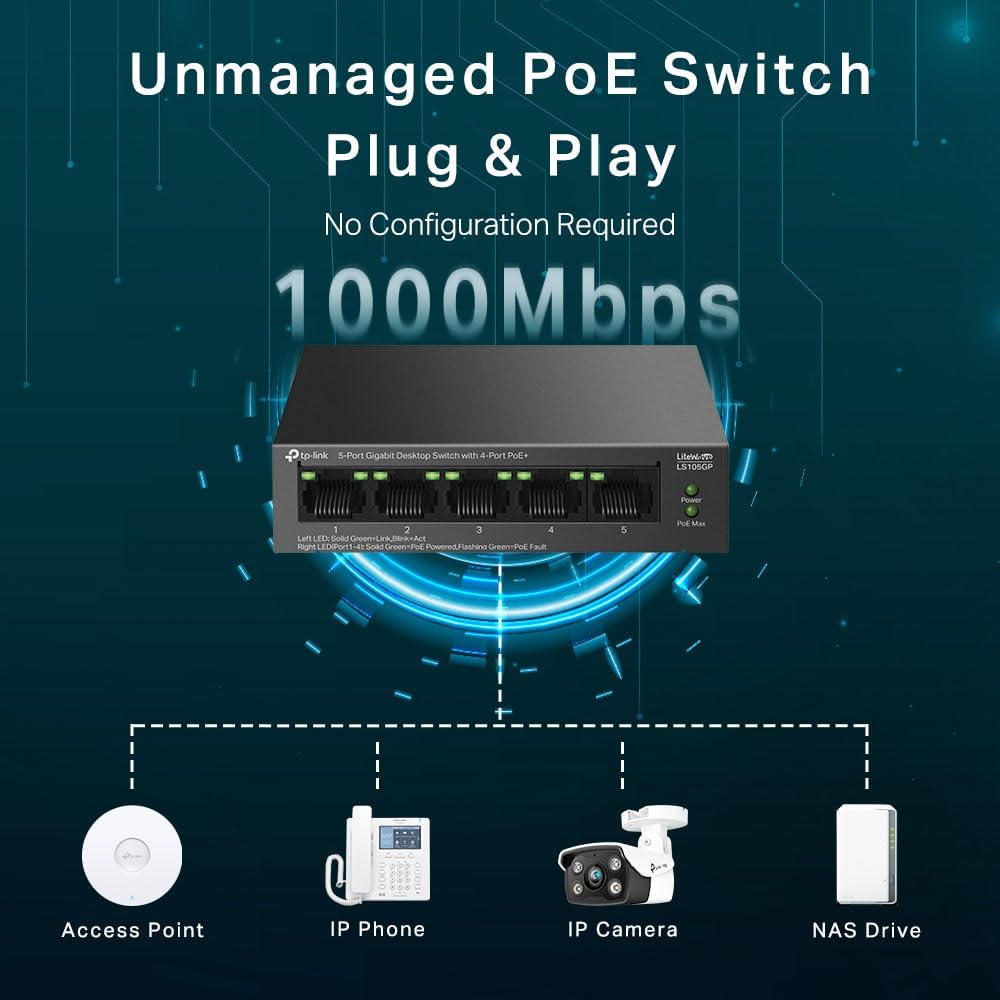
Plug & Play is the headline, and in a setup like this it’s exactly what you want: fewer menus, fewer steps, fewer “why isn’t it linking?” moments. In the real world, that usually translates to something like this—connect your modem/router to the switch, plug an IP camera into one of the PoE ports, and the camera should power on and start negotiating network connectivity without you needing to configure the switch.
Where it can get slightly less straightforward is when you mix device types or if a device isn’t PoE-compatible. Then you’d need to double-check whether it expects PoE (and which standard) or whether it should be powered separately.
Also, bear in mind that the PoE budget is shared. With 4 PoE+ ports available, it’s a lot easier to plan when you’re powering a small number of moderate-draw devices, rather than trying to run four demanding units that together could exceed the total.
Tech specs (the numbers you should check)

- Type: 5-port Gigabit PoE switch (4x PoE+ ports)
- PoE standards supported: 802.3af/at
- Power per PoE port: up to 30W supported by each PoE port
- Total PoE budget: 65W total
- Switching capacity: five Gigabit ports with auto-negotiation, up to 10Gbps switching capacity
- PoE transmission distance: up to 250m with Extend Mode
- Hardware design: fanless, metal casing, suitable for desktop or wall-mounting
Where it shines (and where it doesn’t)
It’s a solid pick if you want one-box simplicity for a compact PoE network, especially when you’re powering fixed devices such as cameras, a wireless access point, or an IP phone. The silent, fanless design and the metal case make it feel more “install-and-forget” than a basic plastic desktop switch.
It might not be the best choice if you’re trying to squeeze maximum performance out of multiple high-power PoE devices at the same time, because the 65W total budget is the hard ceiling. Likewise, if you don’t actually need PoE (and would rather just use standard Ethernet), you might be paying for PoE features you won’t use.
If you’re planning a longer CCTV-style run, it’s worth noting that Extend Mode can help reach up to 250m — but the real outcome still depends on the cable and the device on the other end.
Buying verdict
It makes sense if you’re building a small, neat PoE setup and you value a straightforward Plug & Play start, silent operation, and a switch that’s built for real environments thanks to its metal casing and wall/desktop mounting options. The 65W total budget and per-port PoE support up to 30W give you some headroom for typical fixed devices, while Extend Mode is useful for larger camera coverage areas.
You may want to skip it if your planned PoE devices are both numerous and power-hungry, because once you hit the total power budget, you’ll be forced to rethink the layout. It’s also not the right fit if your devices aren’t PoE-compatible, since the “power over Ethernet” idea only works when the connected equipment can accept it.
Worth considering if you want reliable powering and Gigabit connectivity from a compact, install-friendly PoE switch—and you like the idea of less cabling and fewer configuration steps.

Mini FAQ
What is the TP-Link LS105GP for?
It’s designed to provide Gigabit Ethernet connectivity while powering compatible fixed PoE devices over Ethernet, using a single cable for both data and power.
How many devices can it power via PoE?
It has four PoE+ ports, but power is shared against a 65W total PoE budget, so the final number depends on the power needs of your connected devices.
Does it work with 802.3af and 802.3at devices?
Yes, it’s listed as 802.3af/at compliant, which covers standard PoE and PoE+ behaviour.
Is it noisy?
No, it uses a fanless design, which is meant to keep operation silent and reduce power consumption.
Can it send PoE over long cable runs?
With Extend Mode, PoE transmission distance can reach up to 250m, which can be helpful for larger surveillance camera deployments.