


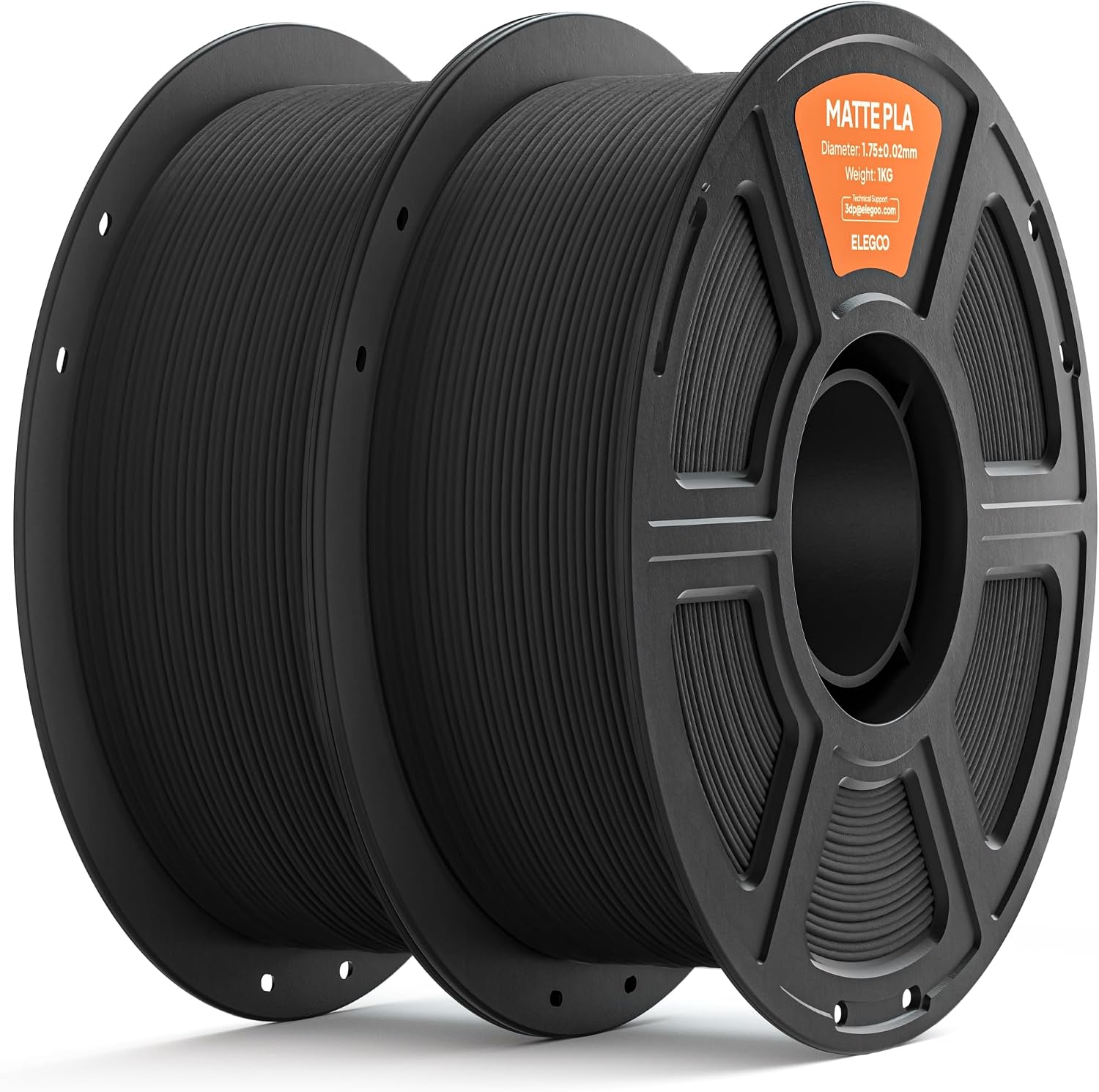
ELEGOO Matte PLA Filament (1.75mm) in Black — 2×1kg spool set for most FDM 3D printers
Product description
What it is and why people buy it
ELEGOO Matte PLA is a 3D printer filament for FDM machines, aimed at prints that look tidy and a bit more “finished” than glossy materials. If you like the look of matte surfaces, it’s the kind of filament you’ll notice straight away: the layer lines are described as nearly invisible, and the texture is smooth with low gloss.
This isn’t a tool for one specific printer model, the listing positions it as widely compatible with most common 1.75mm FDM setups. In practice, that usually means it’s a sensible choice when you want a reliable everyday PLA for prototypes, display pieces, and functional parts that don’t need extreme thermal resistance.
What you’ll notice in real printing
On paper, the biggest practical selling points are consistency and how the spool feeds.
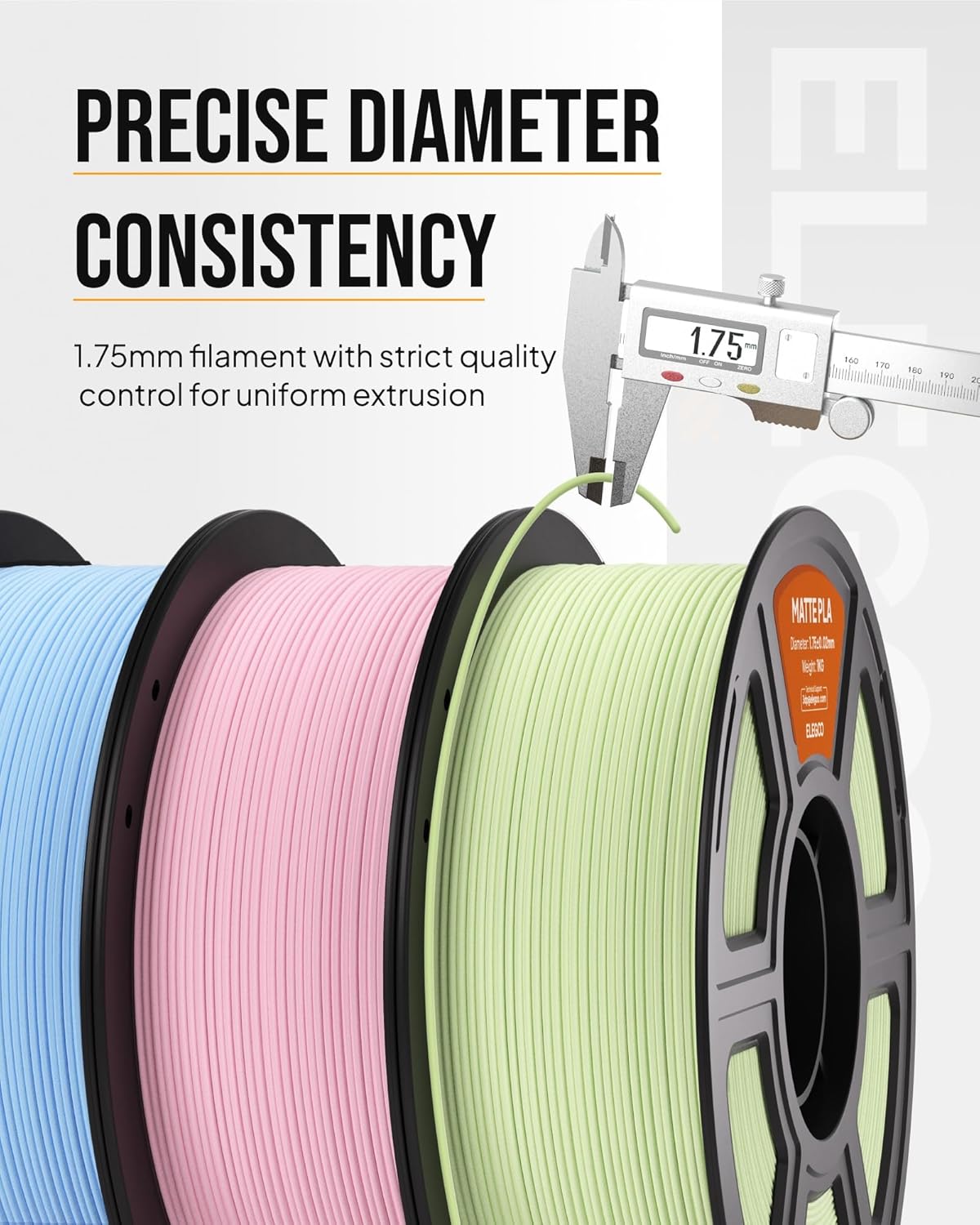
The manufacturer claims high-precision manufacturing and strict quality control to keep the filament diameter at 1.75mm consistently. That matters because inconsistent diameter can cause uneven extrusion, surface issues, or more fiddling than you want.
They also say each spool is neatly wound to help prevent tangling and feeding interruptions. If you’ve ever been interrupted mid-print by a snag or a hesitant feed, you’ll understand why that point is more than marketing.
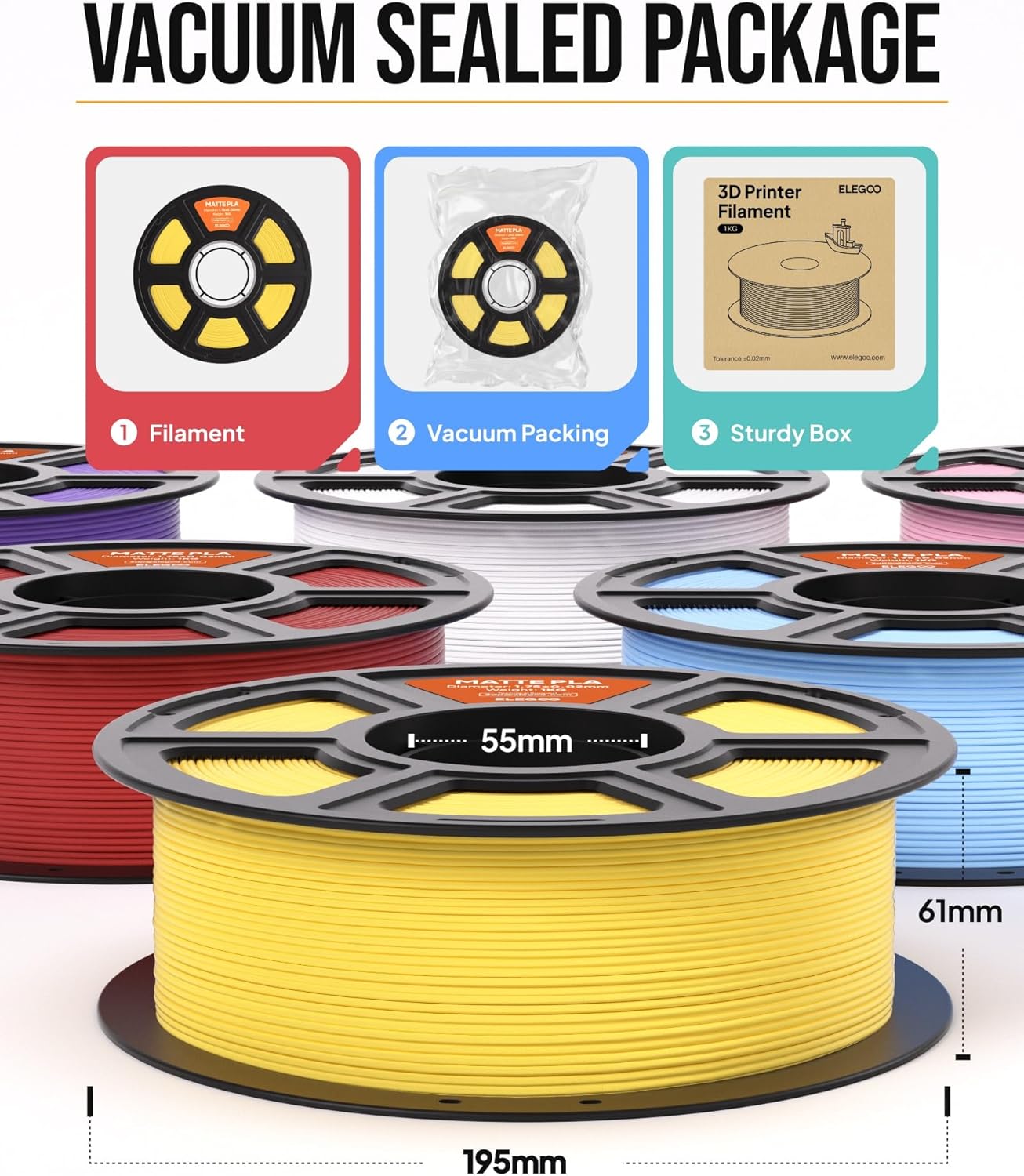
And for day-to-day reliability, it’s said to be thoroughly dried and vacuum-sealed before packaging to shield it from moisture—helping to prevent clogs and air bubbles while printing. Moisture control is one of those “quiet” factors that can make a filament feel far better than average.
Key points to consider (including a limitation)

Matte PLA can be a great visual finish, but it’s worth tempering expectations. Matte surfaces and low-gloss aesthetics don’t automatically guarantee “perfect” results in every environment—print quality still depends heavily on your machine, slicer settings, and how consistent your own process is.
Also, while the listing mentions wide compatibility, it doesn’t specify exact printer models, hotend types, or whether you’ll need to tune for your machine. So if you’re very sensitive to perfect first-layer behaviour, do plan for a bit of trial-and-adjust.
Compatibility and what “fits most FDM” really means
The filament is described as universally compatible with most common 1.75mm 3D printers. That’s helpful when you’re buying for a household workshop or a shared printer.
Still, “most” usually means the filament works as long as your printer uses 1.75mm PLA and standard FDM feeding—rather than a niche setup that needs a specific material profile. If your machine is unusual or you’re using a less common extruder/hotend arrangement, it’s sensible to double-check your printer’s filament size requirement before buying.
Material choice: where matte PLA makes the most sense
Matte PLA is typically a good match if you care about how parts look on the outside. With the claimed nearly invisible layer lines and low gloss, it suits items where you’ll see the surface: enclosures, decorative holders, prototype brackets, display parts, or any “show it off” prints where gloss would look off.
If your priority is maximum strength, long-term heat resistance, or industrial-style durability, PLA—matte or not—can be limiting compared with more purpose-built materials. So it’s best viewed as an approachable, reliable filament for general FDM printing rather than a material you’d choose to “max out” performance.
Pros and cons to weigh

What stands out from the listing - Matte finish with low gloss and smooth texture - Nearly invisible layer lines (as described) - Consistent 1.75mm diameter for more reliable extrusion - Neat winding to help avoid tangles and feeding interruptions - Vacuum-sealed after drying to reduce moisture-related issues
What could be less certain - The product is positioned for “most” compatible FDM printers, but no specific model guidance is provided - Like any PLA, print results still depend on your settings and your printer’s consistency
In the box and how you’d use it
You get 2 spools of 1kg each (2kg total). That’s a practical amount if you print regularly or want to keep one spool ready while you finish a larger project.
A simple example: imagine printing a matte black organiser tray. After slicing, you’d start with a few test layers to confirm adhesion and surface finish, then scale up. With the matte surface goal, you’d expect a cleaner look without shiny highlights—especially on flatter faces.
Mini FAQ
How does matte PLA compare to shiny PLA?

The key difference here is the surface look. This filament is described as matte with low gloss and a smooth texture, aiming for nearly invisible layer lines.
Is this filament suitable for most 1.75mm FDM printers?
The listing says wide compatibility with most common 1.75mm 3D printers. As always, the safe check is that your printer accepts 1.75mm filament for FDM use.
Does moisture matter with PLA?
It can. The listing specifically claims the filament is dried and vacuum-sealed before packaging to help prevent clogs and air bubbles.
What’s the benefit of neat winding?
Neat winding is meant to reduce tangling and feeding interruptions, which can be a real-world pain point during longer prints.
Is black a good choice for hiding layer lines?
Black can help visually, but the listing also claims nearly invisible layer lines. So it should work well if you want a cleaner matte look rather than high-gloss surfaces.
When it makes sense
If you want matte, low-gloss results and you care about consistent filament diameter for dependable extrusion, ELEGOO Matte PLA is a solid purchase candidate—especially with the vacuum-sealed approach and the promise of smooth feeding.
It’s not the best fit if you need material performance beyond what PLA typically offers, or if you require very specific printer/hotend guidance that isn’t covered in the listing. If your printer is standard 1.75mm FDM, though, this looks like a sensible everyday black PLA to keep in rotation.