

3DHoJor PLA Pro 1.75mm Filament (Light Blue) – 1kg cardboard spool, vacuum sealed for most FDM printers
Product description
If you’re shopping for PLA, it’s usually not just about getting something to print once—it’s about repeatable results. The 3DHoJor PLA Pro focuses on fewer tangles and less clogging, plus a finish that’s meant to look smooth and stable.
On paper, it leans into practical printing: a 1.75mm PLA Pro for many FDM machines, with a recommended nozzle range and bed temperature band included. That makes it easier to slot into your existing setup—though of course, real-world tuning still matters.
The essentials
This is a PLA Pro filament for FDM 3D printers, supplied on a cardboard spool and packed in a vacuum-sealed bag with a desiccant. The main selling points in the provided info are “clog-free & less-tangle”, higher strength/toughness versus standard PLA, and low odour / non-toxic positioning based on its corn grain origin.
You can think of it as a middle-ground PLA: not a “toy budget” filament, but also not presented as a specialist engineering polymer. If your goal is clean-looking prints with decent layer adhesion, it fits the usual PLA use cases—prototypes, functional-ish parts, and everyday models—while aiming to reduce common frustrations like tangling and inconsistent extrusion.

It’s also worth noting that even with good filament, prints depend on your printer, hotend, and profile. So if you’re expecting zero calibration ever, you may be disappointed. The product gives starting ranges, but you’ll still want to dial things in.
What stands out in real printing
The two areas you’ll likely notice first are how the filament behaves and what the surface looks like.
The description highlights full mechanical winding and manual examination to avoid tangling, overlap, and clogging. In practice, that matters if you’ve ever had a spool that snags mid-print or feeds unevenly—especially on longer runs. Less-tangle claims are never a guarantee, but the intent here is clearly to make spool feeding more reliable.
On output quality, it’s presented as delivering a smooth, stable surface finish, with low shrinkage and strong layer adhesion. Again, “strong” and “low shrinkage” are comparative statements, not tested guarantees in the info you provided. Still, if you’ve struggled with warping or weak bonds in PLA-like materials, it’s the right direction to look.

Temperature guidance (and where it can fall short)
The info includes nozzle and bed temperature recommendations:
- Nozzle: 210℃–230℃ (recommended 215℃)
- Bed: 45℃–60℃
That’s helpful because many PLA purchases leave you guessing. If your printer profile is already close to these ranges, you’ll have less trial-and-error before prints start looking right.
Where this can get tricky is if your machine uses different temperature behaviour or has a hotend that runs hotter/colder than expected. The PLA Pro temperature band is broad enough to allow adjustment, but it still means you may need to tweak—particularly first-layer settings—before you judge print quality.
Compatibility & printer fit
The listing states it’s compatible with most FDM 3D printers, specifically mentioning a range of popular models (including Bamboo Lab X1/X1C, Creality K1/K1 MAX, AnkerMake M5, Voron 2.4, Prusa, UltiMaker, Flashforge, Raise3D, Ender 3 / Ender 3 Pro, Anycubic Mega Pro, and more).
So if you’re using a mainstream FDM machine and already run PLA regularly, it should be a straightforward swap in terms of setup. That said, “compatible with most” still means it’s not automatically ideal for every edge case—like unusual extruders, non-standard hotends, or setups that strictly require alternative filament handling.
It makes sense if your priority is easy adoption: you already have PLA settings, you want fewer spool issues, and you’d like better toughness than basic PLA.
Strength, toughness and layer adhesion

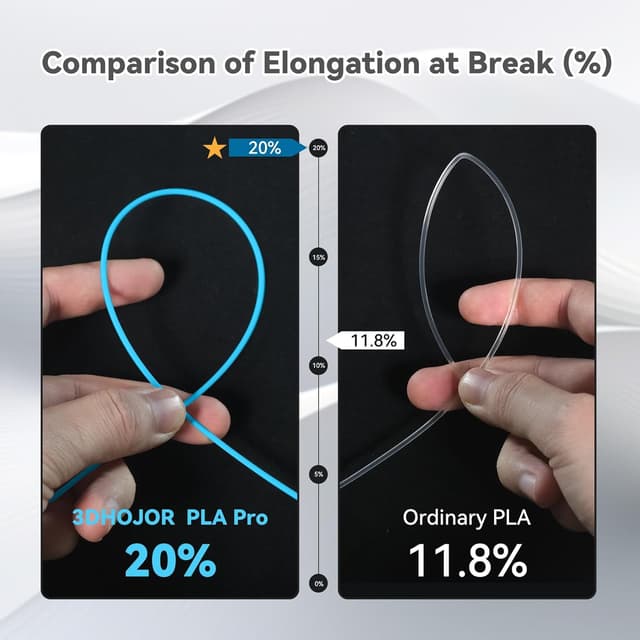
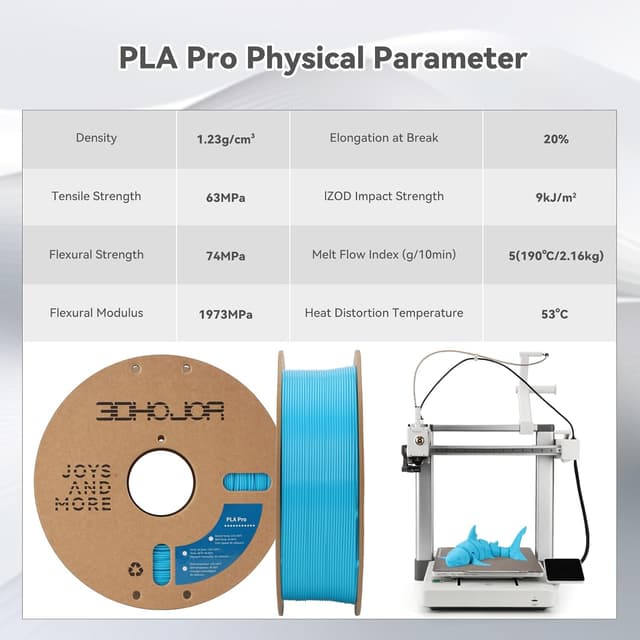
The description claims higher strength and better toughness than PLA, plus high purity and high precision, low shrinkage, and strong layer adhesion.
That combination is the sort of thing people look for when they move beyond decorative prints and start making parts that need to handle normal stress—clips, brackets, mounts, and repeat-use prototypes. It’s not positioned as a premium “must-have” for high-load engineering, but it does sound more confidence-inspiring than plain PLA if you want parts that feel less brittle.
Where you should stay realistic: material claims don’t replace your slicer choices (wall thickness, infill pattern, print orientation) or post-processing if you need extra durability. If you’re trying to “outsmart” poor design with material alone, it might not deliver the outcome you hoped for.
In the box and storage notes
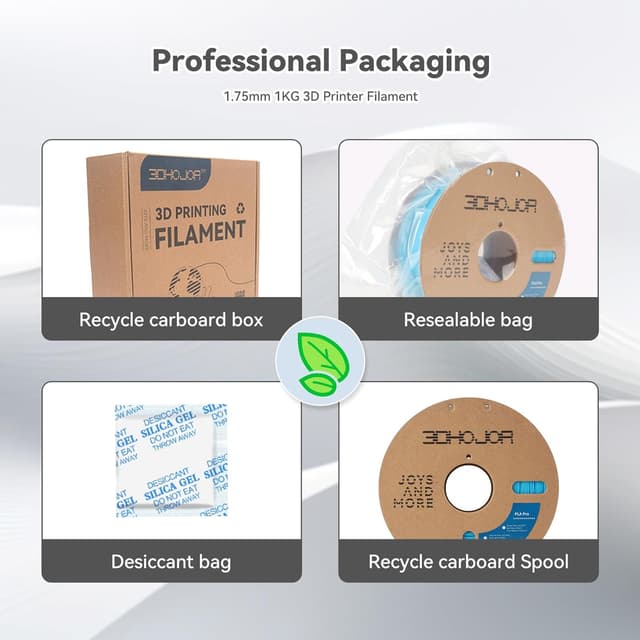
You get a 1kg filament on a cardboard spool, supplied in a sealed vacuum bag with a desiccant. This is the sort of packing that can help with moisture control before you start printing.

For best results, you’ll want to keep the filament protected when it’s not in use. PLA-based filaments can be sensitive to humidity over time, the vacuum-sealed packaging is helpful, but it’s still worth treating it like normal filament storage rather than leaving it exposed.
Key takeaways for buyers
Is it worth it? If you want a 1.75mm PLA Pro that’s aimed at fewer tangles and less clogging, with a smoother surface and a more robust feel than typical PLA, this is a solid candidate to consider.
Should you buy it? It makes sense if your printer is FDM-based and you’re happy to work within the nozzle/bed ranges provided (especially around the recommended nozzle temperature). The vacuum-sealed bag is a practical bonus when you’re opening filament infrequently or you’re in a more humid environment.
It may not suit you if you’re chasing a single-step “print perfect every time” filament without any tuning, or if you’re expecting a specialist engineering performance that goes beyond PLA-style behaviour.
Mini FAQ
Is this filament suitable for most FDM printers?
The listing says it’s compatible with most FDM 3D printers and explicitly names a variety of common models.
What temperatures should I start with?
The provided guidance is 210℃–230℃ for the nozzle (recommended 215℃) and 45℃–60℃ for the bed.
Will the vacuum-sealed packaging help keep it dry?
It comes in a vacuum-sealed bag with a desiccant bag to help prevent moisture and dust before printing.
Does it print without clogging and tangles?
The description claims clog-free and less-tangle behaviour through winding and examination, but no filament can be guaranteed to be flawless in every setup.
What makes PLA Pro different from basic PLA?
According to the listing, it’s positioned as having higher strength and better toughness than PLA, with low shrinkage and strong layer adhesion.