

Svbony SV220 nebula filter 1.25-inch
Product description
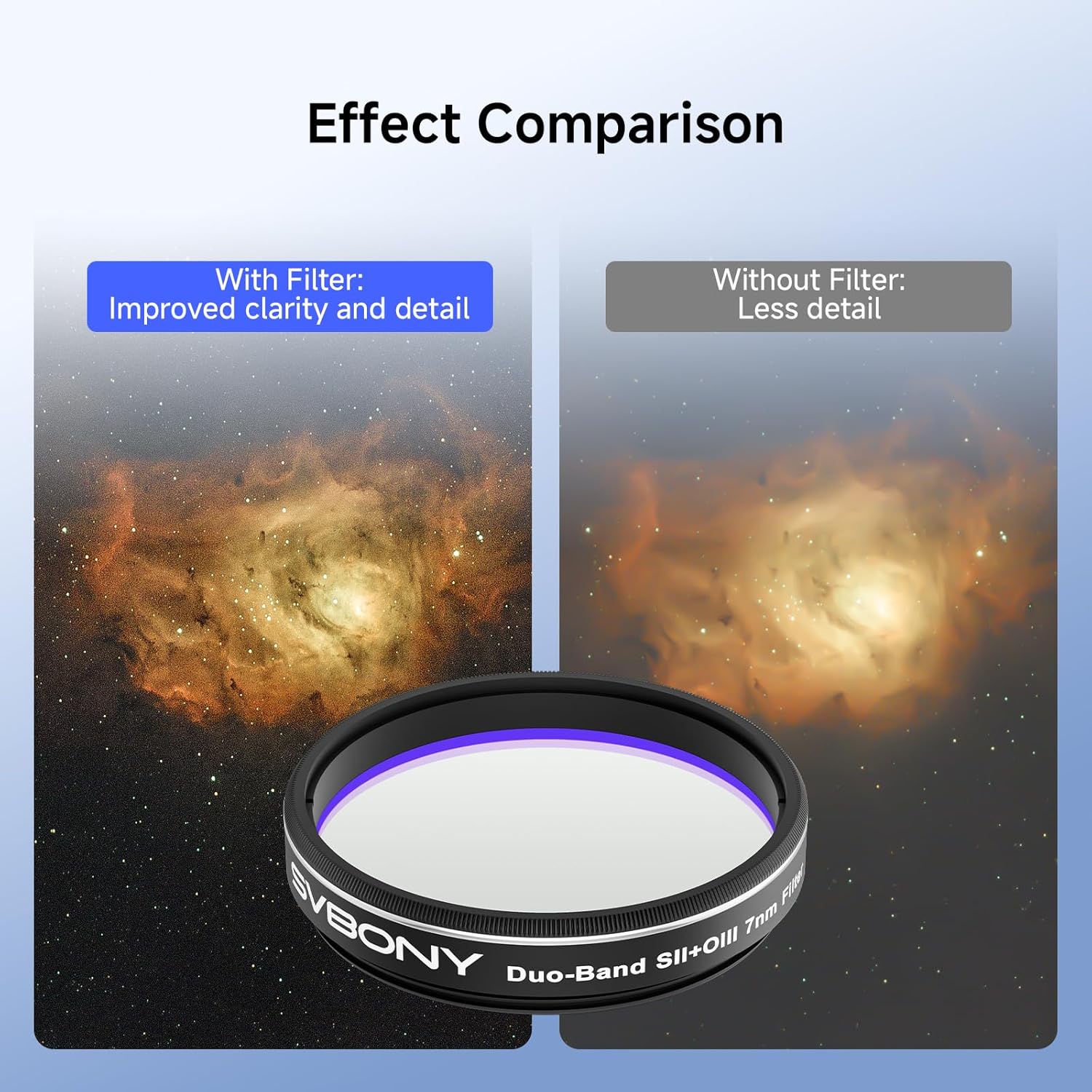
If you image emission nebulae under light-polluted skies, the Svbony SV220 SII and O-III telescope filter is built to help you separate the signal you want from the background you do not. This 1.25-inch dual-band filter targets the SII and OIII emission lines to improve contrast, support clearer nebula structures, and reduce skyglow and stray illumination for cleaner capture. It is designed for narrowband imaging rather than visual use, so it works best when your workflow is focused on camera data and processing.
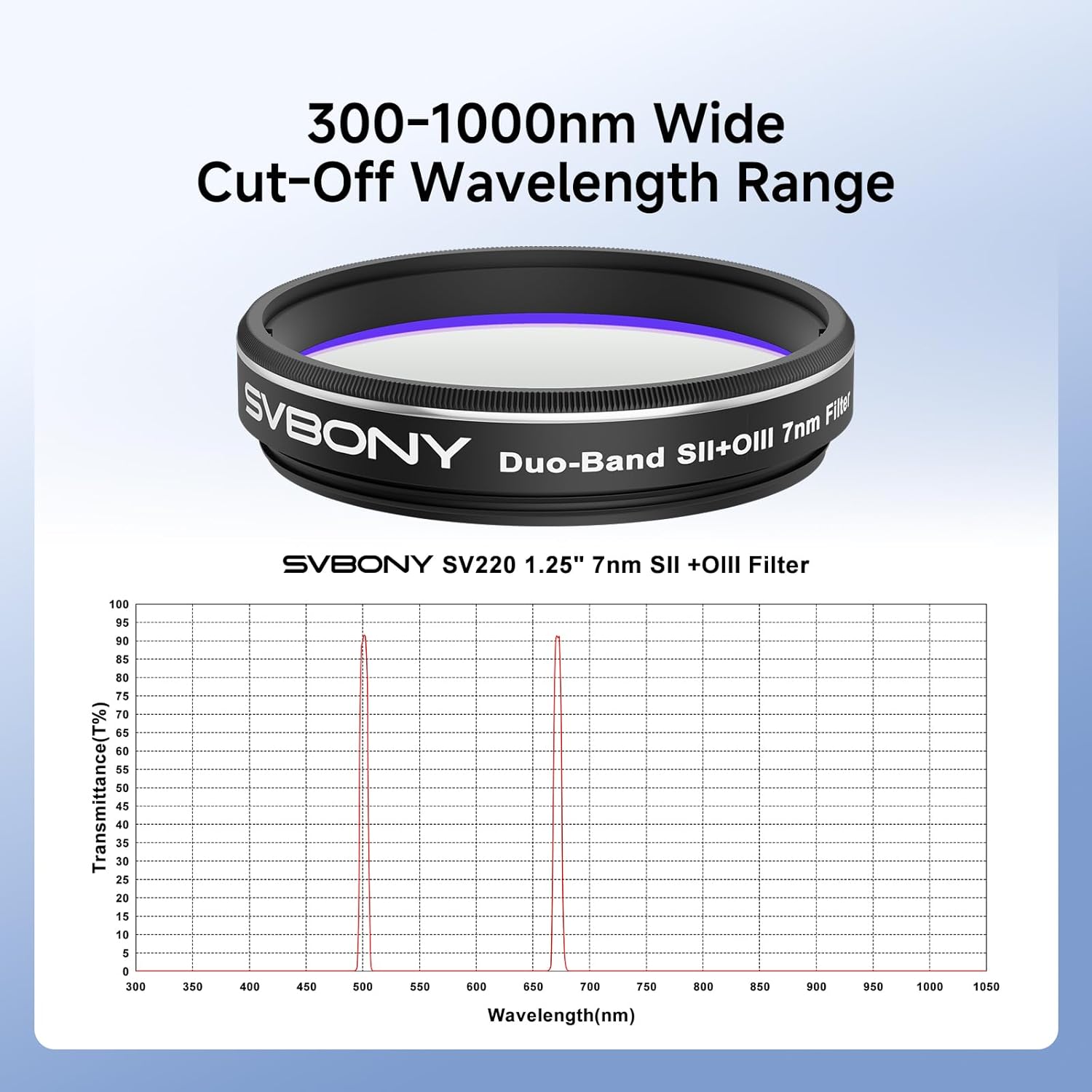
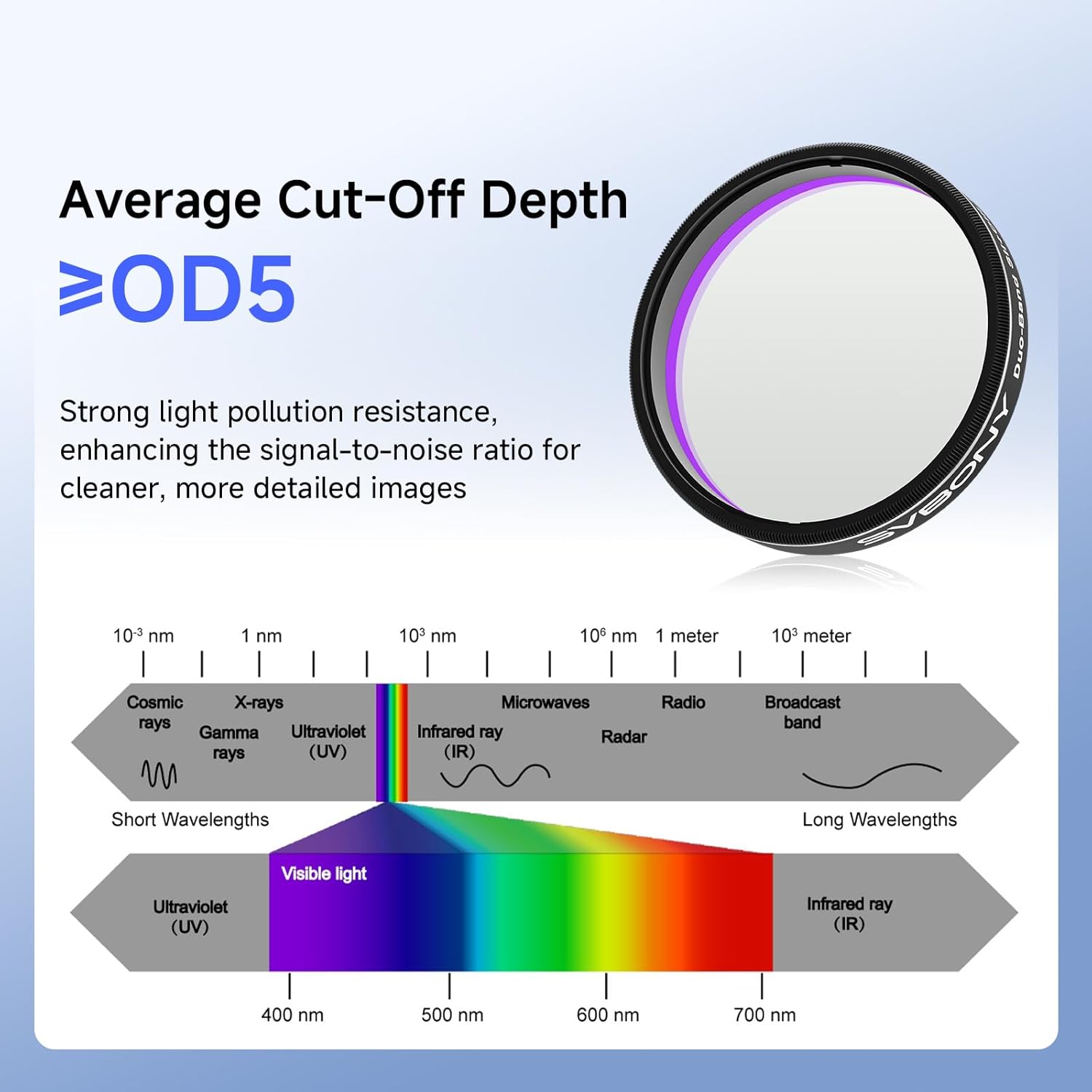
The SV220 is a dual-band SII and OIII filter using a precise 7nm bandwidth, which means it aims to isolate those specific wavelengths around 672nm for SII and 500.7nm for OIII. According to the manufacturer, it blocks over 99.999% of unwanted light, using an average cut-off depth of at least OD5. The result is a darker background in your frames, making faint emission details easier to pick out, even when the local sky is far from ideal. 🌌
It is also tuned for real-world imaging convenience. With a dual-band design, you avoid multiple filter swaps when you want to work with both SII and OIII in the same session. The manufacturer also states the filter has peak transmission of 88% or more at SII and OIII, helping you keep usable light throughput while still narrowing the bandpass. ✨
Key features
The SV220 filter is a narrowband telescope accessory that targets SII and OIII, two of the most useful emission lines for nebula imaging. The 7nm dual-band bandwidth is the core of the approach, narrowing what reaches the sensor so your data can focus on those spectral signatures. This is particularly helpful when you are trying to reveal fine structures in nebulae rather than simply record a bright overall glow.
According to the manufacturer, the filter blocks a very large share of unwanted light, aiming to eliminate skyglow and stray illumination for ultra-clean data capture. In practice, that supports higher contrast imaging and can help reduce how much of the final result is dominated by the night sky. It is a straightforward way to make your imaging workflow more consistent when you cannot control where you observe.
There is also a strong emphasis on transmission. The claimed peak transmission of at least 88% at SII and OIII is intended to maximise the useful signal while still applying the narrow 7nm bandpass. If you are using an optical setup that already gathers plenty of light, that matters because it helps you keep the nebula contrast without starving your exposure.
Tech specs
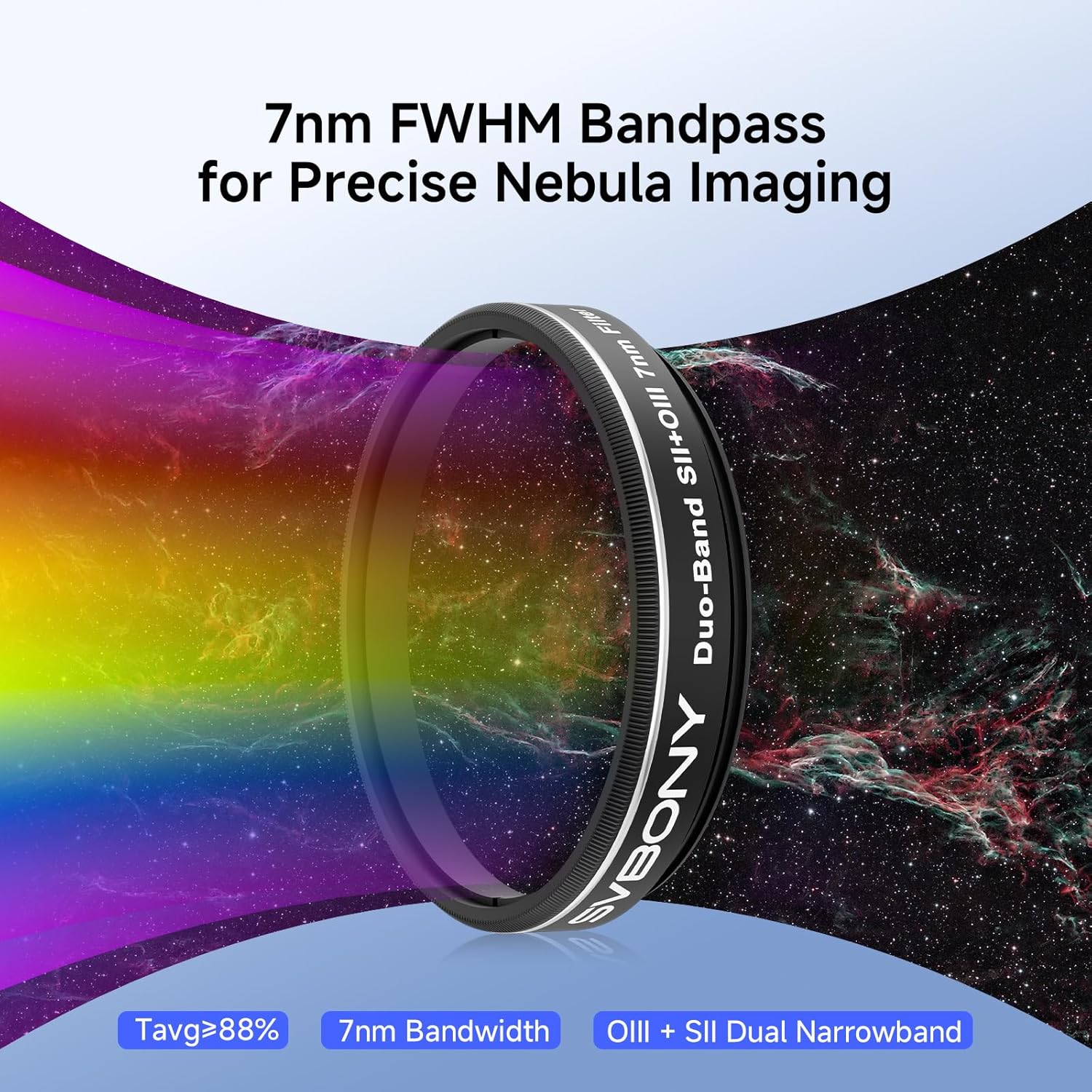
- Name: Svbony SV220 telescope filter, SII and OIII 1.25 inch
- Type: Nebula narrowband filter
- Format: Dual-band SII and OIII
- Size: 1.25 inch
- Resolution: 7nm bandwidth
- Material: Optical filter glass
- Dimensions: 26mm effective aperture
What matters most
The SV220 is described as a filter intended for imaging, not for visual observation, and the manufacturer specifies compatibility with imaging optical systems from f/4 and slower. This helps you avoid mismatches in performance if your telescope is outside that range. If your setup is visual first, or if your optics are faster than the stated guidance, it may not be the best fit for your aims.
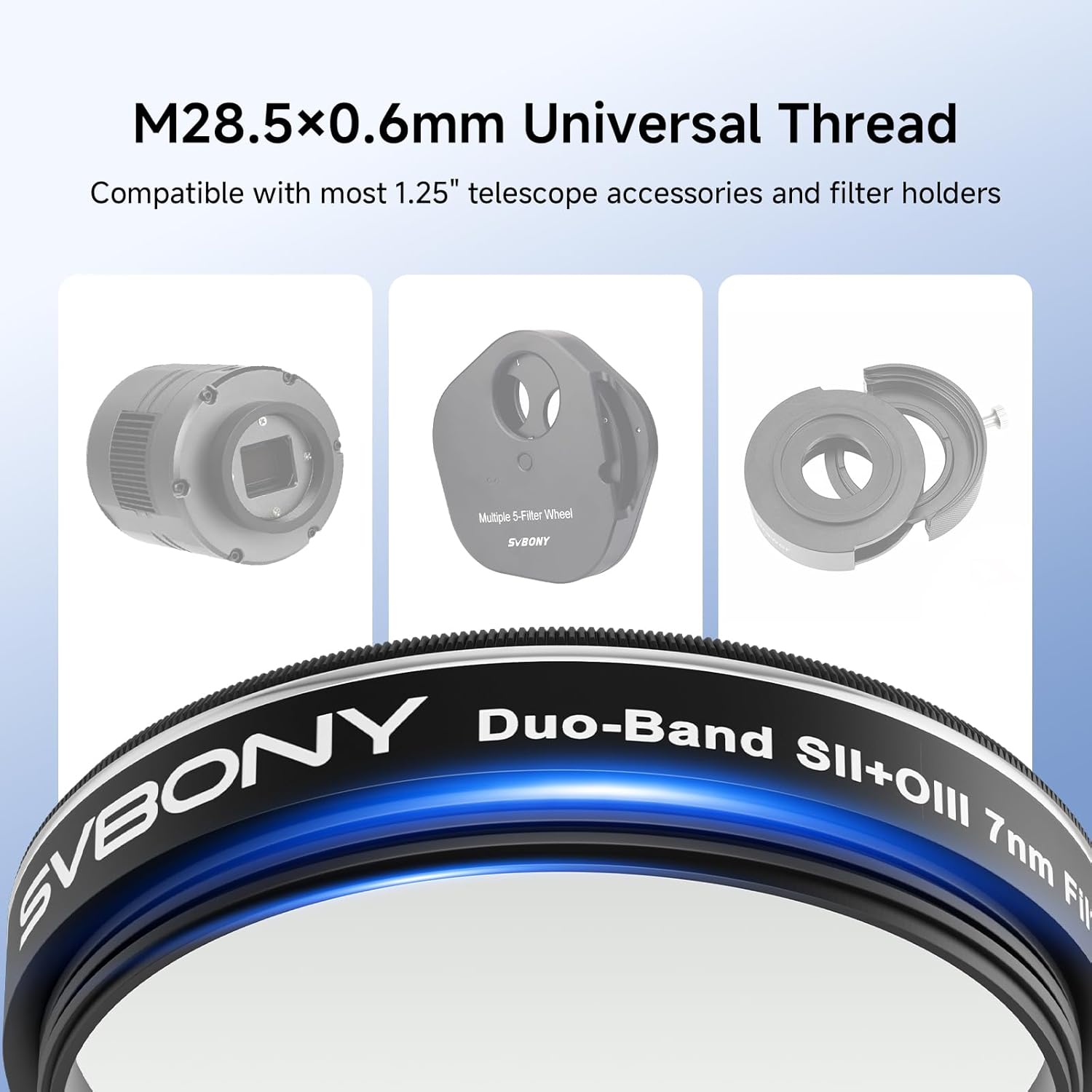
Another practical detail is the thread standard. The SV220 uses an M28.5×0.6mm universal thread, which is meant to be compatible with a wide range of telescopes and optical systems. That makes it easier to integrate into common imaging trains, provided your filter holder accepts that thread size. For many astrophotographers, that reduces friction compared with solutions that require extra adaptors.
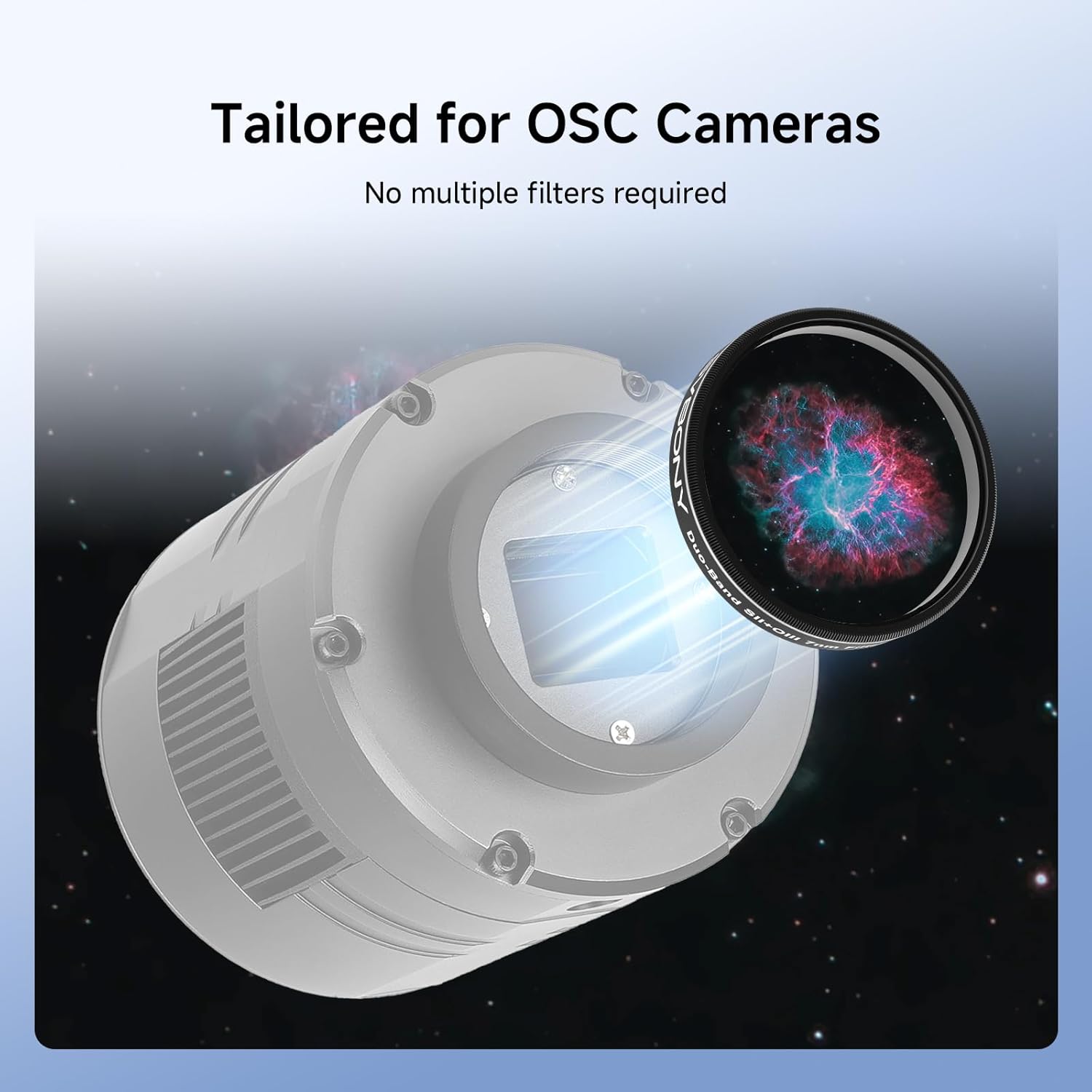
There is also an emphasis on camera pairing. The manufacturer highlights it as optimised for one-shot colour cameras, focusing on capturing SII and OIII lines precisely while supporting SHO style colour balance without needing multiple filter swaps. If you are imaging with an OSC setup in light-polluted skies, this design goal directly matches that workflow. 📷
Who it’s for
It’s a good fit if you regularly shoot emission nebulae and you want to reduce light pollution while keeping the key SII and OIII signals. It makes sense if you use a one-shot colour camera and prefer a dual-band approach that avoids swapping filters mid-session. You’ll like it if you are comfortable with a narrowband imaging accessory where contrast and background reduction are priorities.
It might not suit you if you need this for visual observing, since the manufacturer states it is not designed for visual use. It may not be a great match if your optical system is outside the stated recommendation for imaging from f/4 onwards.