


Set a Target Price: The UK “Price‑Watch” Method for Online Deals
A practical UK guide to saving online with price alerts, wishlists and target prices—plus real trade-offs so you know when to buy and when to wait.
Most online “bargains” aren’t found by luck. They’re found by having a target price and a simple way to spot it when it appears — without living on deal pages all day.
This is the UK-friendly “price‑watch” method: set what you’re willing to pay, track a product across the retailers you’d actually buy from, then decide quickly when the price dips (or when waiting is riskier than buying).

The core idea: you’re not chasing a deal — you’re waiting for your price
A discount only matters if it beats the price you’d happily pay today. That sounds obvious, but it’s why people overspend during big events like Black Friday or the January sales: the headline offer feels urgent, even if it’s not the right product or the right terms.
A target price is personal. It’s based on:
- Your time (are you happy to wait two weeks, or do you need it for a weekend?)
- Your risk tolerance (do you care if a popular item sells out?)
- The total cost (delivery fees, returns hassle, accessories you’ll need anyway)
In the UK, where many prices are displayed VAT-inclusive, the “true” cost often comes down to the boring bits: delivery options, return rules, and whether you’ll end up buying a necessary add-on elsewhere.
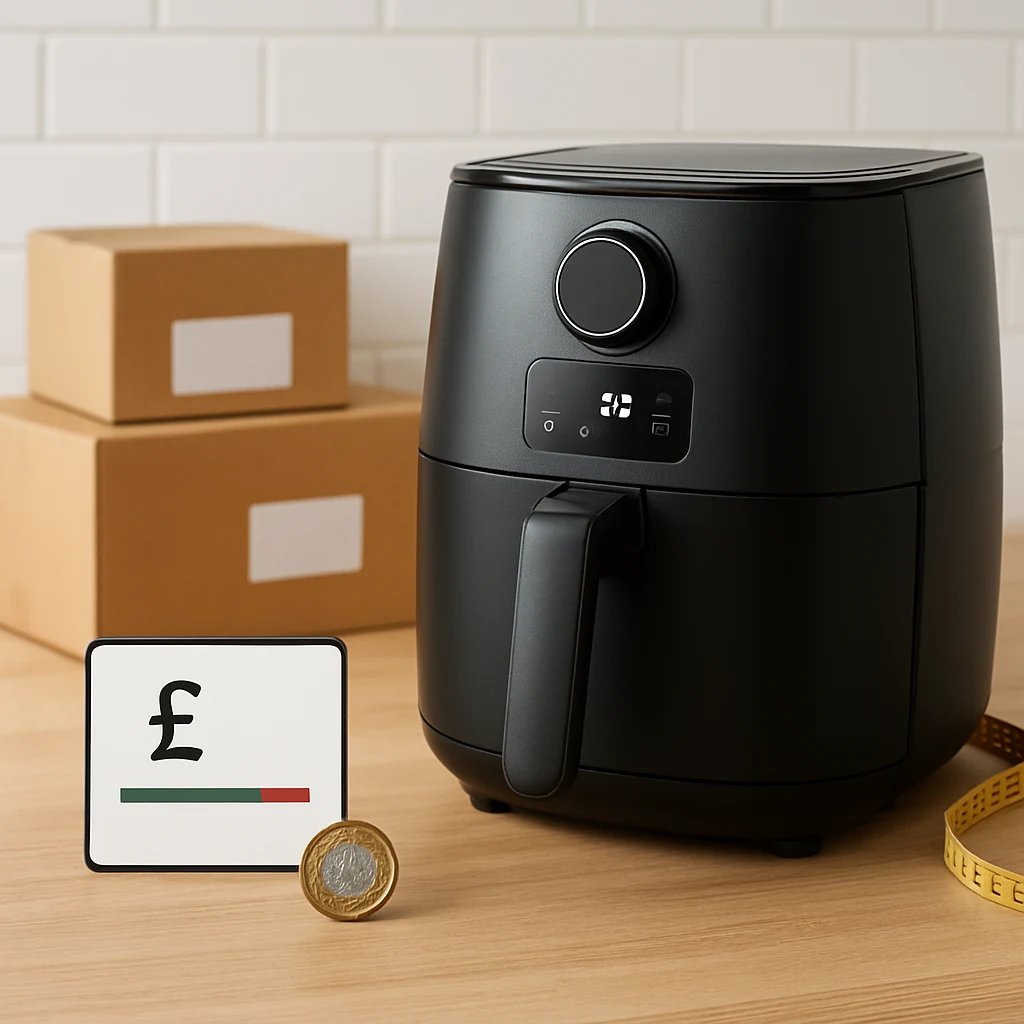
Case 1: You want an air fryer — but you don’t want “deal regret”
You’ve picked a model (or at least the size and features you want), and you’re seeing constant “limited-time” discounts. Here’s a calmer way to handle it.
Step 1: Choose your acceptable sellers before you see the discount
This is where people get caught. The cheapest price might be on a marketplace listing with unclear returns, slow delivery, or awkward warranty support.
Decide now whether you’re happy buying from:
- A major UK retailer (straightforward returns, clearer delivery slots)
- The brand’s own shop (sometimes better warranty handling; sometimes worse delivery)
- A marketplace seller (potentially cheaper; more variation in service)
Trade-off: More sellers = more chances of a lower price, but it can also mean more work checking delivery, returns and who you’re actually buying from.
Step 2: Set your target price in GBP — and write it down
Not “as cheap as possible”. A number.
A simple way: decide what you’d pay today for the exact model, delivered, then knock a bit off as your “I’ll buy immediately” price.
Step 3: Track it in two places, not ten
You don’t need five different browser extensions. You need a reliable alert and a quick way to sanity-check.
A good UK setup is:
- One price comparison site (to scan multiple retailers)
- One retailer wishlist/basket (so you can buy fast when it hits your price)
If you use a comparison tool, keep an eye on whether it’s showing the exact same model (capacity, bundle, colour, updated version). “Looks identical” is where overspending starts.
Step 4: When the price drops, check the “deal friction”
Before you checkout, ask:
- Is delivery still fast enough (or has the cheaper option pushed you to a week)?
- Are returns realistic for you (collection, drop-off, repackaging)?
- Is it actually in stock, or “available to order” with vague dispatch dates?
Trade-off: A slightly higher price from a retailer with painless returns can be the real bargain if there’s any chance you’ll send it back.
Case 2: Trainers you’ll wear weekly — when “wait for a voucher” can backfire
Footwear is where the price-watch method needs a twist, because sizes disappear.
You’ve found the exact trainers and colourway you want. The best price might arrive later… but your size might not.
The decision point: is it size-sensitive?
If it’s a common model and the retailer has plenty of stock, waiting for a code can work. If it’s already low-stock in your size, waiting can mean paying more later or settling for something you didn’t want.
A practical UK approach
Instead of “waiting for a sale”, you can:
- Add them to your basket at two retailers you trust
- Check whether either offers Click & Collect (useful if delivery dates drift)
- Sign up for back-in-stock notifications (more useful than generic newsletters)
If a voucher code appears, great — but don’t treat it as guaranteed. Many codes exclude popular brands, or only apply above a minimum spend.
Trade-off: Buying now at a fair price can beat waiting for a discount that never applies to the item you actually want.
Case 3: A games console or in-demand gadget — don’t confuse “bundle maths”
With high-demand items, “discounts” often show up as bundles rather than a clean price drop. That can be genuinely good value — or a way to shift accessories you don’t need.
How to do the bundle check quickly
Ask yourself two questions:
- Would I buy these extras at full price?
- If I remove the extras mentally, is the base item still a good deal?
If you wouldn’t buy the add-ons anyway, the bundle isn’t “saving” you money. It’s spending money in a nicer-looking way.
Also, watch for the hidden cost: bundles can be less flexible for returns. If you only want to return one item, you might be forced to return everything.

The “quiet savings” people miss: timing around UK return windows
Even when you’re not writing a full-on deal calendar, it helps to remember how shopping behaviour changes in the UK.
Around Christmas, many retailers extend return periods. That can make buying slightly earlier a sensible move if:
- You’re gifting (you want the recipient to have a realistic chance to return/exchange)
- You’re buying something you might keep if it fits/works, but you’re not 100% sure
The flip side: in major sale periods (think Black Friday through Cyber Monday, then Boxing Day and January), you’ll sometimes see stricter terms on certain lines, or slower delivery due to volume.
Trade-off: A better returns window can be worth more than an extra few pounds off — especially for clothes, shoes, and bulky home items.
A simple way to spot a fake “drop”: compare the delivered price
A common trap is celebrating a price drop that’s really just a shift in fees.
Before you commit, compare:
- Item price
- Delivery cost (including any free-delivery threshold you’re being pushed towards)
- Any paid membership requirement (if it’s the only way to get the advertised delivery speed)
If you’re using multiple retailers, keep the comparison consistent: same delivery speed, same returns convenience, same payment method.
What about voucher codes — should you still try them?
Yes, but treat them as a final polish, not the main plan.
The price-watch method works even if codes fail, because your decision is based on a target price, not on the thrill of a code box.
When codes do help in the UK, it’s often in these situations:
- Retailers offering a first-order discount (useful if you genuinely plan to keep buying there)
- Category-specific promos (home, beauty, seasonal gifting)
- Basket-threshold offers (only if you already needed the extra items)
If a code pushes you to add unnecessary items “to qualify”, it’s usually not a saving.

FAQs
Does price tracking work across all UK retailers?
It depends. Some comparison sites cover lots of mainstream retailers; others focus on certain categories. For marketplaces, the seller can change, which makes “the same listing” hard to track properly. That’s why it’s worth picking a few trusted sellers and tracking those consistently.
Should I wait for Black Friday or just buy now?
If you need the item soon, buy at a price you’re comfortable with from a retailer you trust. If it’s a “nice to have”, set a target price and let alerts do the work. If you want a broader seasonal view, start from the deal timing guides on the homepage (/), but keep your target price as the deciding factor.
How do I avoid buying the wrong version of a product?
Be picky with model numbers, sizes and bundles. If the price seems unusually low, double-check specs (storage size, generation, accessories included). The cheapest option is often a different variant.
Is it worth switching retailers to save a few pounds?
Sometimes. But factor in delivery speed, return convenience, and whether you trust the retailer to sort issues quickly. A small saving can vanish the moment you have a problem.
The one action to take today
Pick one item you genuinely plan to buy this month, set a realistic target price in GBP, and create two watchpoints: one comparison alert and one saved basket with a trusted retailer. Then stop browsing and wait for your number.
You may also be interested

The UK Wishlist Method: Plan Your Next Online Deal (No Panic Buying)
A practical UK step-by-step guide to saving online by setting target prices, tracking drops, and buying at the right moment—without falling for “was/now” hype.
Marketplace vs Retailer: How UK Shoppers Pick the Real Deal
A practical UK guide to choosing between marketplaces and direct retailers—price, delivery, returns, warranty and hidden costs—so the ‘deal’ stays a deal.
After You Buy: UK Tricks to Save with Price Drops & Returns
A practical UK guide to saving after checkout: price-drop checks, delivery refunds, returns timing and safe ways to re-order for less.