

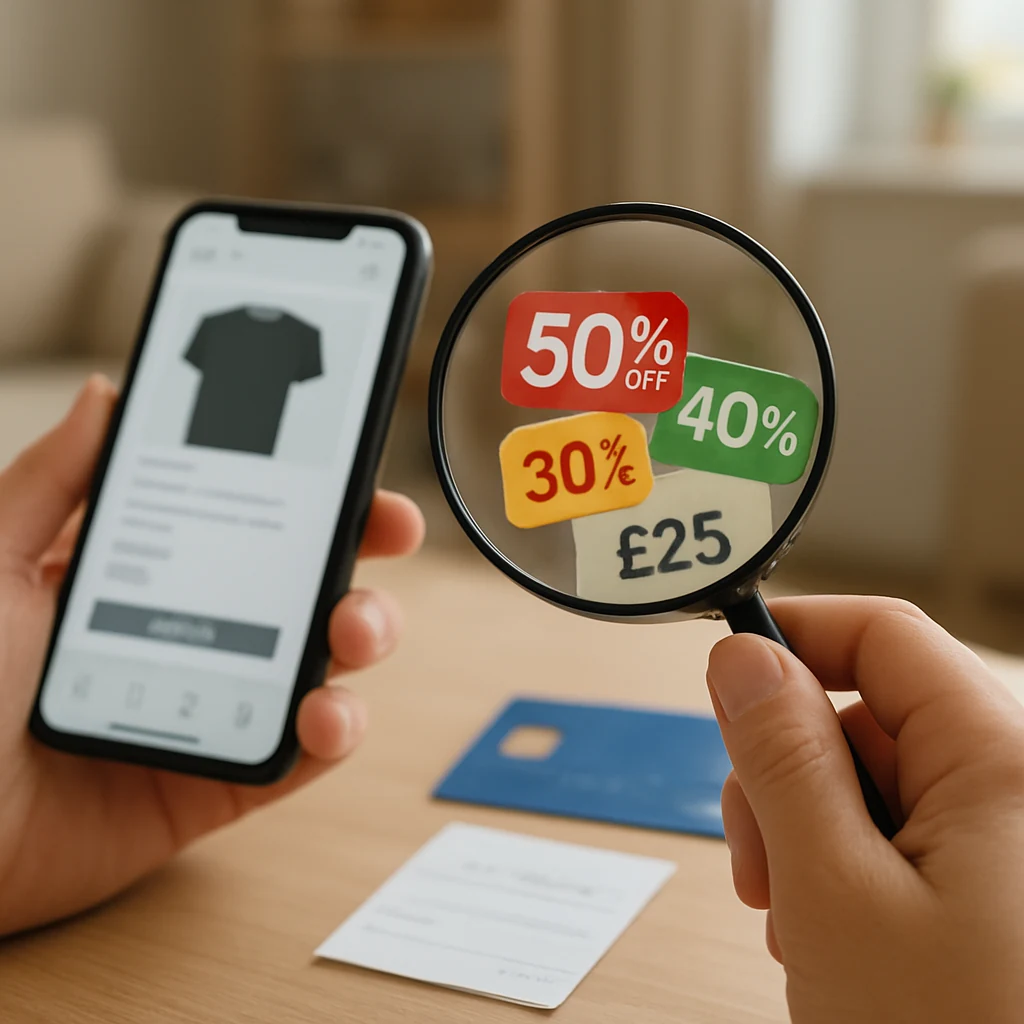
How to Spot a Genuine UK Online Deal (and Avoid “Was £X” Traps)
A practical UK guide to verifying online discounts: price checks, model-number tricks, retailer legitimacy and smarter timing for real savings.
Online deals in the UK can be brilliant — and also a bit… theatrical. One minute you’re seeing “was £199, now £99”, the next you’re wondering why every retailer magically had the same “previous price” last week.
This guide is about saving money without getting lured into a discount that isn’t really a discount. Think of it as deal due-diligence: quick checks that take minutes, but can save you the hassle (and cost) of a poor buy.
1) Start with the real question: “Is this the best price — or just the best headline?”
A big percentage off is only useful if the starting point was realistic. In the UK you’ll often see “RRP” used as the anchor price, but RRP isn’t the same as “what people actually pay”. Some products spend most of the year on “promotion”, so the “full price” exists mainly to make the sale look dramatic.
Why this matters: it’s the easiest place for marketing to mislead without technically lying.
When to use it: any time you’re tempted by a large “was/now” label (especially around Black Friday, Cyber Monday, and the January sales).
What to do: check at least one independent comparison (Google Shopping, a well-known comparison site, or a couple of competing retailers) and look for a consistent “normal” price. If the item is “always on sale”, treat the “was” price as background noise.
2) Compare by model number, not by product name
Retailers sometimes list a product with a slightly different name, bundle, or code so it’s harder to compare like-for-like. This is common for tech, small appliances, and TVs.
Why this matters: a “unique” listing can dodge price-matching, confuse comparison tools, and make a deal look exclusive when it’s not.
When to use it: higher-ticket items (phones, headphones, laptops, air fryers, cordless vacs) and anything with multiple variants.
Look for the model number in the specs (often tucked away under “Product details” or “Technical specification”). Copy/paste that into search. If a retailer doesn’t show a model number at all, that’s not automatically bad — but it does make it harder to verify the deal.
3) Watch for bundles that hide the true cost
A “bundle” can be excellent value (extra controller, case, cartridges, accessories) — or it can be a way to make a standard price look like a special offer.
Why this matters: bundles are harder to compare, and they can include low-value extras you didn’t want.
When to use it: consoles, beauty sets, coffee machines (pods), printers (starter ink), and subscription-linked gadgets.
Do a quick mental split: what would you pay for the main item alone, and would you buy the extras at all? If not, don’t let the bundle dictate your decision. You’re not saving money if you’re paying for clutter.
4) Check the seller — not just the website
UK shoppers increasingly buy from marketplaces (even inside big-name sites). That means the “retailer” you think you’re buying from may not be the business actually fulfilling the order.
Why this matters: returns, warranties, and even whether the item is genuine can depend on who the seller is.
When to use it: any marketplace listing, refurbished goods, and “too good to be true” prices.
Before you buy, look for who the order is sold by and who it’s dispatched by. If it’s a third-party seller, do a quick sense-check: are there clear UK contact details, an address, and a proper returns policy? If it’s vague, overly generic, or hard to find, that’s a sign to pause.
If you want more UK-focused buying tactics (without the nonsense), you can always browse the latest guides from the homepage: Home.

5) Spot “freshly inflated” prices (especially around major sale events)
The UK has predictable deal seasons — Black Friday/Cyber Monday, Boxing Day and the January sales, Spring/Easter promos, Bank Holiday events, back-to-school, and summer events like Prime Day-style promotions.
But here’s the catch: some prices quietly rise before the “discount” is applied.
Why this matters: you can end up paying the same as last month while feeling like you’ve won.
When to use it: the week before a major sale event, and during fast-moving “flash deals”.
If you don’t have time for deep research, do a quick two-step check: (1) compare with at least one other mainstream retailer, (2) search recent prices using a reputable tool or by checking cached listings and recent reviews mentioning price. You’re not looking for perfection — just enough evidence that the deal is genuinely better than normal.
6) Read the small print on “from £X” and “up to Y% off” claims
“From” and “up to” can be technically true while being practically irrelevant. The best discount might apply to one unpopular colourway, a single size, or an accessory no one buys.
Why this matters: it stops you chasing a deal that doesn’t exist for the version you actually want.
When to use it: fashion, trainers, mattresses, and anything with lots of variants.
Click through to your exact size/colour/spec and look at the price there — not the headline. If the “deal” disappears when you choose a standard option, that’s your answer.
7) Consider refurbished, open-box, and “graded” items — but verify the grading and warranty
Refurbished can be one of the most reliable ways to save without relying on seasonal sales. In the UK, many retailers and manufacturer outlets sell refurbished items with a clear condition grade.
Why this matters: the best value is often “lightly used” with a proper warranty, not “brand new” at a token discount.
When to use it: phones, tablets, laptops, headphones, consoles, smartwatches, and premium appliances.
Make sure you understand:
- what the grading actually means (cosmetic marks vs functional issues)
- what’s included (charger, cables, original box)
- the warranty length and who provides it
If the listing is woolly on any of the above, it’s safer to skip — or at least price it as a gamble.
8) Don’t let urgency override your rights (and your common sense)
Timers, “X people are viewing”, “only 2 left”, and “deal ends soon” are classic pressure tactics. They can be legitimate (stock does run out), but urgency is also a conversion tool.
Why this matters: rushed purchases are where you overpay, buy the wrong model, or miss a better option.
When to use it: any time you feel hurried, especially during big sale events.
A quick reset: if the deal vanishes, there will be another. The goal isn’t to “win” today — it’s to pay a fair price for the right item.
Here are a few red flags worth taking seriously:
- the retailer has no clear UK returns information or contact details
- the product page lacks a model number/specs for something that normally has them
- the discount is huge, but other reputable retailers are nowhere near that price
- the listing heavily pushes urgency but is thin on details

9) Make sure the “total price” is the price you’re comparing
Even with VAT normally included in UK consumer pricing, totals can still vary because of delivery charges, paid membership perks, or optional add-ons that appear late in the journey (insurance, extended warranty, “priority handling”).
Why this matters: comparing item prices without comparing totals can make a mediocre deal look like the cheapest.
When to use it: bulky items, same-day/next-day delivery temptations, and retailers that push add-ons.
You don’t need to get deep into checkout (and you shouldn’t feel forced to). Just get far enough to see delivery costs and whether the price depends on joining something.
10) Decide your “good deal” threshold before you browse
This sounds basic, but it’s the most powerful habit for saving money online: decide what you’re willing to pay before you see the marketing.
Why this matters: it reduces impulse buys and makes it easier to walk away from fake bargains.
When to use it: whenever you’re shopping for wants rather than needs — and for anything you could delay until the next sale cycle.
Pick a number you’d be happy with, then go hunting. If you hit it, buy. If you don’t, wait. It turns deal-hunting into a plan instead of a mood.
FAQ: quick UK deal-checking answers
Are “RRP” discounts in the UK reliable?
They can be, but they’re not a guarantee of value. RRP is often a suggested price rather than a widely paid price. Treat it as a reference point, then verify against real-world pricing.
Is it safer to buy from the marketplace seller or the platform?
It depends. Buying directly from the platform/retailer can simplify returns and support, but third-party sellers vary wildly. Always check who is actually selling and dispatching the item.
Do bigger sale events always mean the lowest prices?
Not always. Big events can bring genuine bargains, but they also bring more “noise”: inflated reference prices, bundles, and urgency tactics. Some of the best value can appear outside the headline events, especially for refurbished and last-season stock.
How many comparisons do I really need to do?
For small buys, one quick comparison can be enough. For anything expensive, check at least two sources and confirm the exact model number.
Your next action (takes 3 minutes)
Before you hit “Buy now”, do this once: copy the model number, compare the total price at two other UK retailers, and double-check who the seller is. If the deal still looks strong after that, you can buy with confidence — and without the “was £X” theatre.
You may also be interested

The UK Wishlist Method: Plan Your Next Online Deal (No Panic Buying)
A practical UK step-by-step guide to saving online by setting target prices, tracking drops, and buying at the right moment—without falling for “was/now” hype.
Marketplace vs Retailer: How UK Shoppers Pick the Real Deal
A practical UK guide to choosing between marketplaces and direct retailers—price, delivery, returns, warranty and hidden costs—so the ‘deal’ stays a deal.
After You Buy: UK Tricks to Save with Price Drops & Returns
A practical UK guide to saving after checkout: price-drop checks, delivery refunds, returns timing and safe ways to re-order for less.