

How to Stack Cashback, Gift Cards & Points on UK Online Buys
A practical UK guide to stacking cashback, discounted gift cards and reward points online—without voiding returns or missing the best price.
Most people hunt for a voucher code and call it a day. In the UK, the bigger wins often come from stacking small, legitimate savings that don’t feel like “extreme couponing”: cashback, discounted gift cards, rewards points and the right payment method—while keeping returns and VAT pricing in mind.
What does “stacking” savings actually mean in the UK?
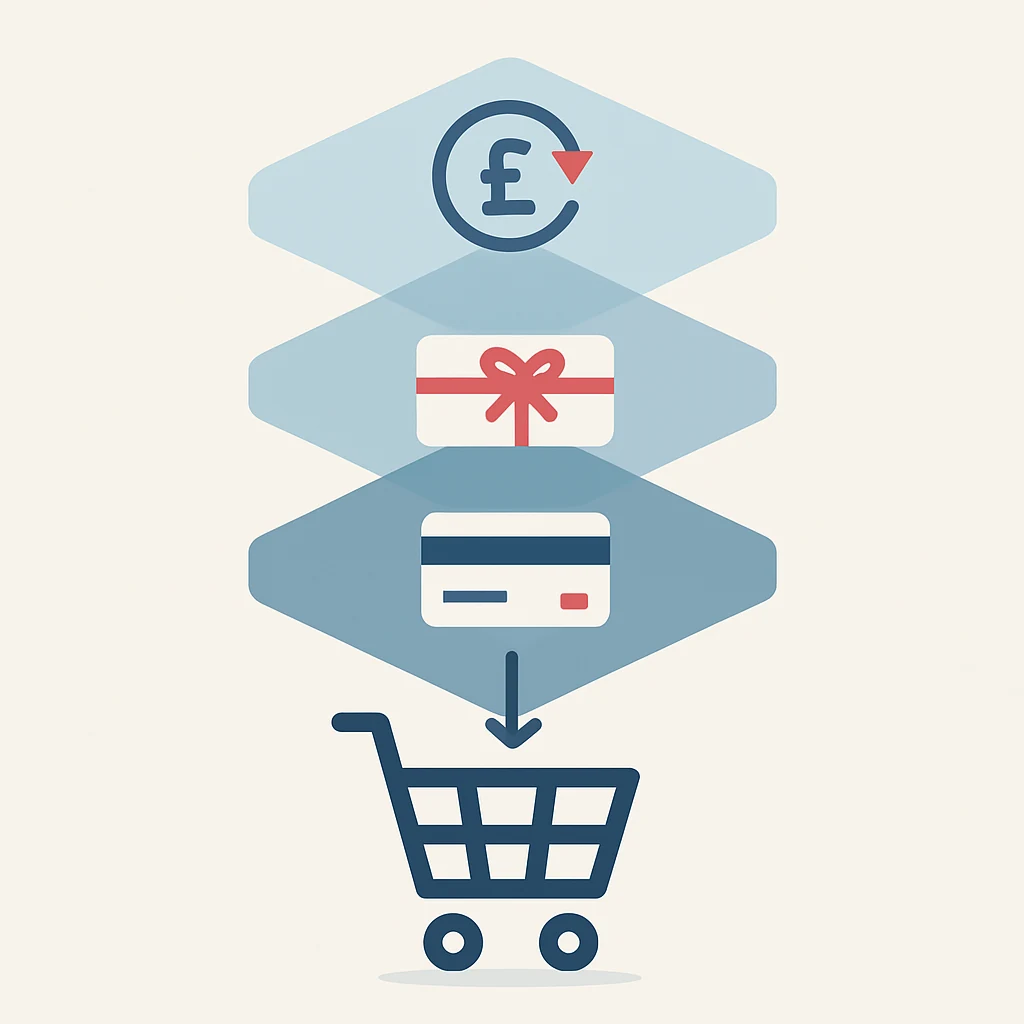
Stacking is simply using more than one saving method on the same purchase—as long as the retailer’s terms allow it. Think: you click through a cashback site, pay with a discounted gift card, and still collect points on your debit/credit card.
The key is being realistic: not every retailer lets everything combine, and some savings methods can cancel others. The goal isn’t to force it; it’s to know the clean combinations that usually work.
Which savings stack is the safest for everyday UK online shopping?
If you want a stack that’s generally low-faff and low-risk, it’s this: cashback + discounted gift card + card rewards.
Here’s the simplest order to try (and the only list you’ll need):
- Start with a tracked click from a cashback site or loyalty portal.
- Add a gift card at checkout (if the retailer accepts partial or full payment by gift card).
- Pay the remainder by card that earns points or cashback (or pay fully by card if no gift card).
- Only then try a voucher code, because codes sometimes overwrite tracking.
This isn’t about being “clever”; it’s about avoiding the common mistake of applying a random code and accidentally losing cashback.
Do voucher codes always break cashback tracking?
Not always, but it’s common enough that you should assume some codes will.
A practical approach is to treat voucher codes as “approved” or “unapproved”:
- If the cashback site lists specific codes, those are more likely to track.
- If you paste in a code from a forum or an extension, it might still work—but it can also invalidate cashback.
If the saving from the code is clearly better than the expected cashback, you might decide it’s worth it. If it’s only a small saving, you may prefer the certainty of tracked cashback.
Are discounted gift cards worth it if I might return the item?
They can be, but returns are where gift cards get annoying.
In the UK, if you pay with a gift card and then return, you’ll often be refunded back to a gift card or store credit (sometimes split across payment methods). That’s fine if you shop there regularly; less fine if it’s a one-off purchase.
A good rule of thumb is: use discounted gift cards for retailers you’d happily buy from again (think everyday essentials, popular fashion chains, homeware, or big marketplaces). For one-off purchases, you may prefer a stack that keeps refunds simple.

Will paying by gift card affect my consumer protection?
It can, depending on how you do it.
If you rely on credit card protections for higher-value items, be mindful that paying entirely by gift card may remove some of the protections you’d otherwise have from paying directly by credit card. Many shoppers solve this by paying at least part of the transaction by credit card where the retailer allows split payments—while still using a gift card for the bulk.
This isn’t legal advice, and rules depend on the exact payment setup, but it’s worth considering before you stack gift cards on expensive tech, flights or high-ticket items.
What about buying through a supermarket or rewards portal—does that stack too?
Yes, sometimes. Some UK loyalty schemes and employee benefit platforms offer “click-through” shopping or gift card top-ups. The practical question isn’t “can I stack everything?” but “which layer is the best one to prioritise today?”
Ask yourself:
- Is today’s offer better as cashback (money back) or as points (future value)?
- Are you likely to use the points soon, or will they just sit there?
- Does the portal explicitly say it works alongside other discounts?
If you’re trying to keep it simple, stick to one “portal layer” per order (one cashback click-through OR one rewards portal), then add the gift card/payment method layer.
Do I need to worry about VAT and pricing when comparing deals?
For typical UK consumer shopping, most prices you see are VAT-inclusive. That’s helpful, but it can still mislead comparisons when:
- Delivery charges are added late in the checkout.
- The “from” price is based on a different variation (size/colour) than the one you actually want.
- Bundles include services you don’t need (warranties, subscriptions, add-ons).
So when you compare deals, compare the true delivered price for the exact item and the delivery option you’d choose.
If you want a quick habit: before you pay, screenshot (or save) the basket page showing item price + delivery + any discounts applied. It’s handy if something changes or a refund doesn’t match what you expected.

Why do some cashback claims fail—and how do I prevent it?
Cashback tracking isn’t magic; it’s basically a chain of referrals that can break.
Common UK-friendly fixes include:
- Don’t open fifteen tabs and bounce between apps. Click through and complete the purchase in one go.
- Be careful with “helpful” browser extensions that inject codes or switch affiliate tracking.
- If you’re using a price comparison site, decide which route you care about more: the tracked cashback route or the comparison route.
If you’re shopping on mobile, consider whether the retailer’s app behaves differently. Sometimes buying in-app won’t track the same way as a browser purchase.
When is stacking most useful in the UK shopping calendar?
Stacking shines when “headline discounts” are either limited or confusing.
- Spring bank holidays and early summer promos can be light on outright price cuts, so cashback/gift cards fill the gap.
- Back to school shopping often has lots of near-identical listings (uniform bits, stationery, laptops). Stacking helps even when prices are similar.
- Black Friday/Cyber Monday is the classic time, but it’s also when voucher codes and tracking get messy. Having a simple stacking order keeps you sane.
- Boxing Day/New Year sales can be brilliant for clearance, but sizes/stock move fast—so having gift cards ready can speed up checkout.
This approach also works outside the big moments: anytime you’re buying something boring-but-necessary online, stacking can quietly do the job.
Is it ever better not to stack?
Yes. Don’t stack just because you can.
If a retailer is offering a strong direct discount and you might need an easy return, it may be better to:
- skip gift cards so refunds go straight back to your bank/card,
- skip unverified voucher codes so you don’t lose tracking,
- focus on buying the right item from the right seller with sensible delivery and returns.
Saving money is great, but not if it costs you an hour chasing a missing cashback claim for a few quid.
How can I build a “default setup” so I’m not reinventing the wheel each time?
A practical setup is less about tools and more about a routine:
Keep one cashback account you actually use, one place you check gift card balance, and one notes page with retailers you buy from often. That way, when you spot a deal, you can act quickly rather than researching from scratch.
If you want more UK-focused deal guides and shopping strategy, start at the homepage and branch out from there: see the latest guides.
FAQs you’ll thank yourself for checking once
“Can I use a gift card and a voucher code together?” Often yes, but not always. Gift cards usually count as payment, while codes are discounts—yet some retailers restrict “promo codes” on certain items.
“Will I earn points if I pay with a gift card?” You’ll normally earn store points based on the purchase, but you won’t earn card points on the portion paid by gift card (because it’s not charged to your card).
“Should I pay for delivery or choose free delivery?” Choose the option that matches your needs. Free delivery can be slower; if you need it by a certain date (birthdays, bank holiday weekends), paying for a tracked/next-day service may prevent a last-minute panic buy.
“Is ‘buy now, pay later’ part of stacking?” It can be, but treat it cautiously. If it leads to missed payments or spending more, it’s not a saving. If you do use it, keep the repayment plan simple and avoid stacking it with impulse add-ons.
One action to take today
Pick one retailer you use regularly, then test a single clean stack on a small order: tracked click-through → gift card → card payment (and skip random voucher codes). Once you’ve seen it work end-to-end—including any returns—you’ll have a repeatable routine for the bigger buys.
You may also be interested

The UK Wishlist Method: Plan Your Next Online Deal (No Panic Buying)
A practical UK step-by-step guide to saving online by setting target prices, tracking drops, and buying at the right moment—without falling for “was/now” hype.
Marketplace vs Retailer: How UK Shoppers Pick the Real Deal
A practical UK guide to choosing between marketplaces and direct retailers—price, delivery, returns, warranty and hidden costs—so the ‘deal’ stays a deal.
After You Buy: UK Tricks to Save with Price Drops & Returns
A practical UK guide to saving after checkout: price-drop checks, delivery refunds, returns timing and safe ways to re-order for less.