


Atlasonix Domino Train for Kids — Automatic Domino Laying Toy Set (Montessori STEM)
Product description
What it is and why kids seem to stick with it
The Atlasonix Domino Train for Kids is an automatic domino-laying toy set designed to keep toddlers and preschoolers engaged while they build, steer, and reset their own domino runs. Instead of manually placing pieces one by one, the set is built around a mechanical train that lays straight lines on its own—so the “action” starts faster. That matters for younger kids, because boredom hits quickly when a setup takes too long.
On paper, it’s also positioned as a Montessori-style STEM toy: independent play, fine-motor practice, and logic/sequence thinking. The goal isn’t just entertainment—it’s getting kids to repeat patterns and experiment with what happens when they change the way they steer the run.
The fun you get (automatic lines + family-friendly play)
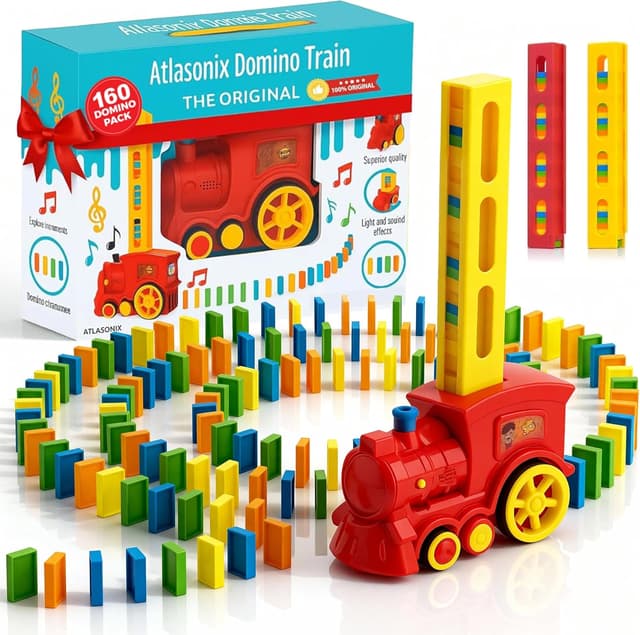
This toy is meant for extended family engagement. So if your kitchen-table play usually turns into “everyone wants a turn,” this is the kind of set that supports that. An adult can help with the first setup, then kids can run their own little domino show. And because it’s automatic, you’re not constantly redoing painstaking placements.
A simple example: imagine a toddler rolling the train along a path you’ve created with the included domino pieces. As it moves, it lays a neat line and triggers domino fall in sequence. After the excitement, they can try a new path, change the direction, or steer more carefully to see how the chain behaves. It’s the kind of loop—create, watch, adjust—that keeps play going.
Key learning angle (hand-eye coordination and basic logic)
The set is described as encouraging hand-eye coordination and logic, while promoting independent play and manual steering. That makes it a good fit if you want a toy that nudges problem-solving without turning into a complex engineering project.
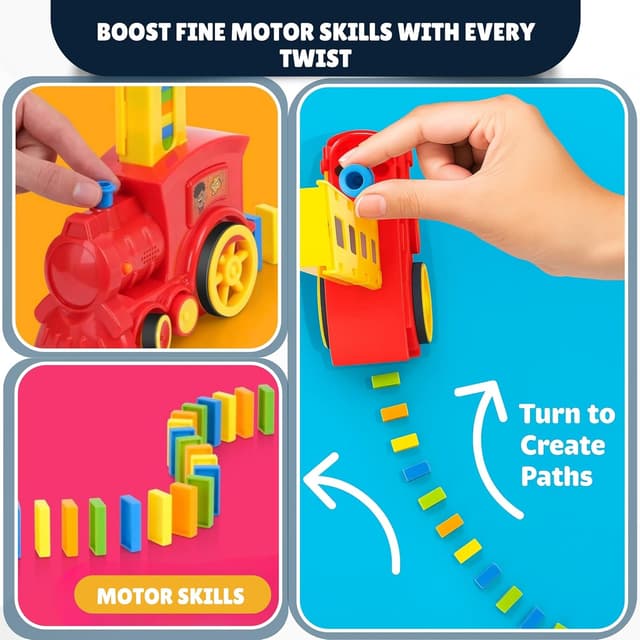
That said, it’s worth keeping expectations grounded: a domino chain toy can build early reasoning skills, but it won’t replace structured learning tools. It’s more about active play and repetition than “teaching in a classroom way.”
Ease of setup and what that means for real life
One of the biggest practical advantages here is the tool-free setup. The automatic domino train is designed to lay perfect lines automatically, using a reliable mechanical system for consistent performance.
If you’ve ever bought a toy that requires tools, extra parts, or a long setup—this is aiming to avoid that. Shorter setup time generally means more play sessions, and fewer “we’ll do it later” moments.

What stands out vs. more basic domino toys
Compared with basic domino sets where the main activity is manually placing each piece, this focuses on motion and steering. That can be a big difference for kids ages 3+ toddlers, who may not have the patience or precision for careful manual placement.
If you prefer a toy where the child controls the path and watches the result quickly, an automatic approach like this makes sense. If you want a quiet, hands-on building experience where every piece is placed deliberately by the child, you may find traditional domino sets more aligned with your goal.
Things to consider before buying
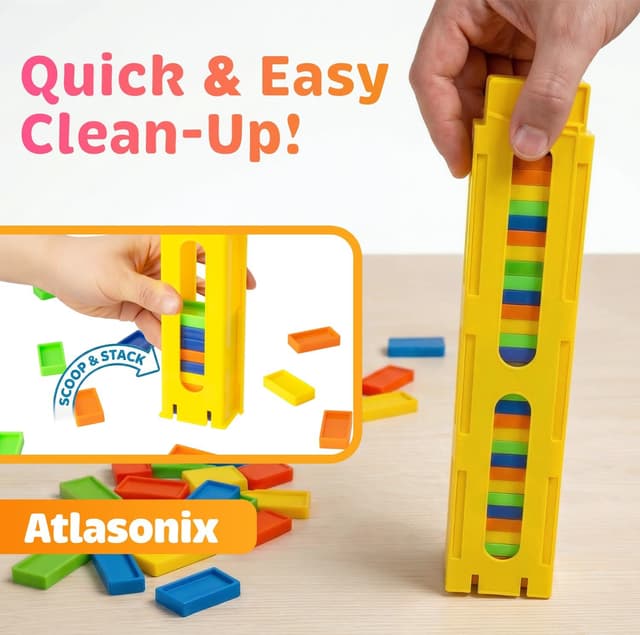
Safety and comfort are addressed in the description: smooth, non-toxic materials and child-safe dominoes. Still, as with any small-pieces toy, it’s smart to follow age guidance and supervise early use.
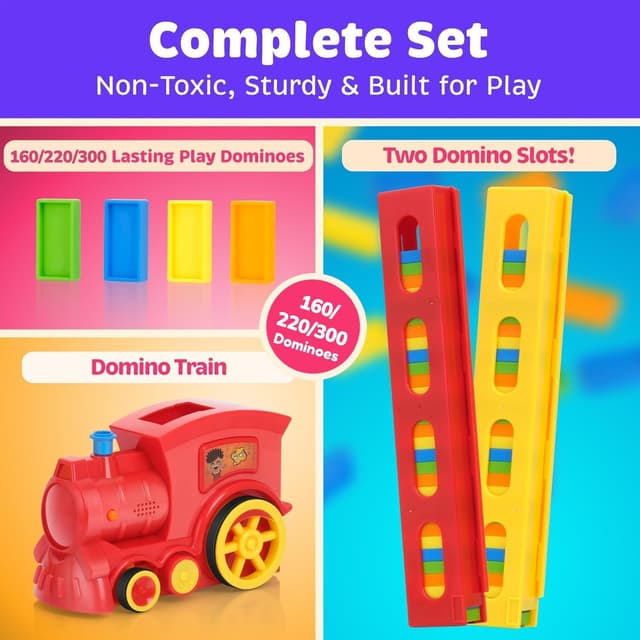
Also, while the set includes a large block count (given in the product title as 300, 220, 160 blocks), the exact configuration you receive isn’t detailed beyond that title wording. So it’s a good idea to double-check the listing’s specific variant before you assume you’re getting a particular number of pieces.
Quick FAQ
How old is it meant for?
It’s described as an independent skill development toy for 3+ toddlers.
Does it require tools to set up?
No—setup is described as instant and tool-free.
What skills does it target?

The product framing highlights hand-eye coordination, logic, independent play, and manual steering.
Is it designed for solo play or family play?
Both: it’s marketed as a toy that supports whole-family engagement while also encouraging independent play for kids.
Is it Montessori-style?
It’s described as a Montessori STEM toy that uses a hands-on approach to encourage learning through play.
Is it worth it?
Buy it if you want an automatic domino-laying toy that keeps toddlers engaged quickly, supports independent steering, and works well for shared family play. The tool-free setup and mechanical “perfect line” idea are especially appealing if you’re trying to reduce friction between “unboxing” and “actual fun.”
Skip it if you’re looking for a traditional domino set where the learning comes mainly from manually placing each piece, or if you need very specific piece counts/configurations without checking the listing variant first. It also may not be the best match if your goal is deep STEM problem-solving rather than repeatable, hands-on play.
For most families, this sits in the practical, play-first category: not a classroom tool, but a toy that tries to turn quick cause-and-effect into repeatable skills over time.