

Blue Marble National Geographic Junior Chemistry Set (50 Experiments) for Kids 4–6
Reviews
Price
Product description
What this is and what it’s meant to do
If you’re looking for a kid-friendly way to get into chemistry without turning your kitchen into a permanent science disaster, the National Geographic Junior Chemistry Set is built for that moment: the early “wait, how is that possible?” phase. This is a junior chemistry lab kit designed for kids starting around age 4, with a focus on hands-on experiments and simple, illustrated steps.
On paper, it’s positioned as a complete early learning lab setup. The kit emphasizes using common household items (the description calls out things like baking soda and vinegar) alongside a set of kid-appropriate lab tools. The promise is straightforward: kids can do experiments themselves, follow along easily, and build curiosity through repeatable activities.
Key points that matter before you buy
You’re mainly buying two things here: a batch of chemistry activities and the tools to run them.
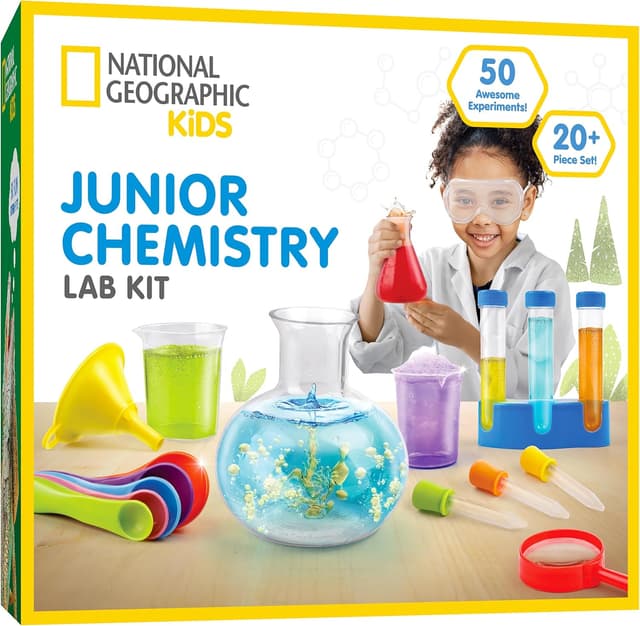
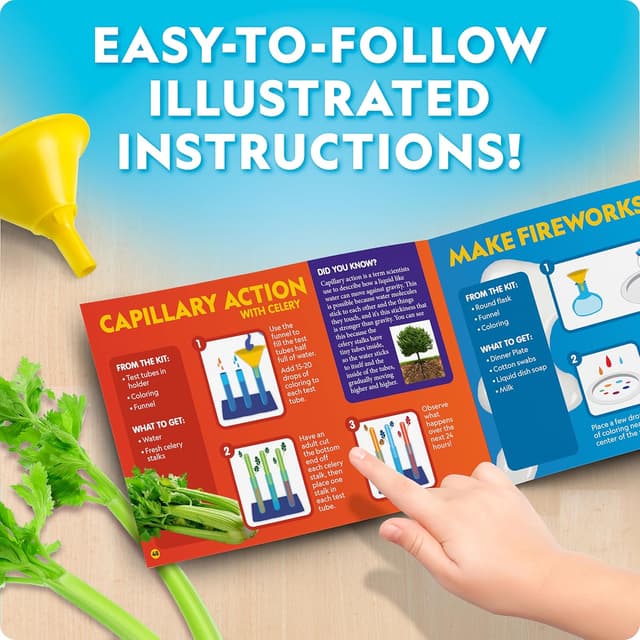
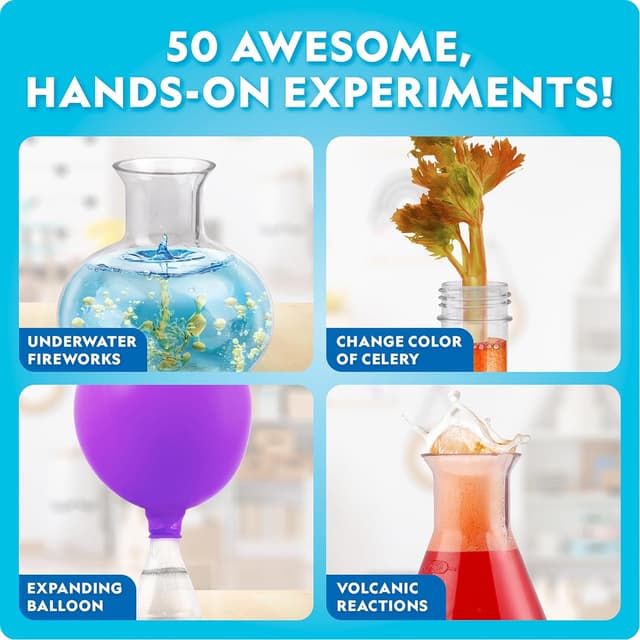
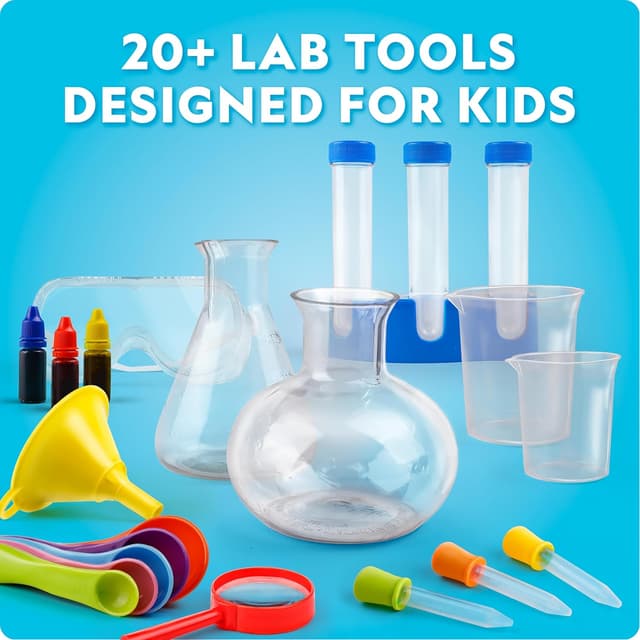
The set includes 50 science experiments, and each one is paired with illustrated, step-by-step instructions meant to be easy for young kids to follow. It also includes 20+ lab tools described as durable and safe for children, so the learning experience isn’t limited to “watching” or “doing one thing.” It’s meant to feel like a real mini lab.
That said, no kit is perfect for every home. For younger kids (especially around 4), you’ll likely want supervision—chemistry experiments can be exciting and messy, even when the tools are designed for kids. Also, the description doesn’t spell out every material or safety feature in detail, so it’s worth checking what the tools are made of and how the experiments handle liquids/containers for your specific household routine.
What you’ll notice in use (a practical example)
A typical early chemistry moment with a kit like this is repeating a reaction safely while the child follows the pictures rather than relying on complex reading. For example, the kit description specifically mentions baking soda and vinegar as household items you can use. In practice, that kind of “mix and observe” setup is exactly where illustrated steps shine: a child can match what they’re doing to the visuals, and you can focus on timing and cleanup instead of translating instructions.

If your goal is to get kids participating—measuring, pouring (with help), and observing outcomes—this kind of experiment-driven kit is easier than buying random science supplies one by one.
Lab tools and instructions: the real value
It’s easy for chemistry kits to be “mostly instructions” or “mostly tools.” This one is trying to be both. The inclusion of 20+ lab tools (described as kid-safe and durable) is important because it reduces friction: kids don’t need special equipment hunting, and you’re not constantly improvising with adult tools.
The illustrated instructions also reduce the learning curve. When steps are visual and sequential, younger kids can stay engaged longer. That matters because chemistry learning works best when the child can connect cause and effect—what changes after combining ingredients—without getting stuck at the reading level.
Awards and credibility angle (and a small reality check)
The brand behind this kit is Blue Marble, described as the winner of the Toy of the Year award from the Toy Association, and it also mentions an American support team. That kind of credibility can be a plus if you prefer educational toys with a track record.
Still, awards don’t replace fit. This set is for early learners (not advanced chemistry), and you should expect it to feel more like guided experimentation and curiosity-building than deep lab technique. If you’re trying to “teach chemistry” in a rigorous, curriculum-like way, this may feel more like an engaging starter than a full learning program.
Who it’s for—and who should skip it
It’s a solid pick if you want a complete junior chemistry kit for kids around 4–6, where the learning path is built around illustrated, step-by-step experiments and kid-appropriate tools. It also makes sense if your household has common pantry ingredients and you want experiments that can start quickly.
It may not suit you if: - you’re looking for advanced chemistry skills or more technical lab methods - you want a kit that’s fully independent for a 4-year-old (you’ll probably be supervising) - you prefer an ultra-minimal mess approach (any chemistry reaction can be a bit chaotic)
Quick overview of what to verify before purchasing
Before you commit, it’s worth checking the listing details for anything the base description doesn’t specify clearly—especially what the 20+ tools include exactly, how the experiments handle liquids and containers, and whether the kit clearly matches your child’s comfort level for age 4–6.
Also think about your setup. Kits like this work best when you have a dedicated space for experiments and an easy cleanup plan.
Is it worth it?
Yes, it can be worth it if you want a kid-friendly chemistry introduction with 50 hands-on experiments, illustrated instructions, and 20+ lab tools designed for children—especially for kids in the 4–6 range who learn by doing.
But if your main goal is serious, advanced chemistry learning—or you’re hoping for a fully hands-off experience for a very young child—this may end up feeling like it’s more of a guided starter than the deep dive you expected. For most families aiming at early curiosity and real “try it yourself” moments, though, this kit’s structure is the point.
Mini FAQ
FAQ: Getting clarity on the junior chemistry set

How many experiments are included?
The kit includes 50 science experiments.
Does it use household ingredients?
The description notes that experiments can use common household items like baking soda and vinegar.
Is this appropriate for kids age 4–6?
It’s described as designed for young scientists starting from age 4, specifically for the 4–6 learning range.
Will a child be able to follow the instructions?
The experiments come with illustrated step-by-step instructions, which are intended to be easier for young kids to follow, though supervision is still a good idea with chemistry activities.
What comes with the kit besides experiments?
The kit is described as including 20+ child-safe lab tools, along with the illustrated instructions for the experiments.