

Laser 4293 Antifreeze Tester for Ethylene Glycol coolant
Product description
If you’ve ever wondered whether your coolant still has enough protection, the Laser 4293 Antifreeze Tester is the sort of tool that aims to remove the guesswork.
On paper it’s a simple floating-disc style tester that checks coolant protection at both hot and cold temperatures, and it uses a visual cue to indicate when protection is strong versus when it’s slipping. It’s not trying to be “smart” or app-based, it’s meant for straightforward checks in the workshop or at home.
The essentials
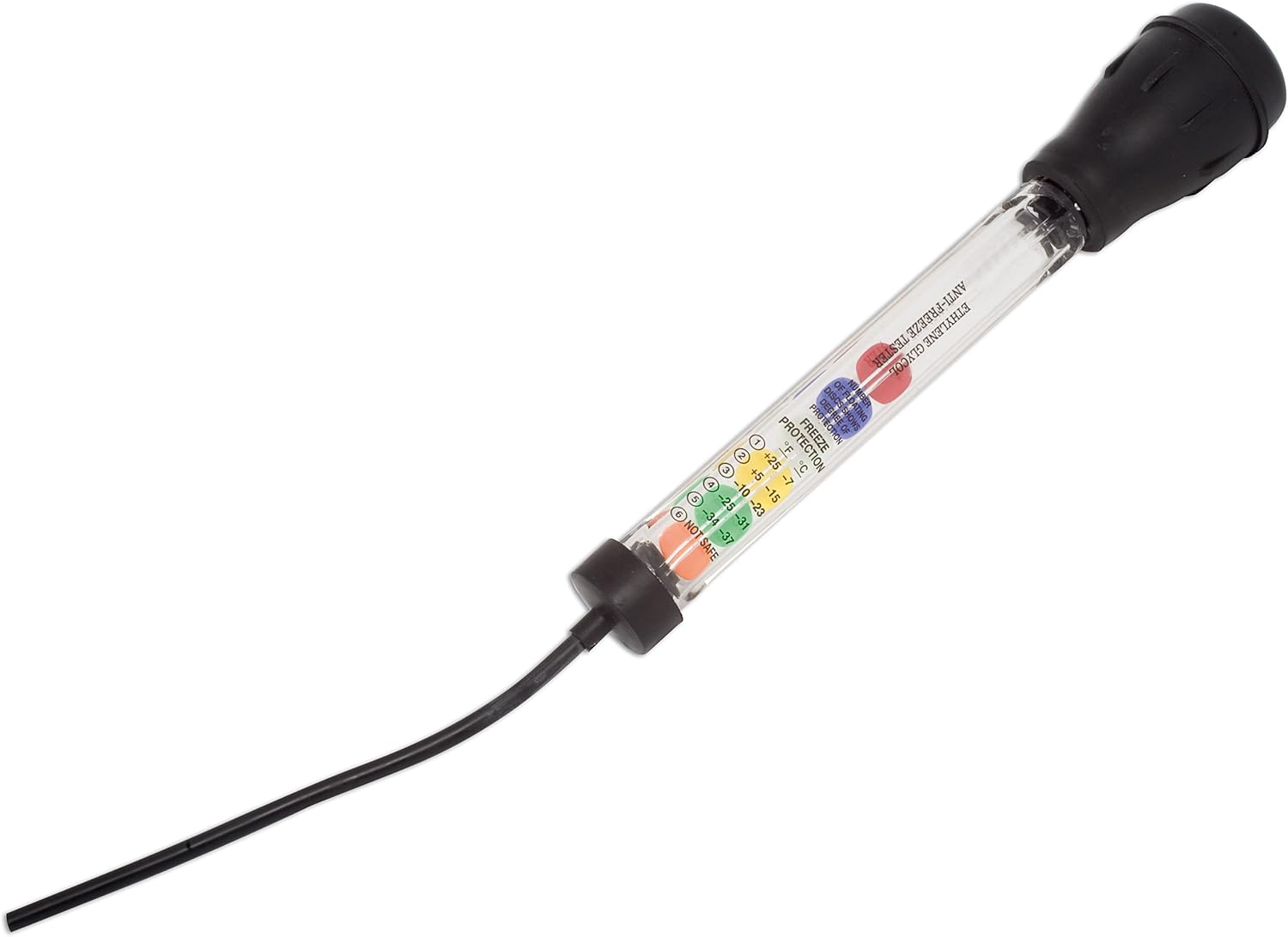
The Laser 4293 Antifreeze Tester is designed specifically for ethylene glycol antifreeze. The way it works is built around a set of floating discs: the number of discs indicates the level of coolant protection.
A key detail is that it tests at hot and cold temperatures. That matters because antifreeze performance isn’t one-size-fits-all across temperatures—so a single “cold-only” reading can be misleading. Here, the design is set up to reflect both sides.
You also get readings in Celsius and Fahrenheit, which is handy if you prefer one over the other.
Then there’s the visual indicator: the floating orange disc shows over protection and loss of efficiency. In other words, it’s not just about “is it enough?”—it also helps flag when the mixture may have moved past the useful zone.
What you’ll notice in use
In practical terms, this is the type of antifreeze tester you’d reach for when you’re preparing for winter, after topping up coolant, or when a vehicle has been sitting unused for a while and you want a sanity check.
Imagine you’re doing a routine service: you’ve drained and refilled (or added some antifreeze) and you want to know if the protection level matches what you expect. Instead of relying purely on the bottle label or timing, you run the test and look for the disc pattern and the orange indicator.
It’s a “look and interpret” approach rather than a dial you trust blindly. That can be a good thing if you prefer repeatable, visual readings.
Key things to consider before buying
One limitation to take seriously: this model is for ethylene glycol. The base information also points out a separate product for propylene glycol antifreeze (Laser 4292). So if your coolant is propylene glycol, this may not be the right match.
Another thing to bear in mind is that the tester uses discs rather than a digital sensor. That can still be perfectly usable, but it does mean the results rely on interpreting the float/disc behaviour properly.
Also, the bulb is listed as black and includes 6 discs. That’s useful for understanding the kit format, but it doesn’t tell you anything about how it performs in edge cases—so if you’re expecting laboratory-style precision, you may feel it’s more “mechanic’s check” than “diagnostic instrument”.
Key takeaways for the right buyer
It’s a solid choice if you want a practical antifreeze tester that:

- measures coolant protection using floating discs
- checks at both hot and cold temperatures
- supports Celsius and Fahrenheit
- gives a visual orange indication for over-protection and efficiency loss
It may not suit you if you’re dealing with propylene glycol antifreeze and need a tester matched to that chemistry. In that scenario, you’ll likely be better served looking at the propylene glycol version mentioned in the product notes rather than trying to force this one.
Tech specs
- Type: Antifreeze tester
- Antifreeze type: Ethylene glycol
- Measurement method: Floating discs
- Number of discs: 6 discs
- Temperature testing: Hot and cold temperatures
- Units: Reads in Celsius and Fahrenheit
- Indicator: Floating orange disc shows over protection and loss of efficiency
- Bulb colour: Black
Should you buy it?
Buy the Laser 4293 if you’re looking for a straightforward way to check whether ethylene glycol coolant still offers the right level of protection, especially when you care about both hot and cold behaviour. It’s the kind of tool that makes sense for routine maintenance, topping-up checks, and seasonal prep.
Skip it if your vehicle uses propylene glycol antifreeze, because the notes specifically direct you to a different Laser part for that chemistry. Also, if you want something highly digital or “hands-off”, this disc-based approach may not feel like the experience you’re after.
Mini FAQ
Does it test both hot and cold coolant conditions?
Yes, the Laser 4293 is described as testing at hot and cold temperatures, rather than only one temperature range.
What antifreeze type is it for?
It’s intended for ethylene glycol antifreeze. If you’re using propylene glycol, the product information points to a separate Laser tester.
What do the floating discs indicate?
The number of floating discs measures the level of coolant protection.
What does the orange floating disc mean?
The floating orange disc is described as showing over protection and loss of efficiency, so it’s useful for spotting when the mixture may have shifted beyond the ideal performance window.
What temperature units does it read?
It reads in both Celsius and Fahrenheit.