

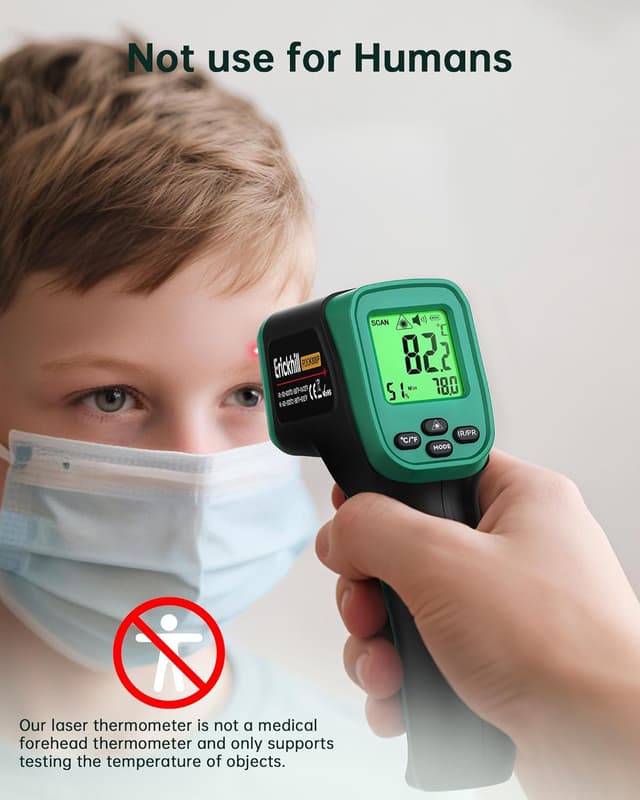
ERICKHILL Infrared Thermometer & Probe (Non-Contact Laser) -50°C to 800°C
Product description
If you want one tool for both fast surface checks and more precise food temperature readings, this ERICKHILL infrared thermometer gun is built for that. It pairs a non-contact laser sensor with a stainless-steel probe, so you can switch modes depending on whether you’re measuring a hot pan/oven/grill surface or taking a more “contact” style reading in food.
That said, it’s not perfect for every scenario. Infrared readings can be affected by surface conditions, and while the range is broad, you’ll get the best results when you understand what you’re aiming the sensor at. Worth a proper look if your priority is speed and practicality around cooking, grilling, and occasional household/industry checks.
Key takeaways
It’s essentially a 2-in-1 thermometer: an infrared laser thermometer for quick, non-contact surface temperatures, plus a stainless-steel probe for more targeted food temperature readings. The range is stated as -50°C to 800°C, making it suitable for everyday cooking tasks and also some wider uses like checking hot equipment. Accuracy is quoted as ±2°C and the measurement time as 0.5 seconds, which is the kind of speed that makes “check, adjust, move on” feel natural while you’re cooking.
A detail worth noting is that it supports adjustable emissivity. That’s helpful because different surfaces reflect infrared energy differently, and emissivity settings are one way to improve consistency. Still, if you mostly need one simple thermometer for single-point cooking without worrying about settings, you may find this a bit more “learnable” than the simplest kitchen-only probes.

The essentials
Use the probe when you want a direct temperature reading where it makes sense—think meat, thicker food, or where you want the temperature where the probe actually contacts. Then switch to infrared mode for quick checks of ovens, grills, pans, or other hot surfaces where you don’t want to wait or where contact isn’t practical.
A small micro-scenario: you’re grilling, and you want to know whether the grate is up to temperature before you place food. Aim at the surface from a reasonable distance, take the quick reading, and then adjust your heat. Later, when cooking is underway, swap to probe mode to check the internal temperature of thicker cuts. That “switching” is the main practical advantage here.
There are also convenience features mentioned such as data hold and auto power-off, plus modes for max, min, and average. For anyone who likes to monitor changes during cooking (rather than just one-off readings), those modes can be genuinely handy.

What stands out
Fast readings and responsiveness: The thermometer is stated to measure in about 0.5 seconds with ±2°C precision. That’s a sensible spec for kitchen workflow.
Wide temperature coverage on paper: With -50°C to 800°C, it’s positioned as more than a basic cooking thermometer—people who also check freezers, grills, ovens, or even non-food equipment can see the appeal of having one device covering a big window.
Distance-to-spot ratio of 12:1: The entry mentions a 12:1 ratio. In plain terms, at distance the measured spot is smaller than some cheaper units, which can help you avoid reading the wrong part of a surface—just be mindful of where you point it.
Adjustable emissivity: This is one of those features that separates “works sometimes” from “works more reliably” when surfaces aren’t uniform.
Where it may feel less convincing is that no tool like this replaces a proper food thermometer if you’re relying purely on infrared for internal temperature. For internal cooking, the probe mode is the one you’ll want to lean on.

Tech specs
- Type: Infrared laser thermometer with probe (2-in-1)
- Measurement range: -50°C to 800°C
- Measurement speed: 0.5 seconds
- Accuracy: ±2°C
- Distance-to-spot ratio: 12:1
- Emissivity: Adjustable
- Modes: Max, Min, Average
- Display: Large backlit screen
- Probe: Stainless-steel probe
- Body material: ABS body
- Functions mentioned: Data hold, auto power-off
Who it suits (and who should skip it)

It makes sense if you want one device that covers both contact and non-contact temperature checks, especially for cooking/grilling/freezing tasks and for occasional household or industry-style temperature checks. You’ll like it if you value speed, the ability to monitor max/min/average, and the flexibility of switching between infrared and probe measurements.
It might not be the best match if you’re after a single-purpose kitchen thermometer where you’d rather keep things dead simple and never touch emissivity or mode switching. It also may not suit you if you mainly need the most dependable internal food temperature readings and don’t care about surface checks—then a more focused food thermometer approach is often less hassle.
Care & maintenance
Since it uses a stainless-steel probe and measures hot surfaces, keep the probe and the sensor area clean so you don’t end up with grime affecting readings. The entry doesn’t go into cleaning instructions, so stick to safe, manufacturer-appropriate wiping and avoid harsh abrasives that could scratch the probe or sensor area.
¿Merece la pena?
For the kind of “all-rounder” job it’s described for, this ERICKHILL thermometer is easy to justify. The combination of a non-contact laser sensor for quick surface checks and a probe for more precise food readings is the value. Add in the quoted speed, ±2°C precision, adjustable emissivity, and the 12:1 distance-to-spot ratio, and it’s positioned as more capable than a basic kitchen-only gadget.
Just keep expectations realistic: infrared thermometers can be sensitive to how the surface behaves, and if you’re measuring tricky surfaces, you’ll want to take emissivity into account and aim carefully. If you only need one temperature reading style, you might find a simpler thermometer better for your specific use.

Mini FAQ
Can I use it for both cooking and household checks?

Yes, the description explicitly frames it as suitable for everyday cooking tasks and also household/other uses like checking oven heat, pan surfaces, BBQ grills, and even other equipment.
Do I need to use the probe for food?
For internal food temperatures, the probe is the intended route. The infrared mode is aimed at fast, contactless surface readings for items like pans, ovens, and grills.
What does adjustable emissivity help with?
It’s there to improve consistency when measuring different surfaces that reflect infrared differently. It’s especially relevant if you find infrared readings don’t line up with what you expect.
How accurate is it?
The entry states ±2°C accuracy and a 0.5-second measurement time, so it’s designed for quick, reasonably precise checks.
Is it safe to assume it’s always accurate at any distance?
Not automatically. The 12:1 distance-to-spot ratio helps, but accuracy still depends on proper aiming at the relevant surface area and on the surface conditions.