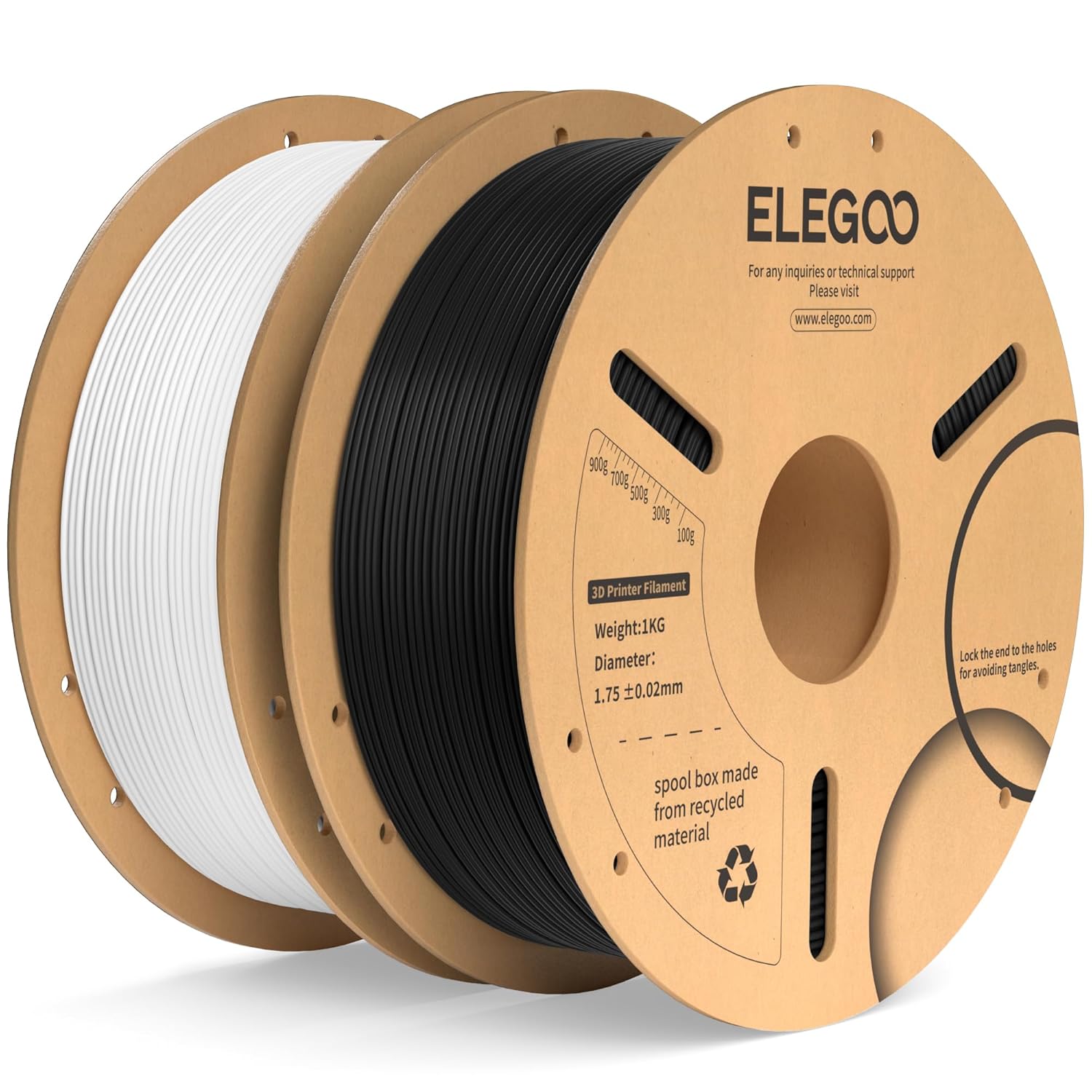
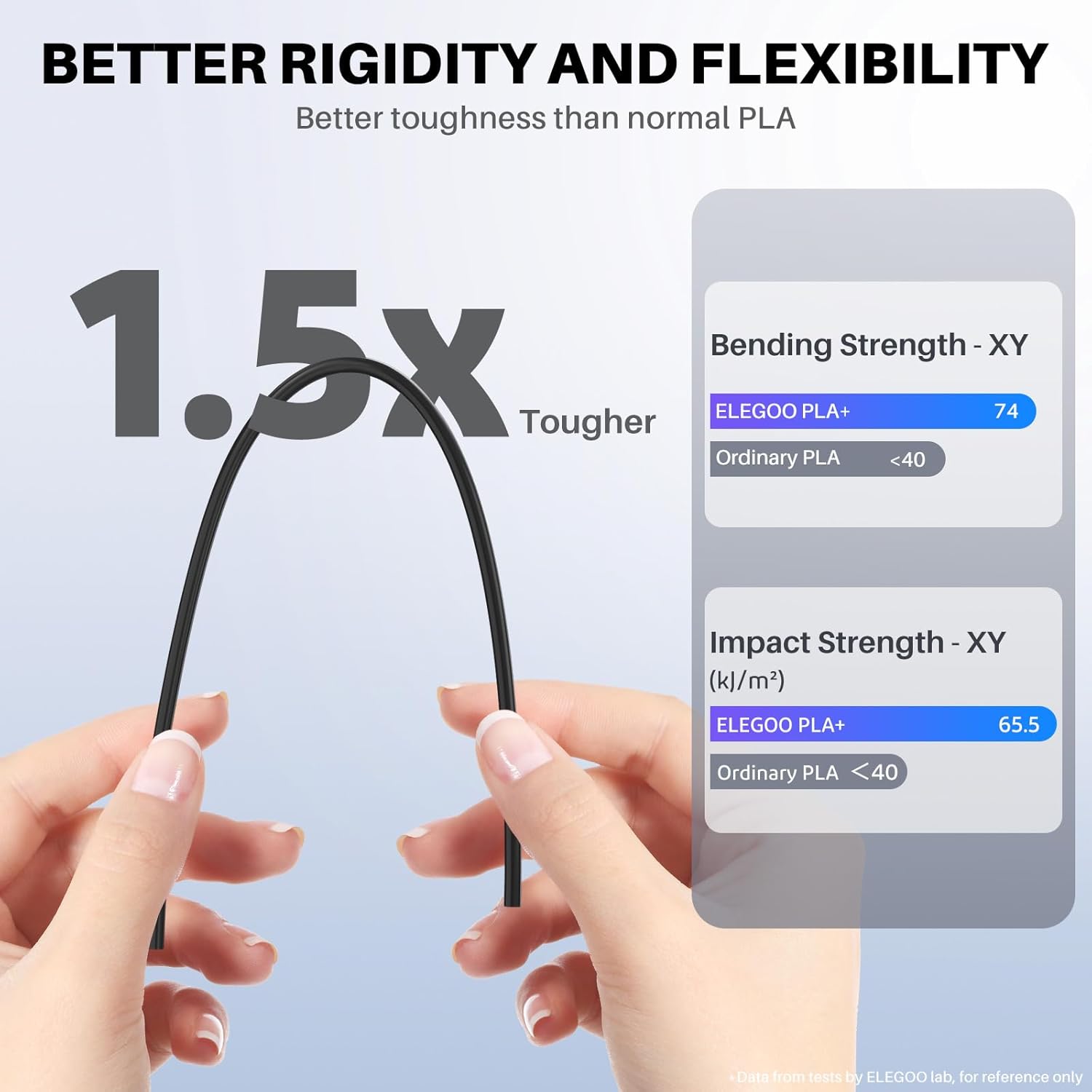
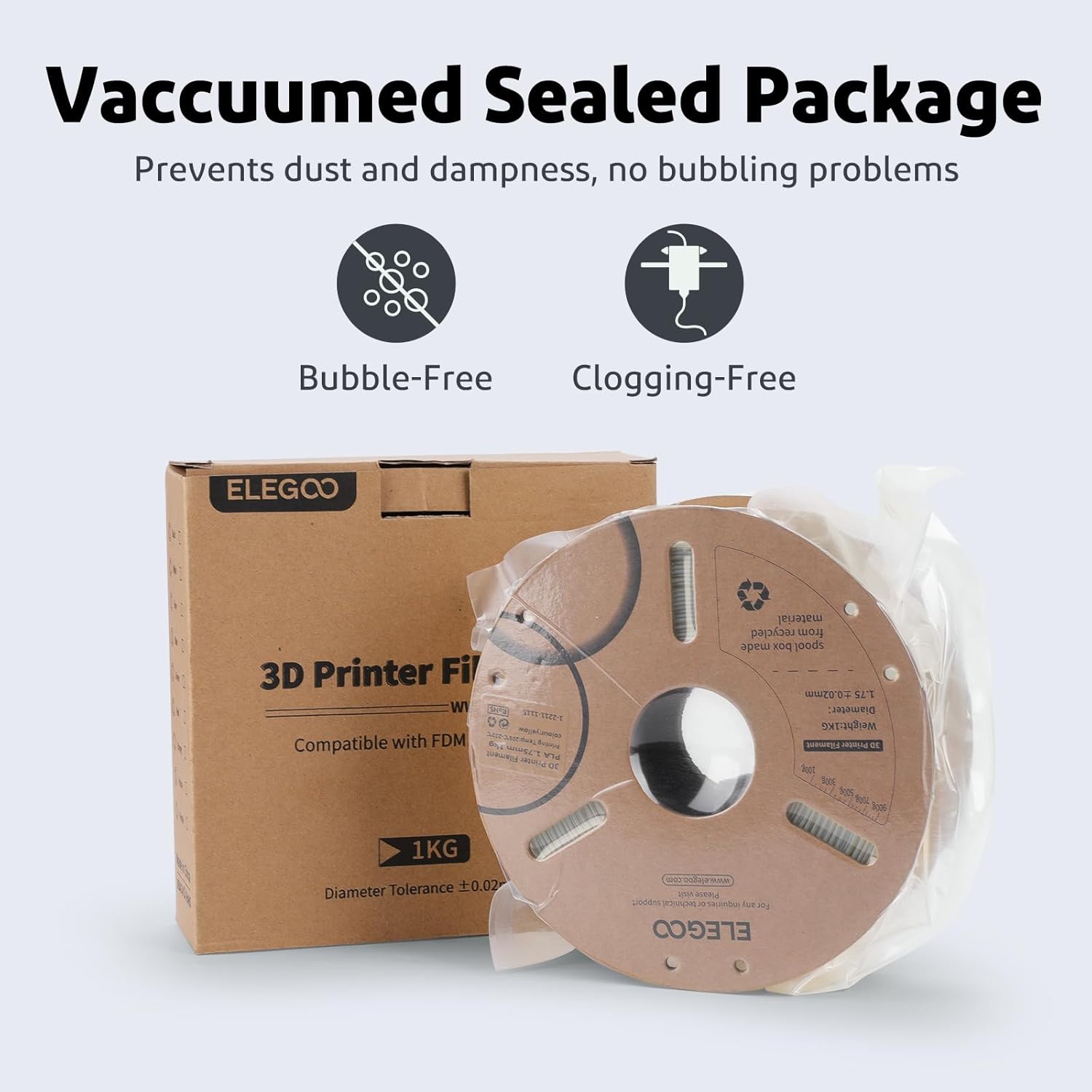
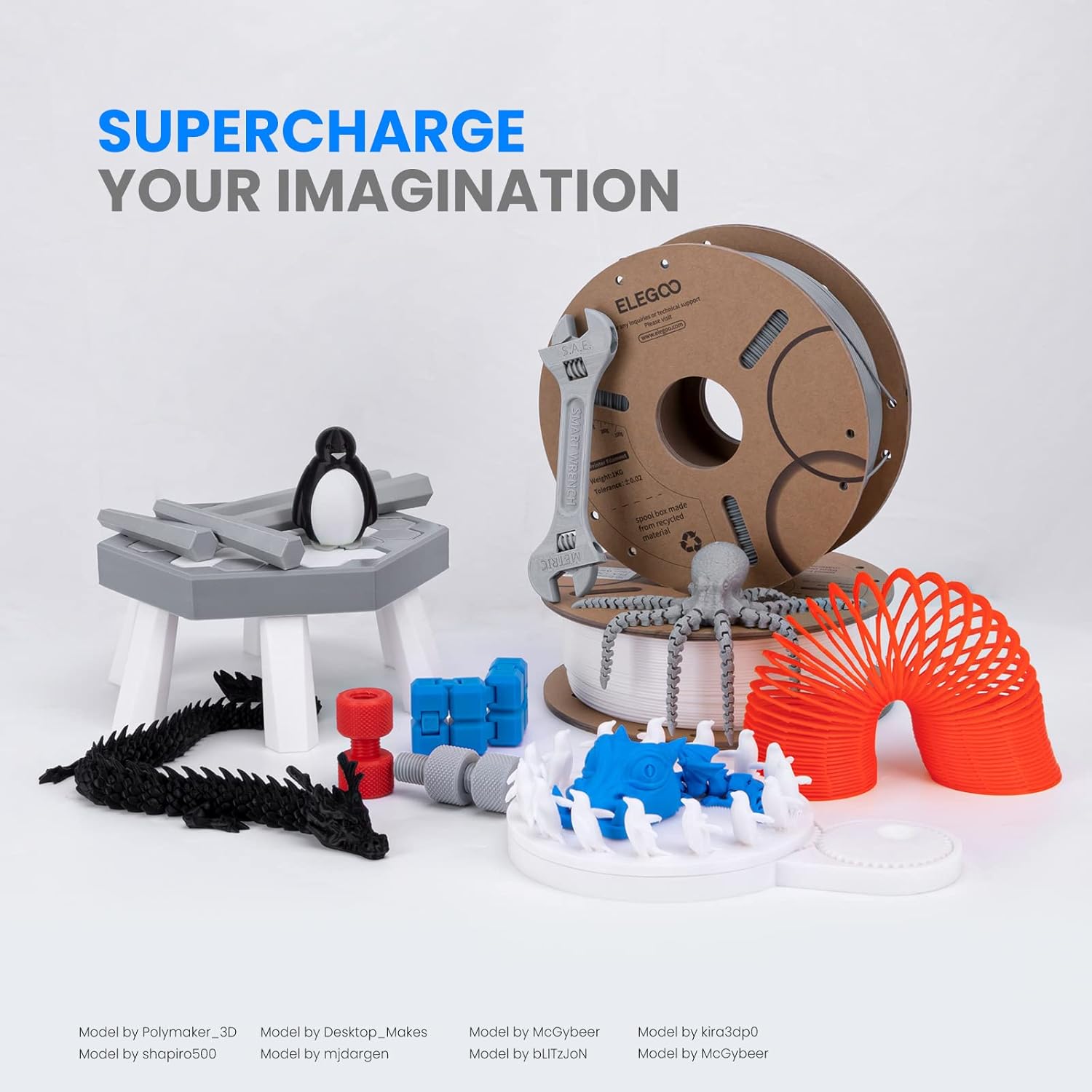
What it is and the need it meets\n\nThis ELEGOO PLA+ Filament comes as a 2kg set (two 1kg spools) in black and white, designed for FDM 3D printers using 1.75mm filament. It’s marketed as PLA Plus, with claims of greater tenacity and impact resistance than standard PLA, alongside reduced warping and shrinkage. In practice, that combination aims to deliver functional parts with clearer surface finishes and easier printing at comparatively lower temperatures. If you’re printing small jigs, housings, or prototypes that must survive a bit more abuse, this type of material can be appealing.\n\n## How it performs on paper\n\nThe product highlights include tighter dimensional tolerances (+/- 0.02 mm) and consistent feeding, which helps minimise clogging and run-out issues that can plague looser filaments. It’s also described as having a glossy surface finish from precise extrusion and strong layer adhesion, with a lower likelihood of delamination. The packaging notes that the filament is dried and vacuum-sealed to guard against moisture—important for maintain print quality. However, as with any PLA+ formulation, results depend on your printer, nozzle temperature, and retraction settings.\n\n## What stands out and where it may fall short\n\nOn the plus side, the claim of lower deformation means you may see more dimensional stability in parts with small inserts or tight clearances. The two-colour option (black & white) can be handy for visual contrast or functional testing. The explicit focus on smooth surfaces is beneficial if you want cleaner top layers and reduced post-processing. On the downside, PLA+ is still a variant of PLA, it’s not a high-temperature or high-load engineering material. If your prints need endurance at higher heat or continuous mechanical stress, you may need a different material family or reinforced options.\n\n## Who it’s for\n\nThis filament is likely well suited for hobbyists, educators, and makers who value predictable prints and reasonable durability without stepping into more demanding materials. It can work for functional prototypes, light‑duty jigs, or display pieces where a neat finish matters. If you’re printing parts that will see impact or need stronger elongation than standard PLA, this PLA+ option might be worth a try.\n\n## When to buy and when to skip\n\nConsider buying if you prioritise dimensional accuracy, clean winding, and a straightforward print process at moderate temperatures. It may not be the best choice if your use case involves continuous mechanical loading, high-temperature environments, or chemical exposure. In those scenarios, materials designed for durability or heat resistance could be more appropriate.\n\n## What to review before purchasing\n\nCheck that your printer is compatible with 1.75 mm filament and that you can manage the initial extrusion temperature within the typical PLA+ range. Ensure your spool handling allows for clean unwinding to minimise tangles, which the product claims to address with meticulous winding. Also confirm you have proper moisture control, since hygroscopic filaments can degrade print quality if left unsealed.\n\n## Practical use case and comparison in context\n\nFor a practical scenario, you might print a small enclosure that needs a sturdy shell yet tolerates minor flex. Compared with standard PLA, this PLA+ variant aims to provide better impact resistance and surface finish at similar printing temperatures. If you’re choosing between this and basic PLA, consider the need for a slightly tougher part and a more consistent feed, if those factors aren’t critical, standard PLA may suffice.\n\n## Final verdict\n\nFinal verdict: A solid option if you prioritise dimensional accuracy, a tidy winding, and a modest boost in toughness for everyday 3D printing. It suits hobbyists and educators who want a reliable, easy‑to‑print material for functional parts without venturing into more extreme engineering polymers. It may not be the best fit for high‑heat or high‑load parts, where specialised materials would be preferred.\n\n## FAQ\n\nIs it compatible with most FDM printers? Yes, it’s marketed as compatible with most 1.75 mm FDM printers.\n\nDoes it really resist impact better than standard PLA? The description suggests higher tenacity and impact resistance, though real‑world results depend on printer setup and part design.\n\nShould I buy 2kg in one go? If you plan multiple prints or want the convenience of a single purchase, the two 1kg spools offer continuity, otherwise a single spool may suffice for smaller projects.