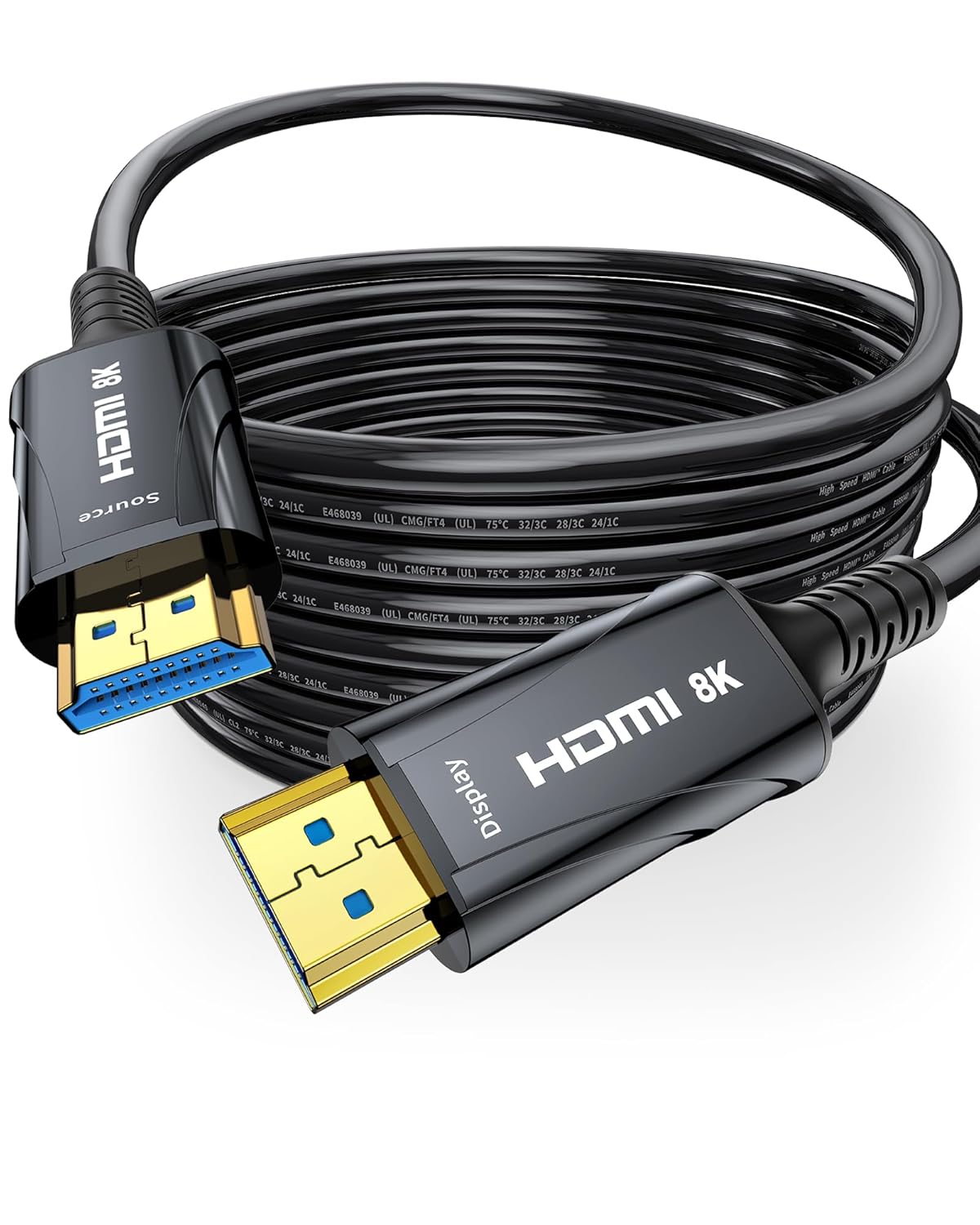
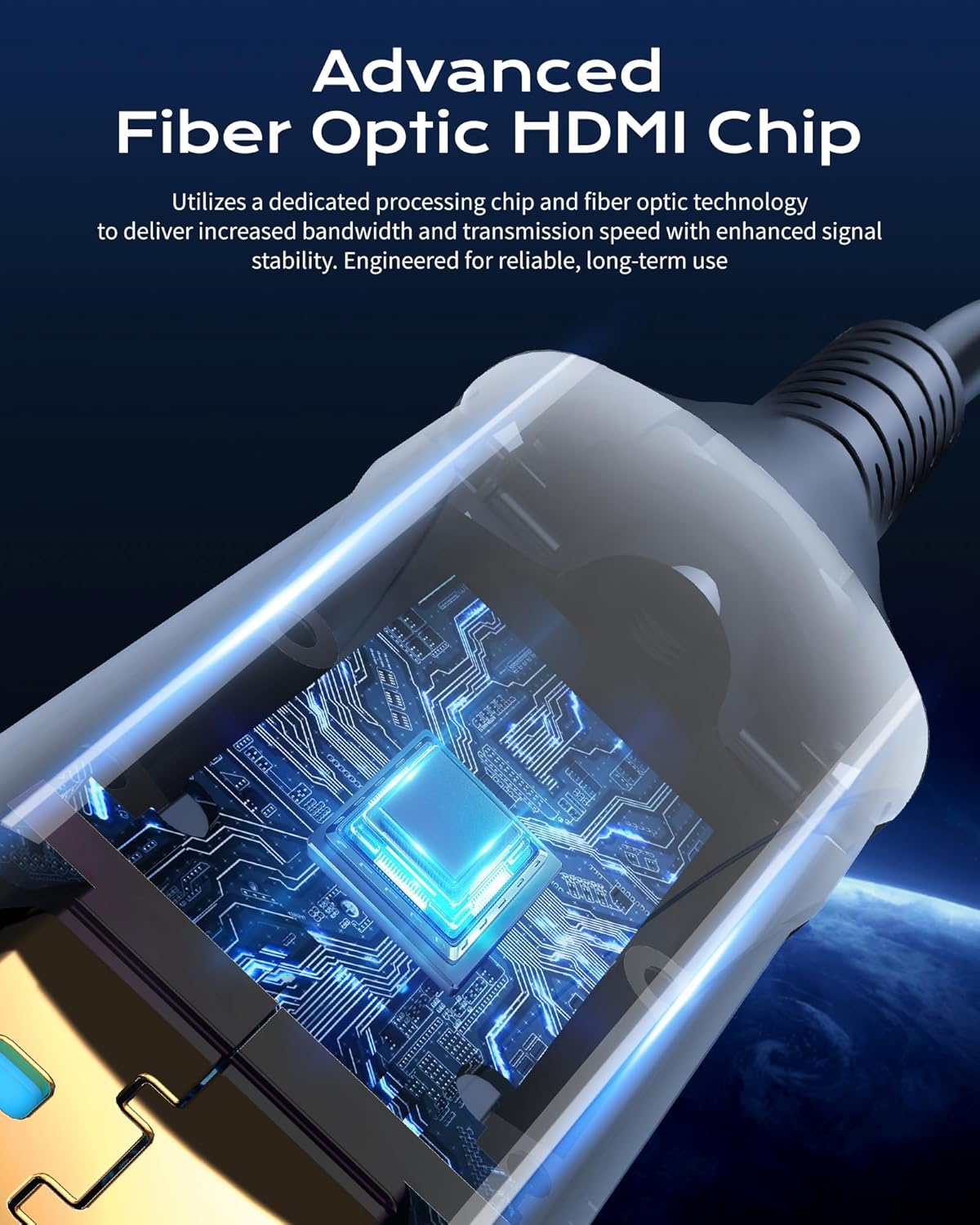
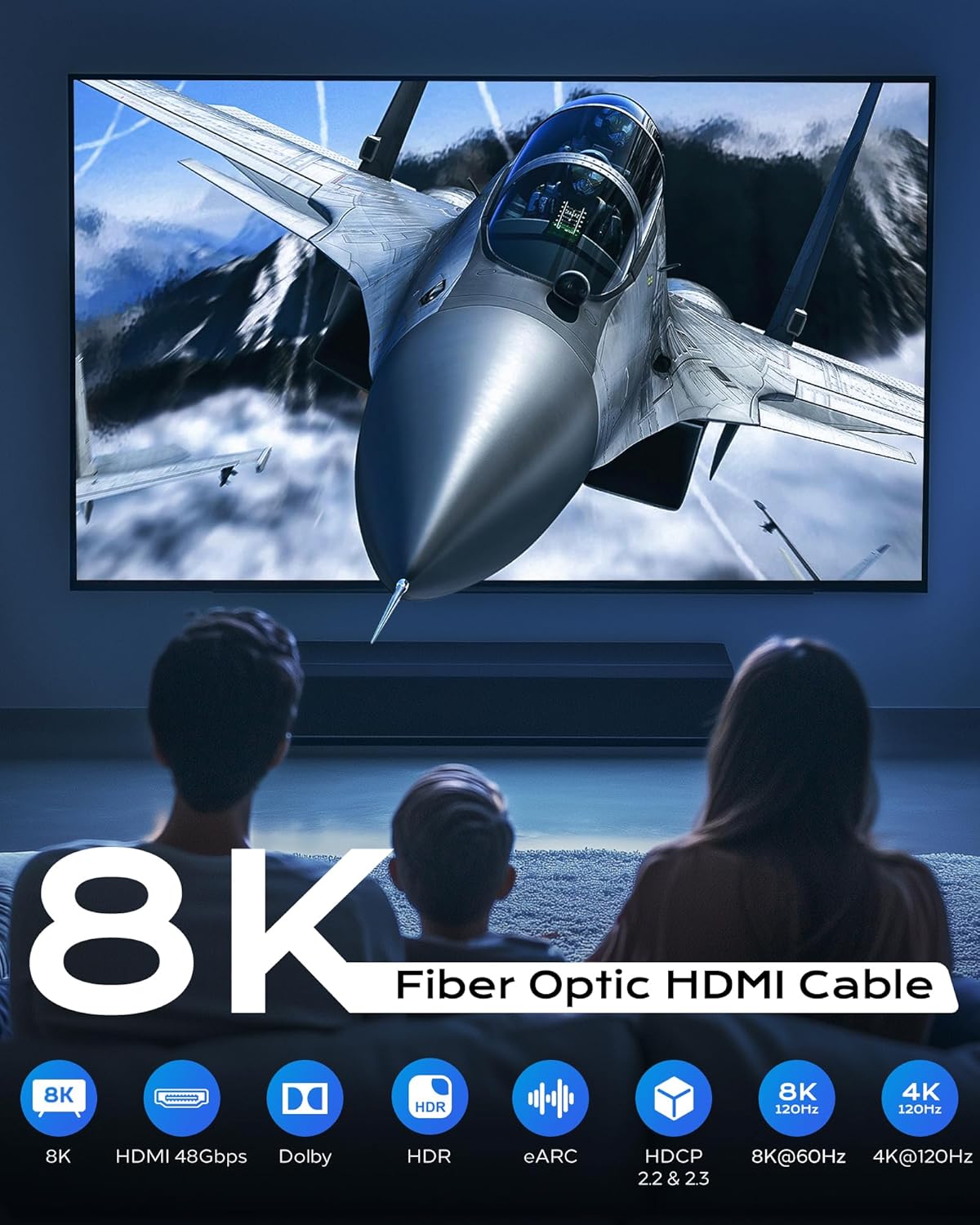
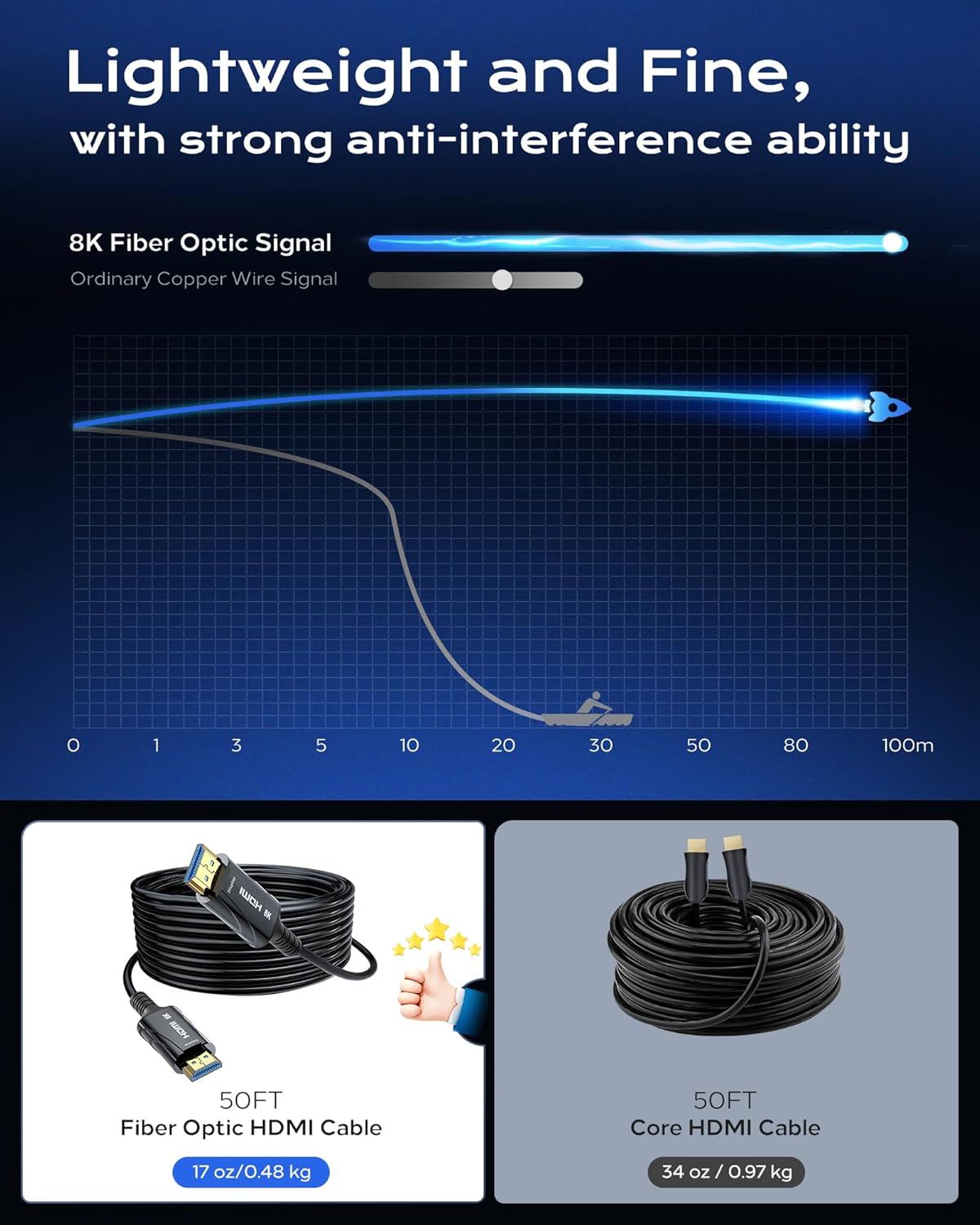
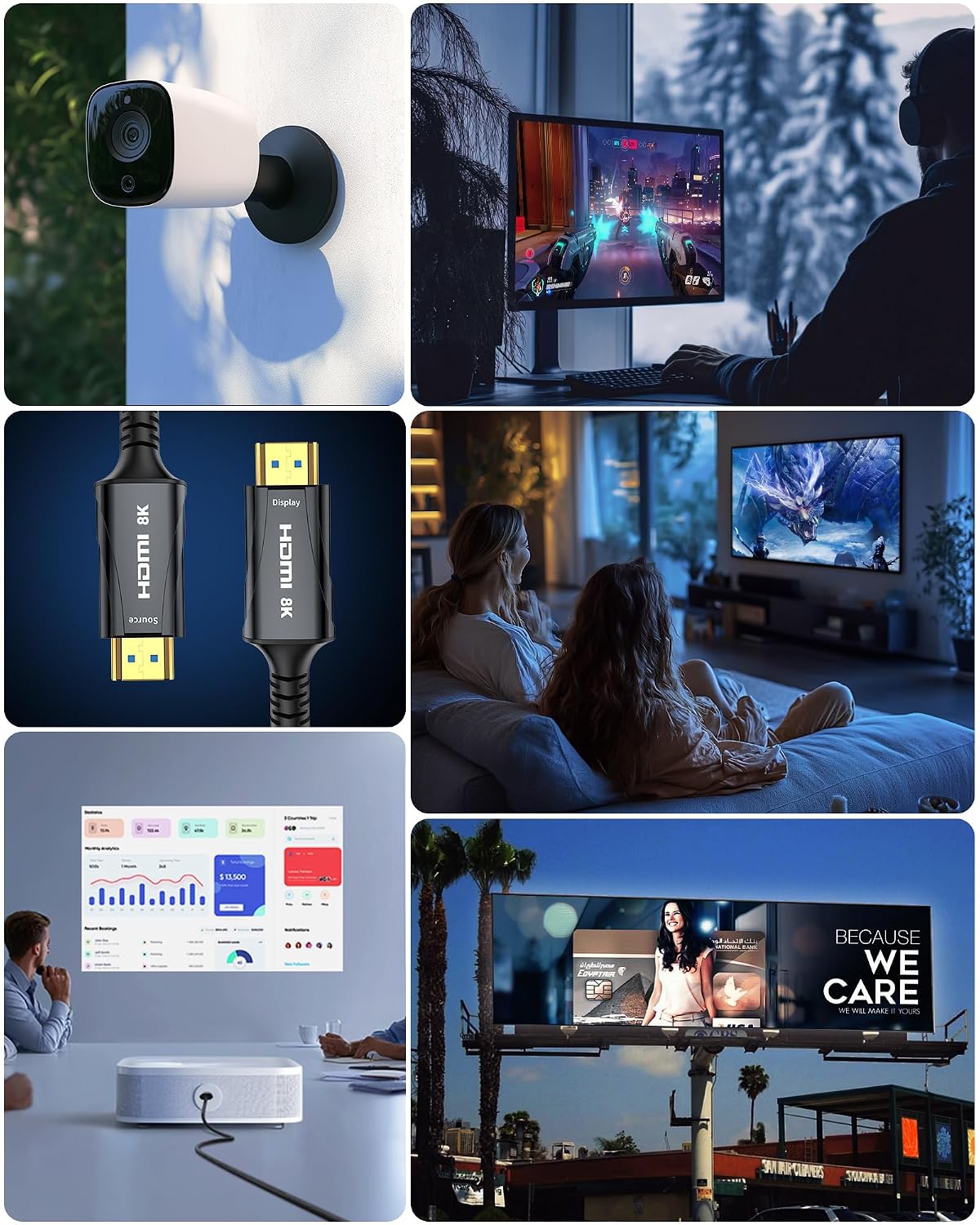
What it is and what it’s for\nThe Cratree 8K Fiber Optic HDMI Cable is a long-haul HDMI cable designed to carry high-bandwidth video and audio signals over 20 metres without the common issues of copper cables, such as signal loss or interference. It targets users who need reliable, high-resolution streaming for large displays, home theatres, or professional setups where distance matters. On paper it supports 8K at 60Hz and 4K at 120Hz, plus modern features like Dynamic HDR, HDCP 2.2/2.3, eARC and VRR, making it a contender for future-proofing a compatible system.\n\n## How it works and what the tech means\nThe fibre optic construction is paired with a robust housing and oxidation-resistant 24K gold-plated connectors to minimise corrosion and maintain a solid signal path. The internal design uses a quad-layer shielding approach to reduce external interference and preserve image clarity over the full 20-metre length. It is backward compatible with older HDMI standards (2.0, 1.4 and earlier), so it can slot into existing setups without replacing every device. However, you must connect the SOURCE end to the signal source (e.g., laptop, Blu-ray player, PS5) and the DISPLAY end to the display (TV, monitor or projector).\n\n## Real-world expectations\nIf you’re after pristine, high‑resolution gaming, cinema-style viewing or confident long-distance connections in a conference hall, this cable promises stable transmission with minimal delay and frame drops on supported formats. It is not a universal magic wand for every device: some setups may require confirming EDID, HDR, and audio settings to ensure all features (like Dolby Atmos or DTS:X) align across devices.\n\n## What stands out\nOn the positives, the 20 m length is significant for large rooms and distance-heavy installations, coupled with HDMI 2.2/2.3 compatibility and a comprehensive feature set including eARC, ALLM, QFT and VRR, which broadens the use cases beyond basic video. The 24K gold connectors and multi-layer shielding are tangible upgrades over basic copper cables in theory, and the product is positioned as a mid-to‑high end option for users who prioritise signal integrity over budget.\n\n## Potential limitations\nNo product is perfect for every setup: long fibre runs can still be sensitive to mechanical stress or bending radius, so careful routing is advised. You’ll also want to verify that your devices actually support 8K60 or 4K120 and that HDCP 2.2/2.3 is enabled where required. Given the length, cable management becomes more important than with shorter HDMI leads.\n\n## Who it’s for\nIt’s aimed at users who value high resolution over longer distances: home cinemas with large screens, gaming rooms with stretched layouts, conference spaces, or studios needing a single run from source to display without multiple HDMI hops. It suits those who want modern features—HDR, VRR and dynamic audio support—without compromising on image fidelity.\n\n## Who it isn’t ideal for\nIf your setup is close-range or devices cannot push 8K/120 Hz or HDR streams, the benefits may be marginal. It’s also less compelling if you don’t need a long run or if your budget prioritises standard full‑HD or 4K setups rather than 8K ambitions.\n\n## What to check before buying\nConfirm your source device and display support the required resolutions and frame rates, and ensure the EDID settings align so you don’t end up with a lower refresh rate. Consider the routing path to avoid excessive bending, and plan for secure, dust-free connectors to maintain longevity.\n\n## Practical use case\nImagine delivering a late‑night 4K HDR movie from a home theatre PC to a projector across a spacious living room. The cable should handle it without noticeable lag or signal drop, provided all components in the chain support the same high‑bandwidth profiles.\n\n## Comparison in context\nIf you don’t need long-distance transmission or 8K/120 Hz support, a shorter HDMI option might be simpler and more flexible. For users happy with robust, future‑ready feature sets and longer runs, this fibre optic solution offers a more stable path than traditional copper equivalents.\n\n## Is it worth it? (Final decision)\nWorth considering if you require a reliable long-range HDMI with modern features and 8K/4K support for demanding setups. It may not be the best fit if you’re connecting a standard TV close by or if your devices don’t utilise the higher bandwidth.\n\n## FAQ\n1) Does it work with all HDMI devices? It’s backward compatible with HDMI 2.0 and earlier, but full benefits depend on device capabilities.\n2) Can I bend the cable sharply? The design uses shielding and fibre optics, but like any long HDMI cable, avoid sharp turns to maintain signal integrity.\n3) Do all devices need HDCP 2.2/2.3 for 8K? Some content and devices require HDCP compliance, check your source and display compatibility.\n