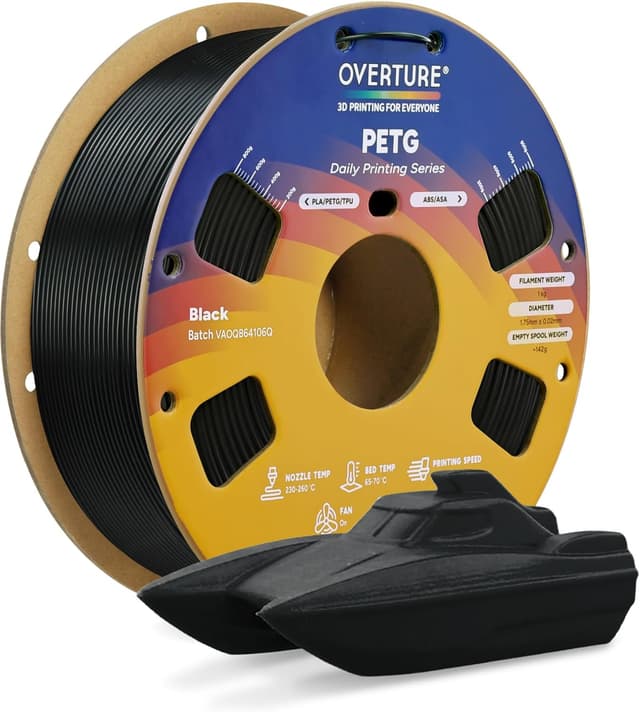



OVERTURE PETG 1.75mm 1kg Filament for FDM

Reviews
Price
Price evolution
Product description
This PETG filament delivers a balance of toughness and printability for functional parts and everyday prototypes, making it a practical choice for hobbyists and professionals alike. It comes on a neatly wound 1 kg spool of black 1.75 mm filament and emphasizes layer adhesion and dimensional consistency for stronger prints.
Key Points
Overture's PETG is positioned between PLA and ABS in performance, offering greater impact resistance than PLA and easier handling than ABS, according to the manufacturer. The spool is intended to reduce tangles, so feeding tends to be more reliable over long prints. It is promoted for outdoor-exposed parts and mechanical components because of its reduced shrinkage and improved moisture resistance compared to basic PLA. 😊
This material prints at moderate to warm nozzle and bed temperatures depending on your machine and profile. Expect some stringing if retraction is not tuned, and consider using a drying routine if your workshop is humid, because PETG can absorb moisture over time.
Technical Specifications
- Name: OVERTURE PETG 1.75mm (Black, 1-Pack)
- Weight: 1 kg (2.2 lbs) spool
- Diameter tolerance: - Dimensional Accuracy: +/- 0.02mm
- Filament diameter: - 1.75 mm
- Material: - PETG
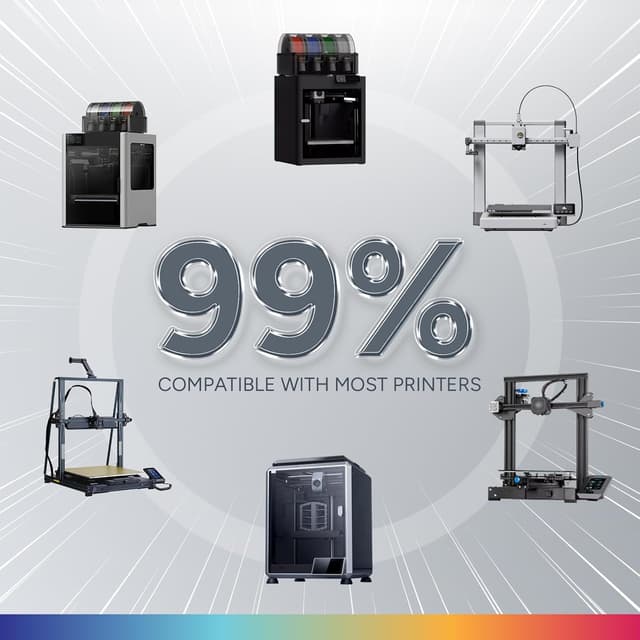
- Compatibility: - Fits most FDM 3D printers
Benefits
The filament combines toughness and chemical resistance with less brittleness than PLA, which helps for parts that will see stress or light impact. Because it bonds well between layers, prints often show stronger mechanical performance and reduced delamination. The neat winding of the spool reduces the time spent troubleshooting tangles during long runs, and the black tone retains colorfastness for practical applications where appearance matters less than function. 🔧
Printing PETG typically requires a higher extruder temperature than PLA and a heated bed to maintain adhesion. It cools more slowly, which helps layer bonding but can soften fine details if cooling is too aggressive. The manufacturer indicates low shrinkage, so dimensional stability is a highlight for parts that need reliable tolerances.
Usage Recommendations
Start with manufacturer suggested temperatures for PETG and adjust in small steps to dial in extrusion flow and surface finish. Use a brim for taller narrow parts to improve first layer adhesion. Retract and travel settings should be tuned to reduce stringing, and a part fan set to low or intermittent speeds helps preserve layer bonding without obliterating detail. For best results with functional components, consider post-processing like annealing or light sanding depending on the required fit and finish. 😎