


BestSelf Co. Little Talk Conversation Cards for Kids (170 Prompts) for Social Skills, Family Games, Travel & Therapy
Reviews
Price
Product description
If you’ve ever sat down for “just one conversation” with a kid and felt the awkward silence creep in, BestSelf Co.’s Little Talk Conversation Cards are built for exactly that moment. The deck is designed to help kids open up and keep the talk moving—without you having to come up with something brilliant on the spot.
It’s positioned as a social-skills and connection tool for ages 4–12, with conversation prompts meant to go beyond everyday small talk. Over the course of the cards, the goal is to support expression, reflection, and better communication in a way that feels like play—whether that’s a family game night, a road trip activity, or something you use in a therapy or learning context.
That said, it’s not a magic wand. Like any prompt-based tool, the experience depends on the child’s comfort level and your ability to keep it light and non-pressuring.
What it is and what it’s for
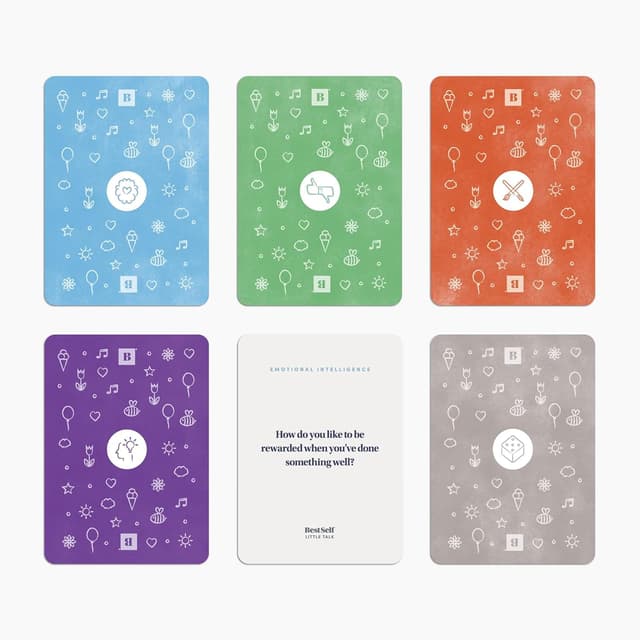
Little Talk is a conversation-prompt card deck for kids, created to spark meaningful questions and discussion topics. The premise is simple: instead of relying on awkward pauses or you “figuring out what to ask,” the cards provide ready-made topics so you can keep the interaction flowing.
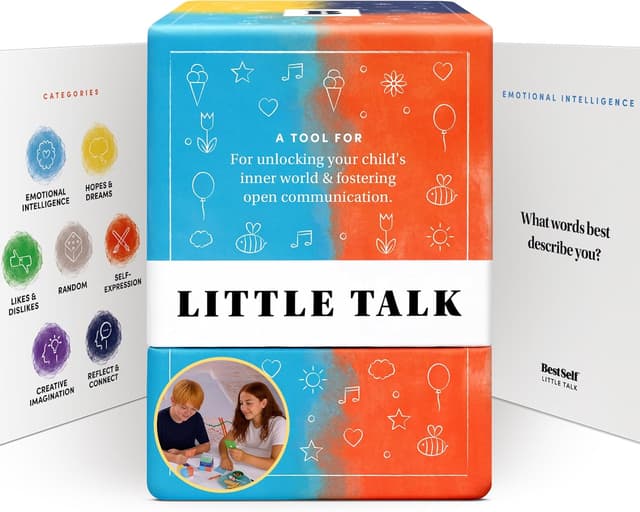
The intended use spans a few common situations: - Family games and quality time: sit down, pull a prompt, and let the conversation become the activity. - Travel and road trips: use prompts to reduce boredom and fill quiet stretches in a fun way. - Therapy or structured support: the deck is described as a tool for social skills, including for kids who may benefit from ADHD-focused strategies (based on the product positioning). - Homeschool moments: a guided conversation can make social-emotional learning feel less like a lesson and more like an interactive game.
The prompts are designed to help kids practice communication and shape how they think and talk about being themselves—toward becoming “more well-adjusted and productive,” as the description puts it.
Where these conversation cards shine
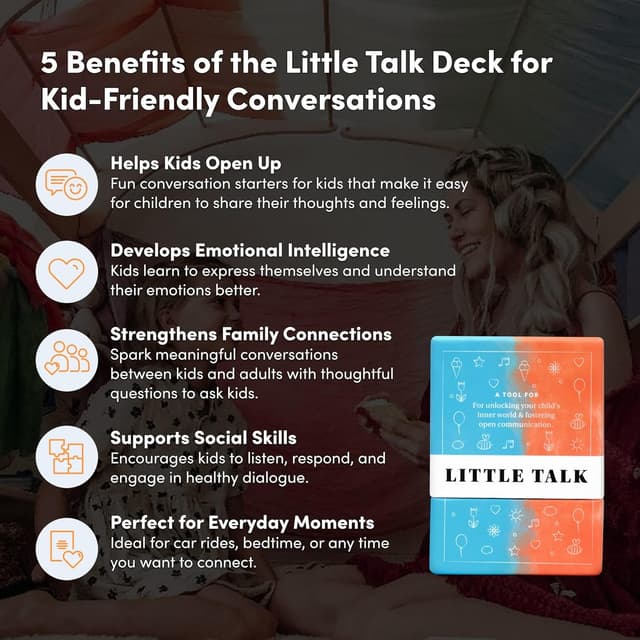
On paper, the biggest advantage is that the deck does the heavy lifting of topic selection. That matters more than people expect, because conversation quality often drops when adults try too hard to “ask the perfect question.” With a deck in hand, you can focus on listening and creating momentum.
There’s also a clear effort to keep topics age-appropriate and conversation-worthy. The description highlights that the prompts support meaningful discussion for children around ages 4 to 11, and the humor is described as being kid-appropriate.
A practical example: imagine a road trip where the usual “Are we there yet?” starts. You pull the top card, read it together, and take turns answering. Even if a child gives short answers at first, you can follow up with the next card or ask a gentle “Why do you think that?”—not as an interview, but as part of the game.
And if you’re a clinician, teacher, or therapist, you’re likely looking for tools that reduce pressure. Prompt decks can be helpful because the child isn’t staring at a blank page—you’re both working from something concrete.
What to consider before you buy
There are a couple of limitations worth keeping in mind.
First, because this is a prompt deck, it won’t automatically produce deep or engaging conversations with every child every time. Some kids open up quickly, others need a softer approach, more time, or a different setting. You may find that you’ll want to skip certain prompts that don’t land well.

Second, the description mentions the deck provides 170 prompts (and references a large set of prompt cards) and supports an age range up to 12, while also stating meaningful discussion for children 4 to 11. That overlap is normal for products, but it’s a good reminder to check that the prompt style matches your child’s age and temperament.
Finally, if your goal is a fully scripted curriculum or a highly specific therapy protocol, a conversation deck is still “just” conversation guidance. It can support structure, but it’s not a replacement for individualized professional plans.
Who it’s for (and who should skip it)
It makes sense if you’re trying to improve day-to-day communication in a low-stakes way. It’s a strong fit if you:
- Want a family-friendly format that reduces awkward silence.
- Need an easy activity for travel, waiting rooms, or calm downtime.
- Prefer tools that help kids practice social skills through discussion rather than drills.
- Are looking for ADHD-friendly conversation support, at least in the way prompt-based engagement can help keep attention moving.
It may not suit you if you:
- Expect every prompt to work instantly without any adaptation.
- Need detailed therapeutic instruction instead of conversation starters.
- Have a child who shuts down when asked questions—sometimes prompts still feel like “questions,” even if they’re packaged as play.
Key takeaways for choosing conversation cards
If you’re comparing prompt decks, focus on the feel of the prompts and how likely they are to keep your child engaged. This deck is designed around meaningful topics, humor appropriate for kids, and reducing the friction of starting conversations.
Also consider how you plan to use it. If you want a quick, repeatable activity for road trips and family game time, that’s where prompt decks generally deliver the most day-to-day value. If you’re using it in a therapy or learning context, it can help you standardize conversation practice sessions—without needing to brainstorm prompts every time.
Tech specs
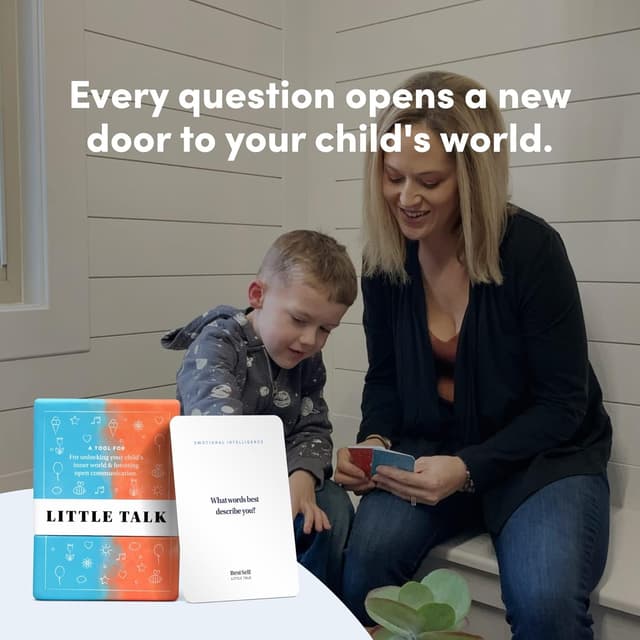
- Name: Little Talk Conversation Cards for Kids
- Type: Conversation prompt card deck
- Format: Deck of prompts
- Capacity: 170 prompts
- Brand: BestSelf Co.
- Intended age range (as described): Ages 4–12
Is it worth it?
Little Talk is worth considering if you want a simple way to get kids talking without the awkward “what do I even say?” problem. Its main strength is prompt-driven structure: you get topics ready to go, designed for meaningful discussion and kid-appropriate humor, and it works across family time, travel, and learning or therapy settings.
It’s not the best choice if you need a highly controlled program or if your child reliably dislikes prompts/questions even in playful formats. If you’re okay experimenting—pulling prompts, skipping what doesn’t land, and keeping the tone relaxed—you’ll likely get more mileage from the deck.

Mini FAQ
How do these cards help with social skills?
The deck is positioned as a social-skills conversation tool, using prompts intended to encourage expression, discussion, and communication practice in an age-appropriate way.
Are they good for travel and road trips?
Yes, the product is explicitly framed for travel and road trip activities, which is usually where prompt cards shine because they’re self-contained and don’t require prep.
What ages are the prompts for?
The description places the deck for children around ages 4–12, and it also mentions meaningful table-top style discussion for children 4 to 11.
Will it work for kids with ADHD?
The deck is marketed as an ADHD tool. That doesn’t guarantee every child will engage, but prompt-based interaction can support focus and keep the conversation moving.
Can parents use it without a specific training background?
Based on the description, yes. It’s designed for parent/child quality time and family game use, not only professional settings.