

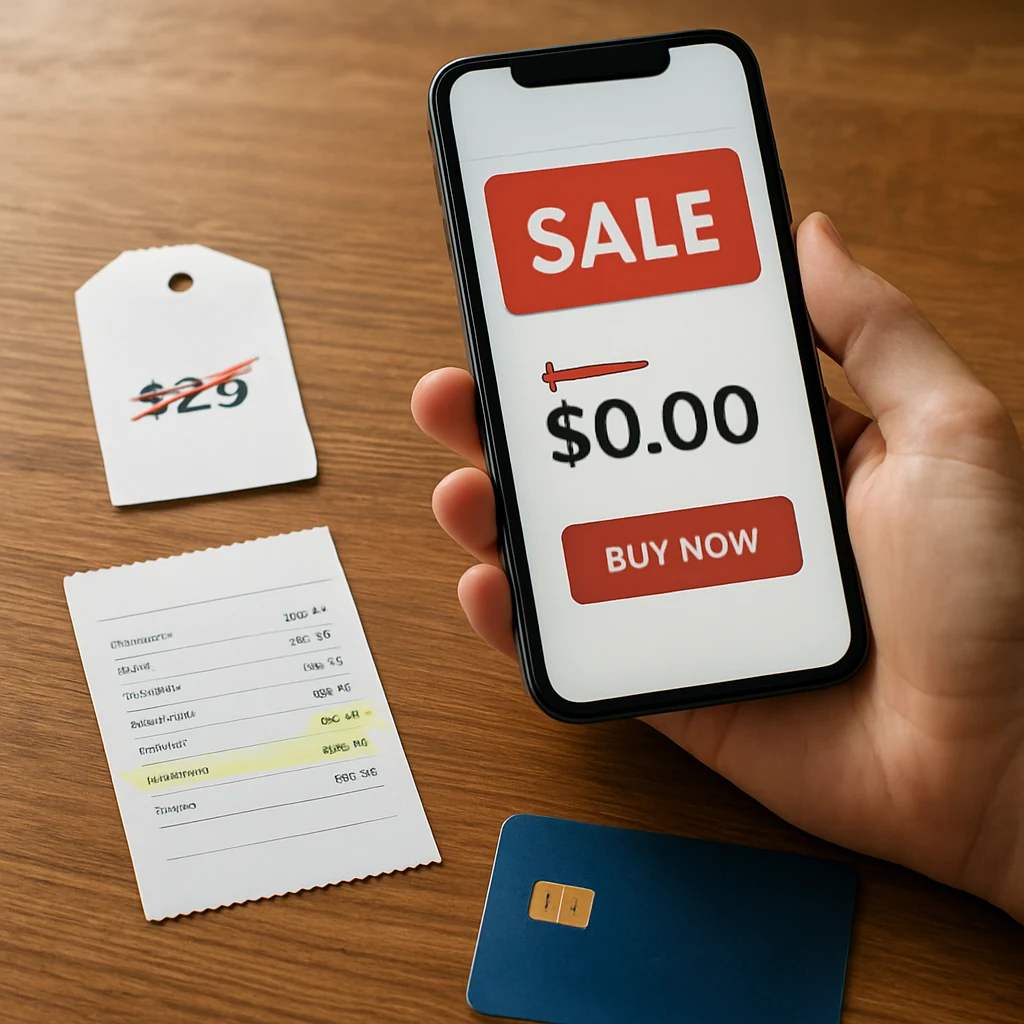
The Deal Reality Check: How to Verify Discounts Before You Buy
A step-by-step US guide to confirm real online discounts using price history, alerts, unit pricing, and fine print—especially for Prime Day and Black Friday.
Online “deals” are everywhere—Prime Day, back-to-school, Labor Day weekend, Black Friday/Cyber Monday, and random flash sales in between. The hard part isn’t finding discounts. It’s confirming the discount is real, the final cost is still the best option, and you won’t regret it a week later.
This mini-guide is a quick, repeatable Deal Reality Check you can run in a few minutes before you click Place order. It’s built for US online shopping: sales tax surprises, shipping thresholds, marketplace sellers, and the way prices bounce around during big shopping seasons.

Step 1: Define your “real” target price (not the banner price)
Before you open five tabs, take 30 seconds to set a target. Otherwise, any “50% off” label will feel like a win.
Pick one:
- Your max all-in price (item + shipping + estimated sales tax).
- Your target price range (helpful for items with lots of models, like headphones).
- Your value target (e.g., “under $1 per ounce” for a pantry staple, or “under $100 for running shoes”).
Why “all-in”? In the US, the same item can flip from “great deal” to “meh” once you add shipping, expedited delivery fees, or the sales tax that shows up at the end.
Step 2: Run a 60-second price history check
A real discount usually has a story. A fake discount often has a timer.
Do a quick price-history look-up using a price tracker (browser extensions and standalone trackers exist; for Amazon-only checks, some people use dedicated Amazon price-history sites). You’re not hunting for perfection—just answering two questions:
- Is today’s price unusually low, or just “on sale” compared to an inflated reference price?
- Does this item routinely drop to about this price during seasonal events?
Seasonal patterns matter. For example:
- Tech and small appliances often get aggressive promo cycles around Prime Day (July) and Black Friday/Cyber Monday.
- Home items frequently pop up around Memorial Day and Labor Day.
- Fitness gear can get interesting around New Year’s.
If the current price is basically the normal price with a dramatic strikethrough, treat it as a regular buy—not a “buy-now-or-lose-it” moment.

Step 3: Confirm you’re comparing the same exact thing
Online retailers love “almost identical” products. You think you’re comparing prices… but you’re actually comparing different SKUs.
Do this verification pass before you trust any comparison:
- Model number Ofertas exact variant (storage size, color, generation, bundle).
- Condition (new vs. refurbished vs. “open-box”).
- Seller type (retailer direct vs. marketplace third-party).
- Warranty and included accessories (chargers, filters, attachments, etc.).
This matters most during major sales events, when bundles and “special editions” appear that don’t match the standard version you saw in reviews.
Step 4: Compare across retailers, but use the right “price”
Comparing is easy. Comparing correctly is the trick.
When you check other stores (or other marketplaces), don’t stop at the product page price. Rebuild the “all-in” number:
- Item price
- Shipping cost (or free-shipping threshold)
- Estimated delivery speed (rush shipping can kill a deal)
- Estimated sales tax
- Any membership requirement (and whether you’d pay it just for this purchase)
A simple habit: keep one note on your phone with three totals. Example:
“Air fryer: $89.99 + tax free ship (Store A) vs $79.99 + $9.99 ship + tax (Store B) vs $84.99 pickup today (Store C).”
Once you see it written out, the “deal” usually reveals itself.
Step 5: Use unit pricing to catch sneaky not-deals
Unit pricing isn’t just for grocery stores. It’s one of the fastest ways to spot online “discounts” that aren’t actually better value.
This is especially useful for:
- detergents and paper goods
- coffee pods
- pet food
- skincare
- vitamins and supplements
If the listing doesn’t show unit price, do a quick calculation (price ÷ ounces/count). Also watch for multi-packs where the count changed. A “20% off” bundle can still be worse than last month if the pack size quietly shrank.
Step 6: Sanity-check the coupon before you trust it
Coupons are great—until they waste your time or push you into a sketchy checkout.
Do a quick credibility filter:
- If a coupon site demands an install or asks for unusual permissions, skip it.
- If the code works but forces a subscription, read the terms carefully.
- If the “discount” only applies to a more expensive shipping option, do the math.
Also: don’t let a coupon decide your purchase. Let it improve a purchase you already planned.
If you want a deeper stacking approach, browse the guides on the homepage at / and apply them after you’ve confirmed the base deal is real.

Step 7: Read the fine print that changes the true price
This step is boring, and it saves the most money.
Before checkout, scan for:
- Return window and return shipping (especially with marketplace sellers).
- Restocking fees (common in certain categories).
- Price adjustments (many retailers don’t do them anymore, so don’t assume).
- Auto-renew subscriptions (streaming trials, “membership pricing,” subscribe-and-save).
- Delivery exclusions (oversize shipping, rural surcharges, “free shipping” that only applies over a threshold).
You don’t need to memorize policies. You just need to catch the one line that turns a “deal” into a hassle.
Step 8: Check the post-purchase risk (and plan your “undo” move)
Even a verified deal can go sideways. The safer your exit plan, the more confidently you can buy.
Here’s a practical way to think about it:
- Low risk: easy returns, reputable seller, stable price history. Buy when it hits your target.
- Medium risk: returns are possible but annoying, price fluctuates. Set an alert and wait 24–72 hours if you’re not in a rush.
- High risk: third-party seller with strict returns, unclear warranty, volatile pricing. Only buy if the savings are truly worth it.
One more thing: if you’re buying for a time-sensitive moment (a birthday, a trip, dorm move-in), prioritize reliability over a slightly lower price. Paying $10 more is often cheaper than paying twice.
Step 9: Use alerts instead of impulse (especially in sale season)
During Prime Day and Black Friday week, deal fatigue is real. Alerts keep you calm.
Set alerts for:
- Your target price on the exact model you want
- Restocks if an item is frequently out of stock
- Price drops for a short window after purchase (so you can decide if it’s worth reordering or requesting a match—if available)
The goal isn’t to chase every discount. It’s to make the right buy once.

Common “real deal” signals vs. “fake deal” signals
No fancy checklist here—just a quick mental split.
A deal is more likely real when you see: steady price history + a clean discount + consistent pricing across major retailers.
A deal is more likely questionable when you see: a dramatic strikethrough price you’ve never seen before + a countdown timer + confusing product variations that make comparisons impossible.
FAQs
Should I wait for Black Friday or buy now?
If the price history shows the item routinely drops around major events (Prime Day, Black Friday/Cyber Monday), waiting can make sense—especially for electronics. If you need it soon or the current price is already at (or below) the typical sale low, buying now is reasonable.
Are marketplace sellers automatically a bad deal?
Not automatically, but they add risk. Check seller ratings, return terms, and whether the manufacturer warranty applies. For higher-dollar items, “sold by the retailer” can be worth a slightly higher price.
Do coupons always apply before sales tax?
Often yes, but not always in the way you expect. Taxes can be calculated on pre-discount or post-discount amounts depending on the state and how the discount is structured. The practical move: compare final totals at checkout.
Is free shipping always the best option?
Not if it forces you to add items you don’t need. Sometimes paying a small shipping fee is cheaper than padding your cart to hit a threshold.
How do I avoid buying the wrong version of a product?
Anchor your search on the model number and confirm the specs (size, generation, storage, included accessories). Don’t rely on the product title alone—titles are often messy or optimized for search.
One simple move to do today
Pick one item you plan to buy in the next 30 days and set a target all-in price plus a price-drop alert. The next time you see a “limited-time” banner, you’ll already know whether it’s a real deal—or just marketing.
You may also be interested

Cash Back or Coupon? Keep Your Online Savings From Disappearing
Learn when to use coupons, cash-back portals, or card offers—and how to avoid tracking mistakes before Black Friday and Cyber Monday.

Open-Box and Refurbished Deals: A Smarter Way to Shop Holiday Sales
Learn how to vet open-box and refurbished deals before Black Friday, from condition and warranties to battery health, seller quality, and gift readiness.

Discounted Gift Cards: 6 Mistakes That Can Erase Your Savings
Buying discounted gift cards for holiday shopping? Avoid balance problems, refund traps, and bonus-card restrictions before locking up your money.