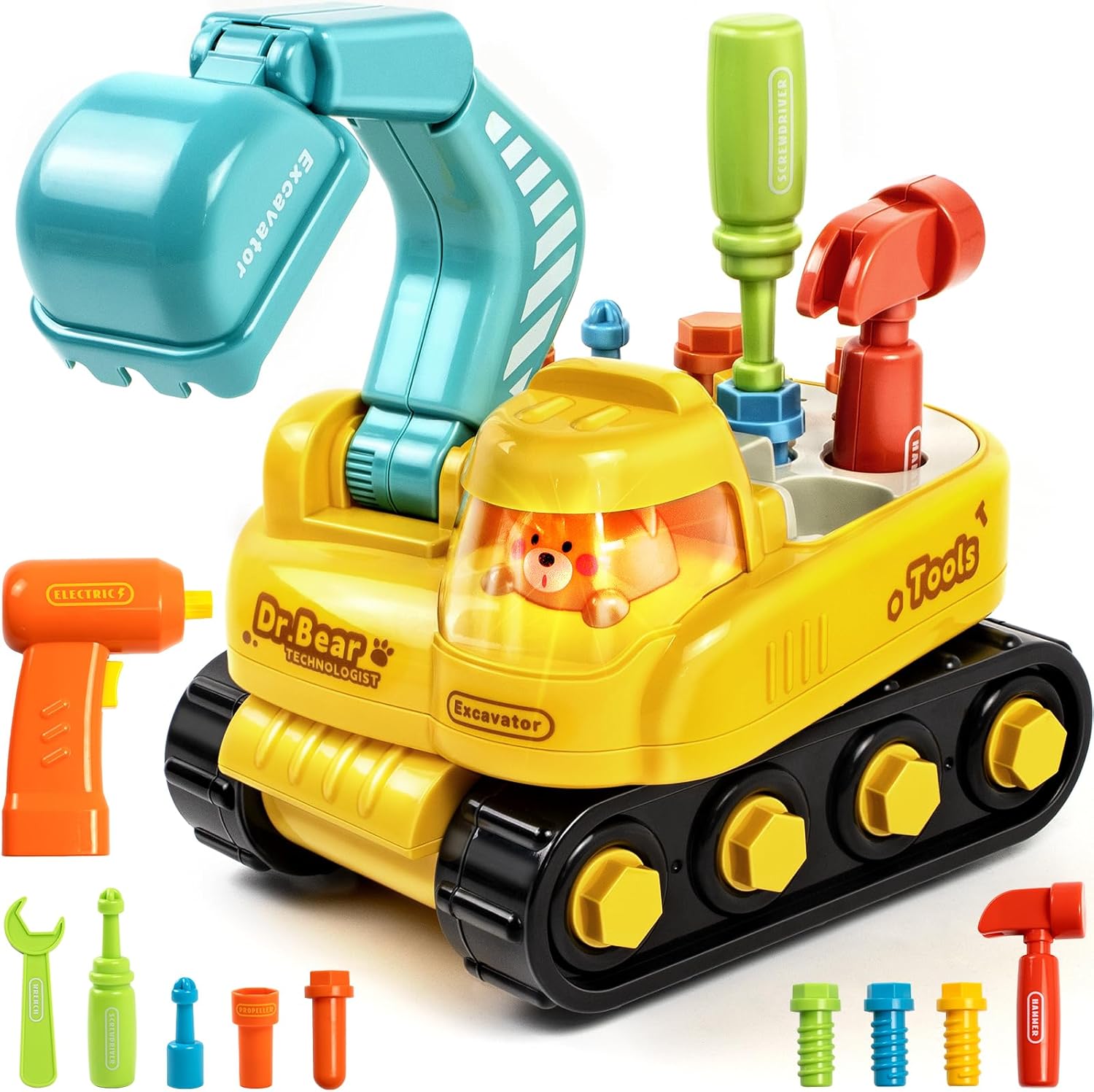
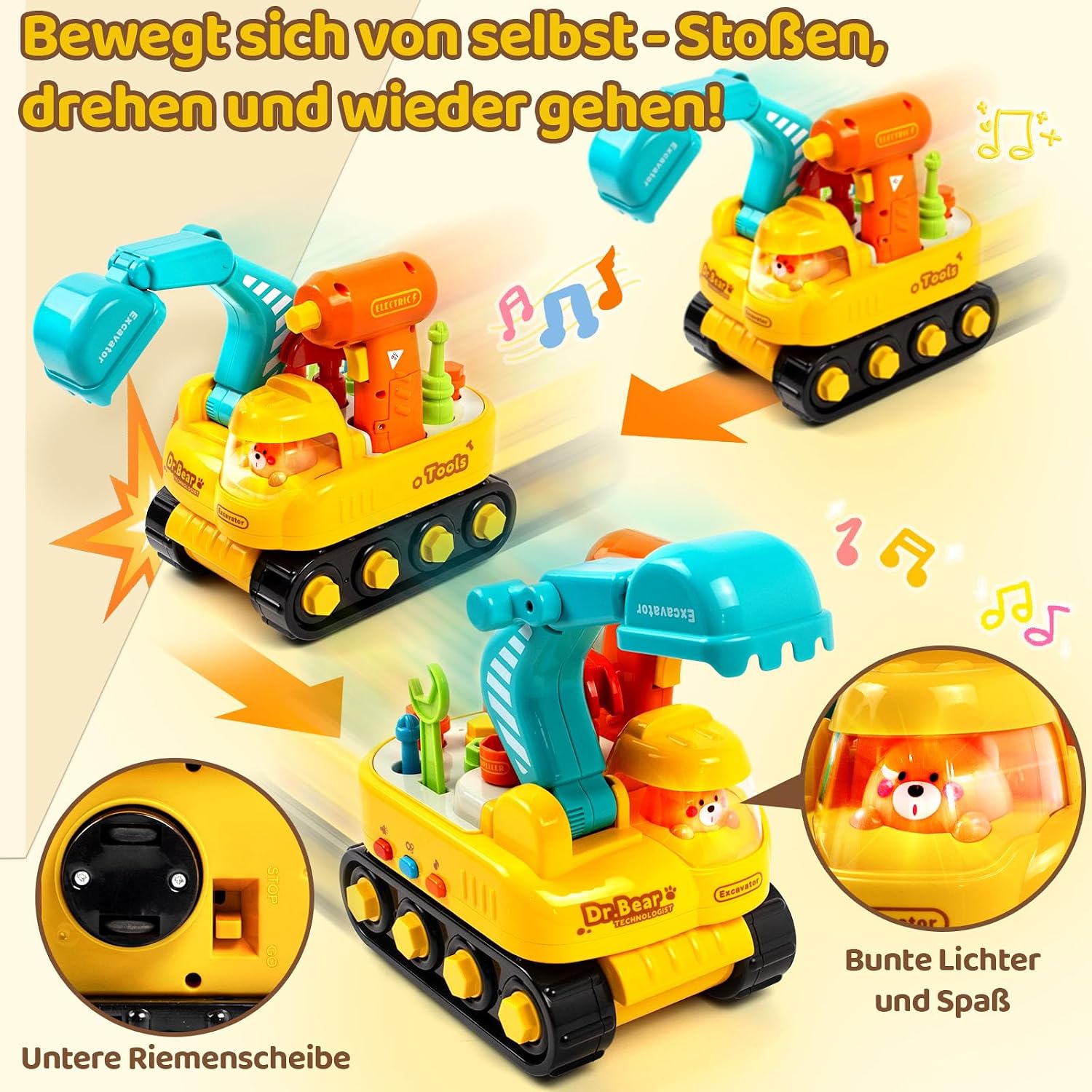
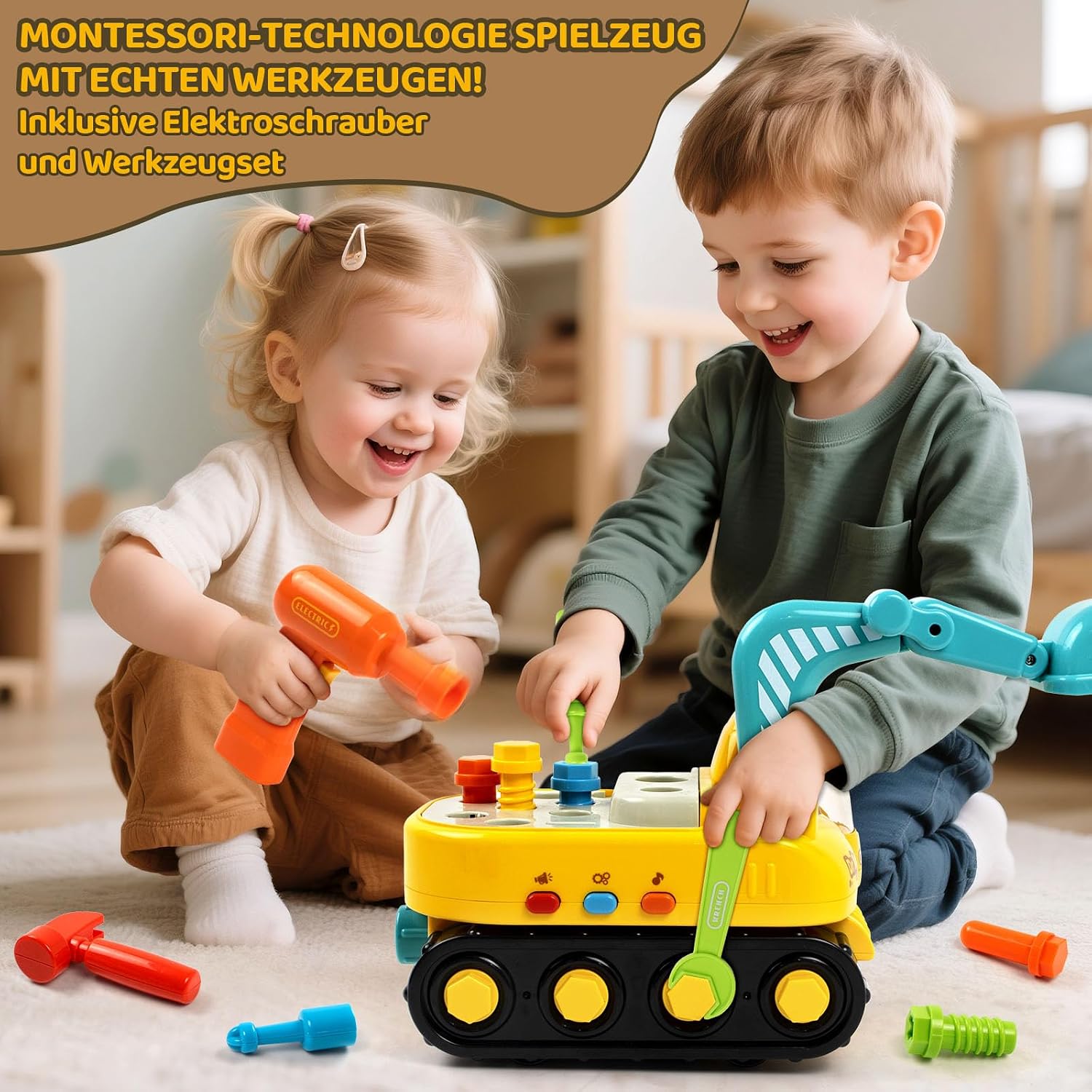
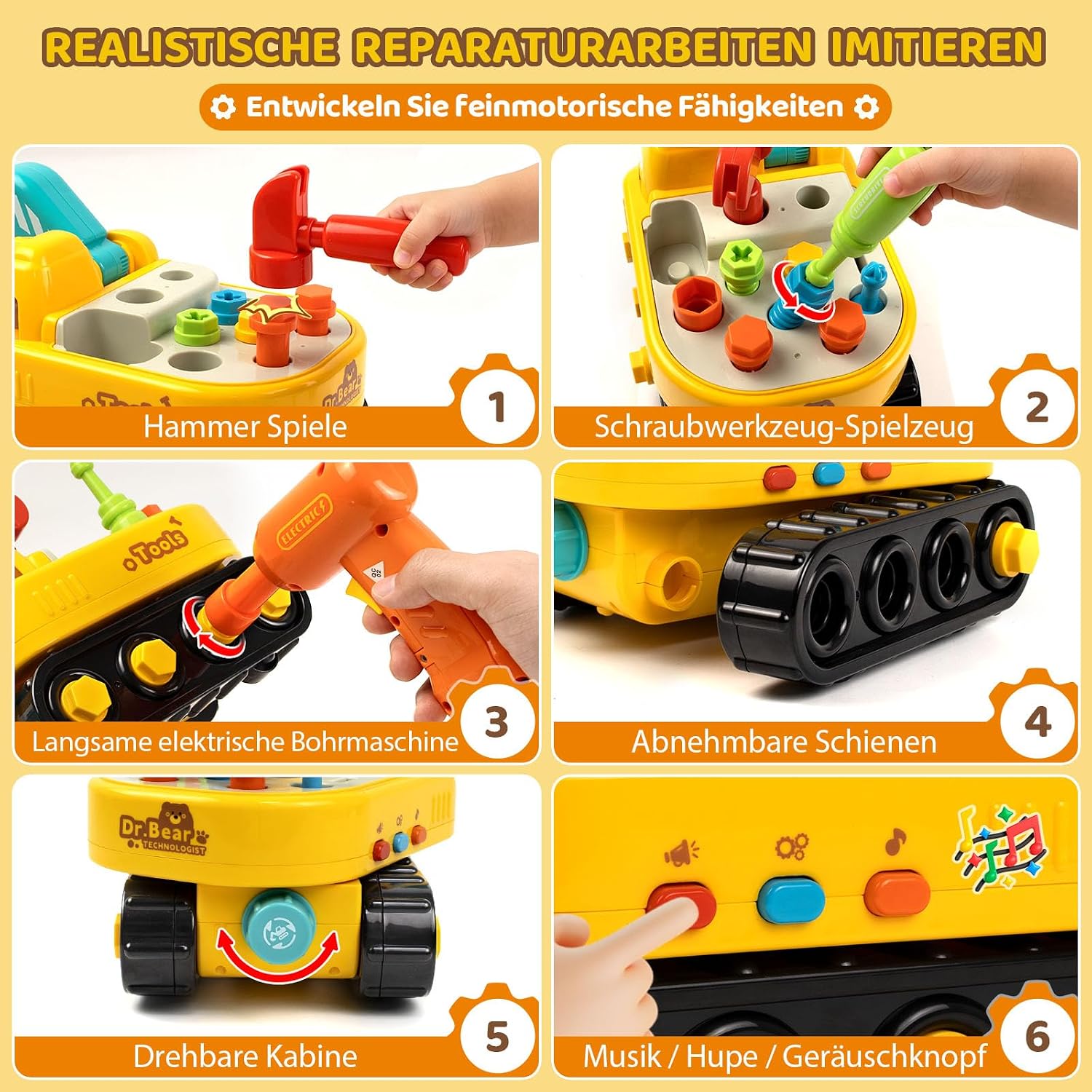
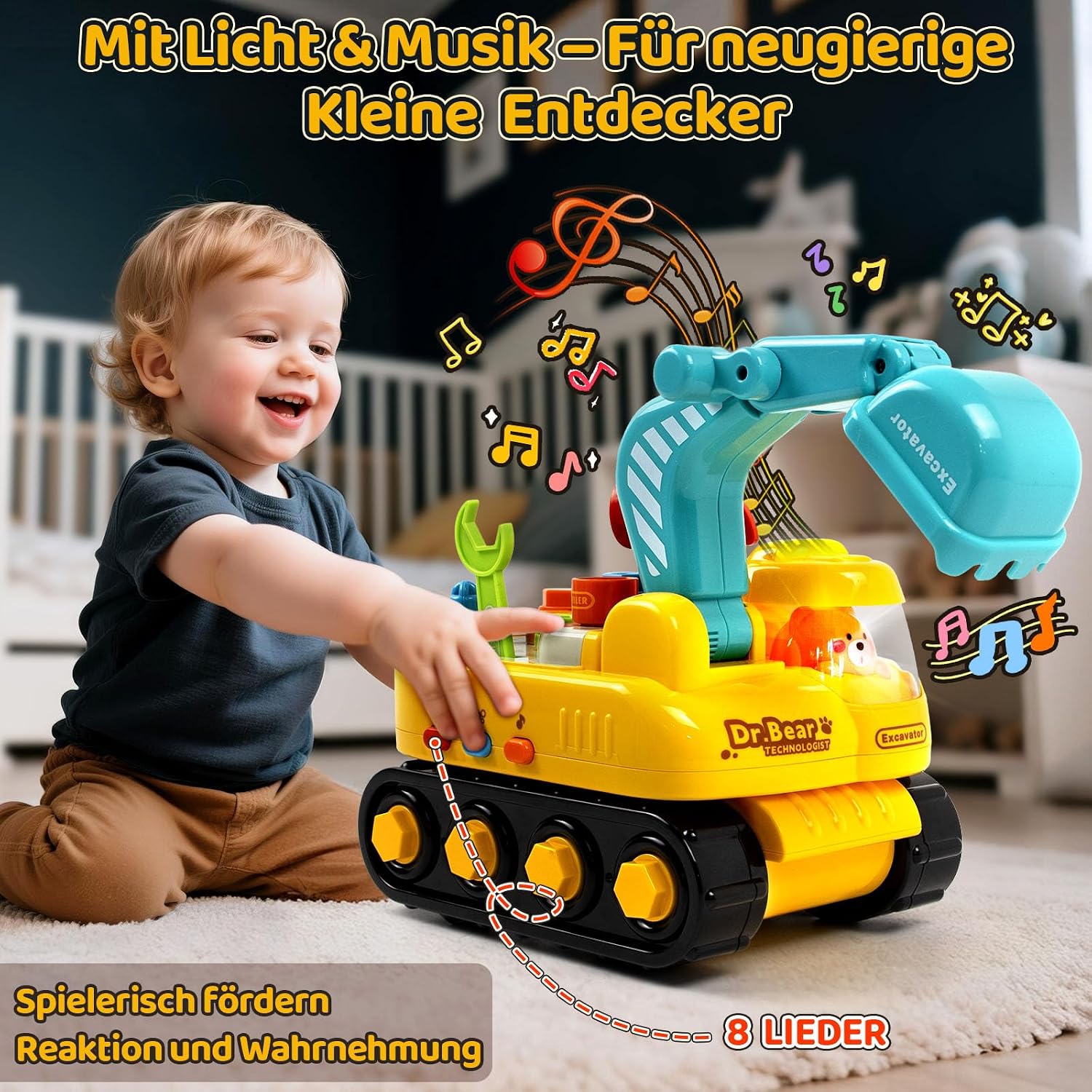
What it is and what it tries to achieve\nThis educational construction vehicle brings a hands-on pretend play experience to toddlers and early learners. The electric excavator toy includes a battery-powered drill, a manual wrench, and a collection of colourful screws to encourage fine motor skills, basic problem-solving and early STEM awareness. Aimed at children around 18 months and up, it blends imaginative play with simple mechanical tasks to spark curiosity about how things are built and how machines work, without overwhelming younger users.\n\n## How it works and what makes it engaging\nThe vehicle drives automatically and is equipped with auto obstacle avoidance, turning around when it meets an obstacle for safer, continuous play. The front bucket, main arm and a smaller arm are movable, and the driver’s cabin can rotate to add a touch of realism. Three interactive controls light up the play area: a music button that plays eight cheerful songs, a second button that triggers engine and machinery sounds, and a third for volume control. LED lights flash to add visual excitement as kids pretend to construct and repair. It’s designed to be durable and straightforward to operate, so little hands can experiment freely.\n\n## What stands out (and where it may fall short)\nOn the plus side, the set emphasises hands-on learning. The combination of a real drill-like tool and manual components helps with dexterity and eye–hand coordination, while the rotating cabin and movable arms enhance imaginative scenarios. The audio-visual features add engaging feedback during play. However, the experience hinges on the child’s interest in pretend-play engineering, older toddlers or children seeking more complex tasks may outgrow it quickly. It’s also worth noting that the learning outcomes depend on guided, purposeful play rather than pure discovery alone.\n\n## Who it’s for\nIt suits parents and carers looking for a compact, safe introduction to construction play for toddlers (18 months to around 4 years). It’s particularly useful if you want a toy that blends imaginative role-play with basic mechanical interaction and sensory feedback.\n\n## Who it isn’t ideal for\nIf you’re after a highly technical or advanced STEM toy with real hydraulics or sophisticated coding, this set isn’t the right match. It’s also less suited to kids who prefer active outdoor play or who want a larger, more feature-rich vehicle in a short timeframe.\n\n## When it makes sense to buy\nIf you value a structured, all-in-one activity that combines pretend building, fine motor practice and simple cause–effect learning in a compact form, this toy offers a realistic balance. It works well as a birthday present or a contribution to a wider toy rotation aimed at developing basic engineering concepts in a playful way.\n\n## What to check before buying\nLook for age-appropriate safety features (rounded edges, non-toxic materials) and verify that the drill and tools are easy to manipulate for small hands. Consider how much room you have for playtime and whether the automatic drive mode aligns with your child’s play style.\n\n## Practical usage note (real-world scenario)\nImagine your toddler guiding the excavator along a pretend worksite, tightening screws with the included drill and wrench while the cabin rotates to align with the “work area.” The lights and music respond to even gentle actions, reinforcing a sense of cause and effect during play.\n\n## How it compares to alternative approaches\nIf you want a contained, studio-style toy that teaches through immediate, tangible manipulation, this set offers a strong value proposition: all-in-one tools, movable parts and interactive feedback in one compact unit. For children who prefer larger outdoor play or more physically active construction play, a larger vehicle or separate role-play kit could supplement this set.\n\n## What you get (in brief)\nA safe ABS-plastic excavator toy with movable arms, a rotating cabin, a battery-powered drill, a manual wrench, screws, and three sound/light buttons. The build prioritises durability and simple functionality suitable for toddlers.\n\n## FAQ (short answers)\n- Is it suitable for 18-month-olds? Yes, with adult supervision and guidance to ensure safe handling.\n- Can the volume be adjusted? Yes, there is a dedicated volume control.\n- Does it require assembly? The basic components are assembled, but some interactive elements may need minimal setup.\n\n## Final decision\nIs it worth it? Worth considering if you’re after an engaging, compact toy that blends pretend play with basic mechanical skills and interactive features, suitable for 2–4 year olds. It may not satisfy older children seeking more complexity or more strenuous construction activities.