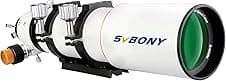
Svbony SV503 80mm ED refractor OTA for astrophotography 📷

Description:
This Svbony refractor optical tube assembly brings an 80 mm aperture and ED doublet optics to visual astronomy and deep sky astrophotography, offering brighter views and improved colour fidelity for more detailed observing sessions. It suits amateur astronomers who already have a mount and want a high-contrast, portable OTA for planets, the Moon and brighter nebulae.
Key Points
The SV503 pairs an 80 mm aperture with extra-low dispersion glass to reduce chromatic aberration and give images with more accurate colours, according to the manufacturer. The tube includes an ultra-wideband fully multi-coated optical path to cut reflectivity and reduce internal reflections, which helps deliver cleaner stars and improved contrast. 🔭
Focusing is handled by a dual-speed focuser with a 1:10 fine-tuning gear ratio, making it quicker to reach rough focus and then refine to pinpoint sharpness for both visual use and imaging. Adaptability is another strong point because the OTA accepts both 2-inch and 1.25-inch accessories without additional adapters.
A practical note, the package is an OTA only. You will require a compatible mounting system and any imaging hardware separately, and for high-resolution astrophotography a solid equatorial mount is recommended.
Technical Specifications
- Name: Svbony SV503
- Aperture: 80 mm
- Focal ratio: F7
- Optical design: Doublet ED with lanthanum glass and spacer
- Coatings: Ultra-wideband FMC, reflectivity around 0.2% per surface according to the manufacturer
- Focuser: Dual-speed 2-inch focuser with 1:10 fine focus ratio
- Accessory compatibility: 2-inch and 1.25-inch eyepieces and adapters
Usage Recommendations
For visual observing, start with low- to medium-power eyepieces to locate targets and then increase magnification for planetary detail. The fine focus is particularly useful when pairing with a planetary camera or eyepiece projection for lunar and planet imaging, where small adjustments improve clarity. ⚙️
When using for deep sky imaging consider field flattening or a reducer if you plan on wide-field targets, because faster imaging setups can benefit from additional corrective optics. Also bear in mind that atmospheric seeing and mount stability will strongly affect results, so match the OTA to a stable mount and good tracking for best performance.