

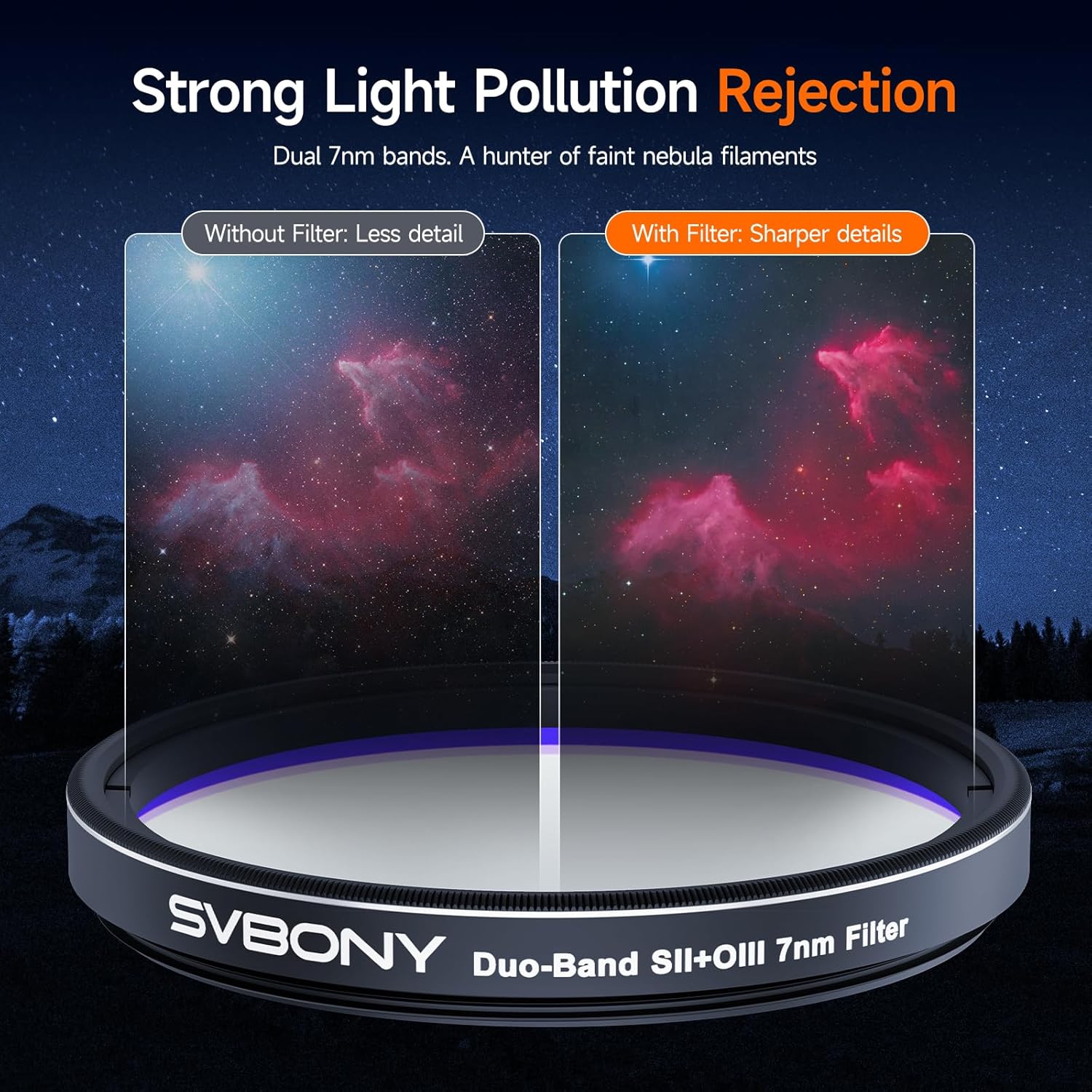
Svbony SV220 2-inch SII & OIII Telescope Filter (7nm Dual Band) for emission nebula imaging
Product description
What it is and what you’re trying to achieve
The Svbony SV220 is a 2-inch dual-band telescope filter aimed at astrophotography—specifically to capture emission nebulae using the SII and OIII wavelengths. In practical terms, it helps you deal with the two things that usually fight you hardest when imaging: light pollution and the amount of background glow that washes out faint structure.
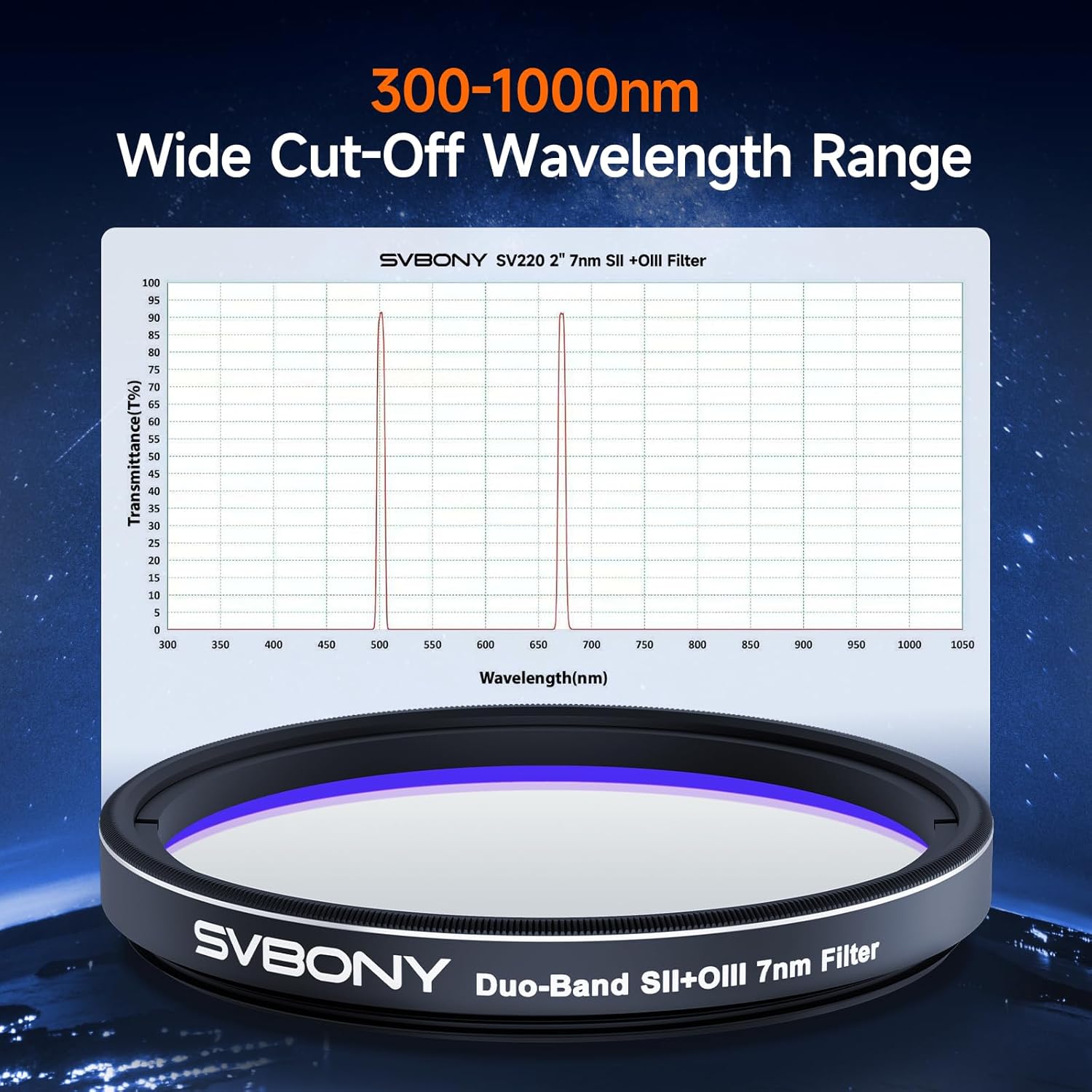
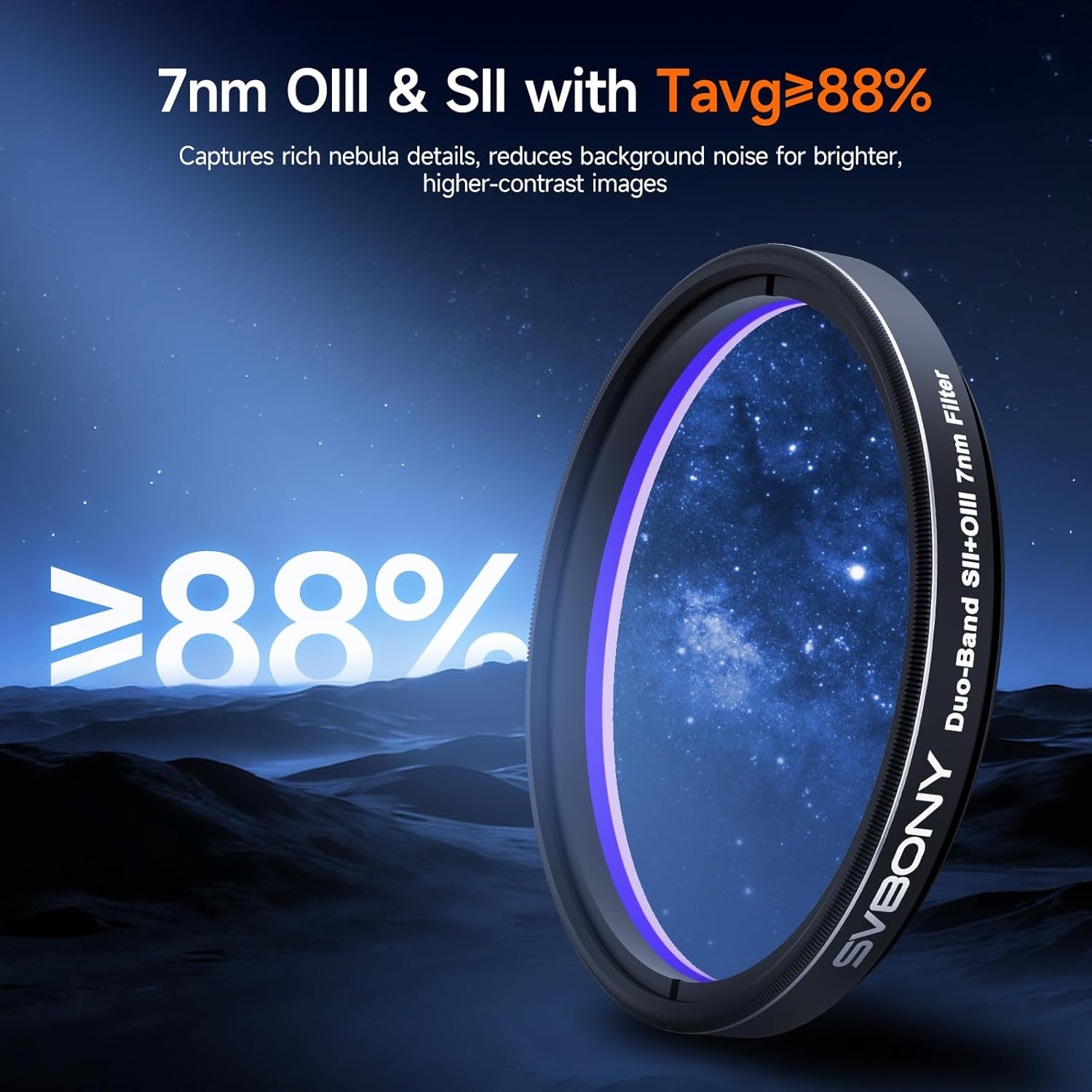
This filter is designed around narrowband ideas. The base description mentions an aggressive light-pollution cut-off of at least OD5, while still transmitting the key SII (672nm) and OIII (500.7nm) emission lines. It’s a setup that, on paper, should give you stronger contrast and cleaner colour behaviour compared with trying to do the same thing without any filter—especially if you’re imaging from a brighter sky.
That said, it’s not the kind of accessory that will magically turn every target into a perfect result. The real gains tend to show when your imaging workflow (camera type, exposure strategy, and target selection) is already leaning into emission nebulaes.
Key features that matter for buying
If you’re evaluating whether this is worth your money, focus on what’s actually stated and what it implies for your results:
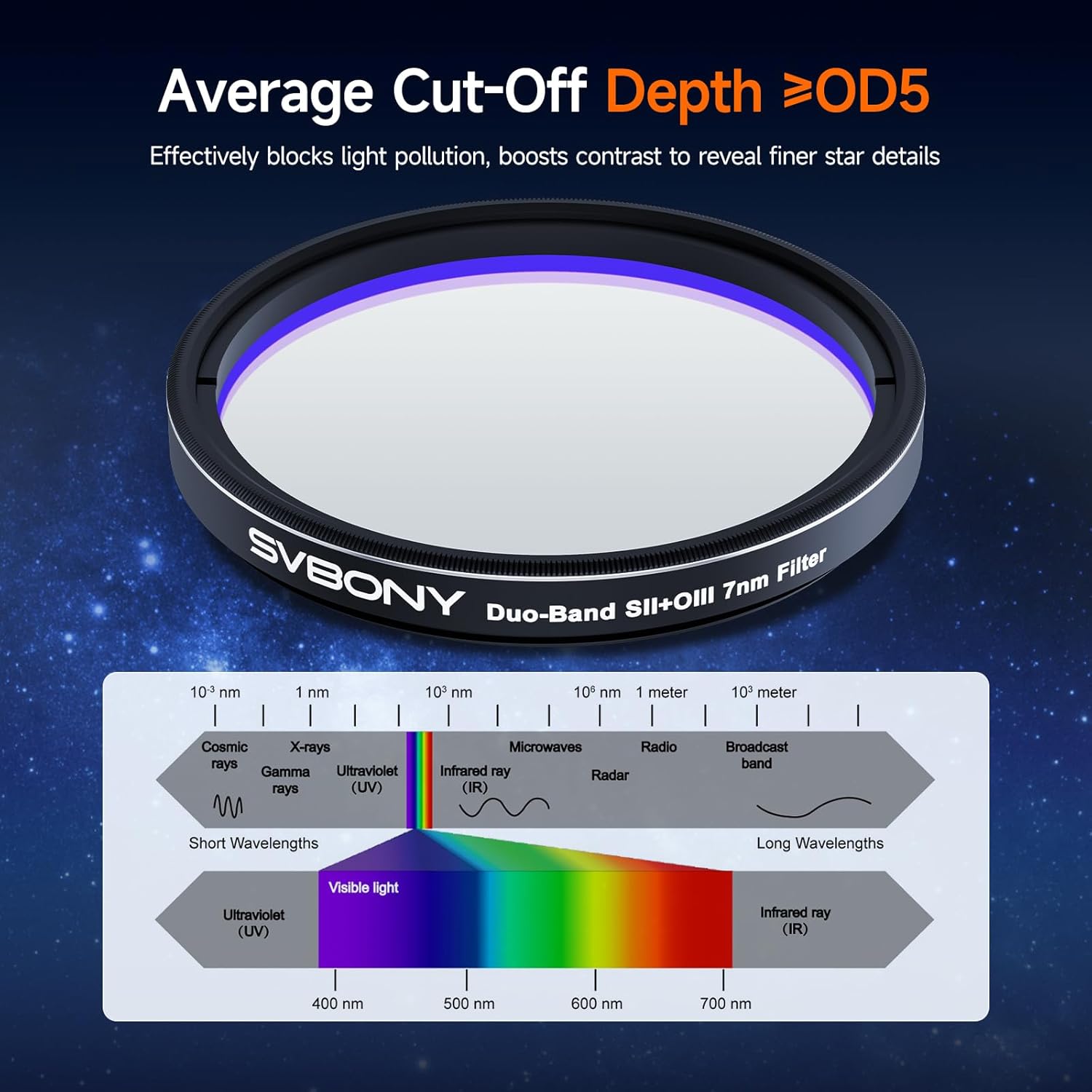
- OD5-style light pollution cut-off (≥OD5): the claim here is about reducing stray and unwanted light while retaining the useful narrowband signals.
- 7nm dual narrowband bandpass: the filter is built to isolate the SII and OIII emissions more tightly than broad “light pollution” filters.
- High peak transmission (≥88%) at SII and OIII: that’s important because narrowband filters can otherwise leave you starved for signal.
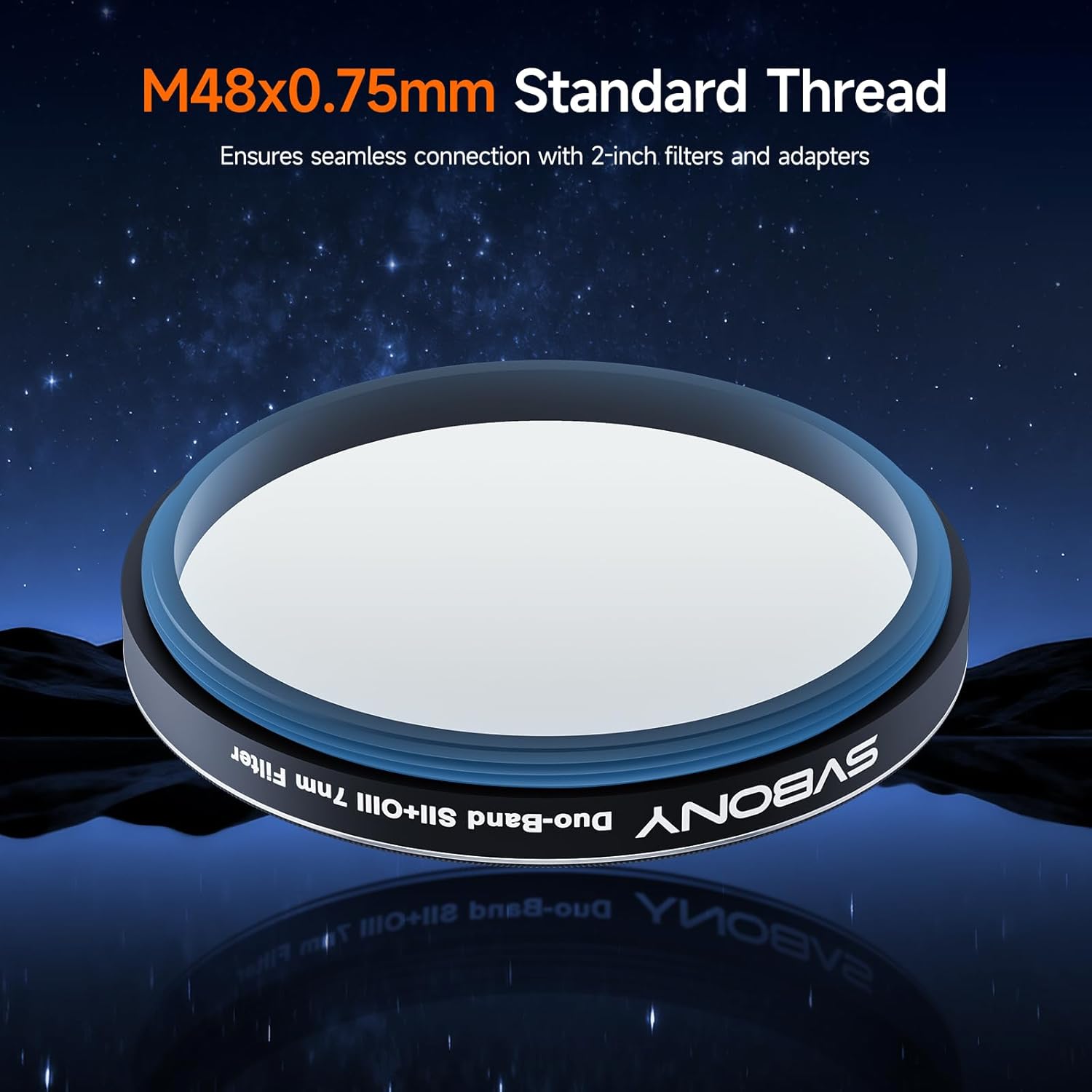
- 2-inch format with M48x0.75mm thread: this is about physical compatibility with many common 2-inch imaging setups, at least where the threading matches.
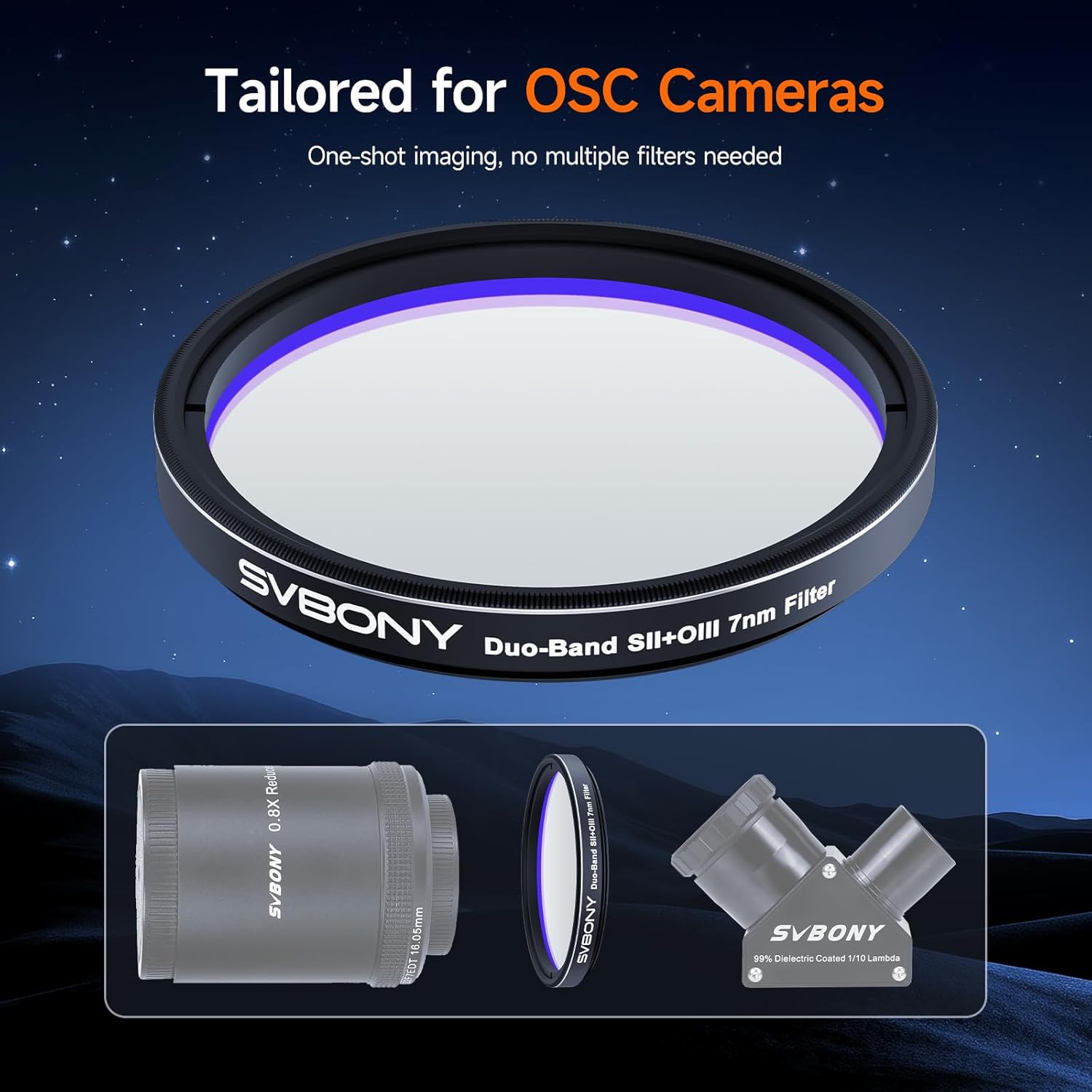
There’s also a clear workflow advantage mentioned: it’s made to simplify OSC imaging (One-Shot-Colour cameras). The SV220 is described as enabling you to capture SII and OIII together for a richer SHO palette without swapping filters.
What you’ll notice in use
This filter is at its best when you’re already shooting emission nebulae and you’re fighting a bright sky.
Think of a typical session: you set up your telescope and OSC camera, target something with lots of ionised gas structure, and start stacking. With a narrowband filter like this, the background should be less “milky”, and the nebula contrast should stand out more clearly against the remaining sky glow. Because it’s dual-band (SII + OIII in one piece), you avoid the time and hassle of changing filters mid-plan.
One thing to keep in mind from the description: it’s explicitly not designed for visual observation. So if your goal is to use it through an eyepiece, this isn’t the right direction.
Also note the recommended optical speed: it’s described as optimised when paired with optics faster than f/4. If your system is slower than that, you may find performance is less ideal than the marketing suggests.
Full-frame setup claims (and where they help)
A notable point in the base description is the 44mm clear aperture, framed as full-frame optimised performance. The idea is to support uniform illumination across full-frame sensors and reduce vignetting, helping with edge-to-edge clarity.
Whether this fully solves your vignetting depends on your exact telescope + camera spacing, but having a stated clear aperture gives you something concrete to match against your own gear. If you shoot with a full-frame sensor (or are close to it), it’s one of the reasons this filter may make more sense than smaller clear-aperture alternatives.
For who it makes sense (and who should be cautious)
It makes sense if:
- You mainly image emission nebulae and want to target SII and OIII without extra filter swaps.
- You use a One-Shot-Colour (OSC) camera and you’d like a simpler SHO-style workflow.
- You image from light-polluted skies and want to cut stray illumination while keeping the key emission lines.
- You have (or plan to use) a 2-inch imaging train that can take the filter via the stated M48x0.75mm thread approach.
It’s not the best match if:
- You’re looking for something to use visually at the telescope—the description is clear that it’s not intended for that.
- Your system is not faster than f/4 (since the filter is described as optimised for faster optics, and imaging performance may not align with expectations otherwise).
- You’re expecting a “general-purpose” nebula filter to perform like a dedicated narrowband system in every scenario, it’s specifically about SII/OIII emission-line work.
The essentials on compatibility and buying checks
Before you buy, it helps to confirm three practical points:
- Threading / mounting: the base description states a universal M48x0.75mm thread, intended to integrate into most 2-inch setups. Double-check that your camera/filter holder path uses that standard.
- Your camera type: it’s presented as simplifying things for OSC imaging. If you’re using a different camera workflow, the “no filter swaps needed” angle may not apply in the way you’re imagining.
- Optical speed: consider whether your telescope is f/4 or faster, as the description calls out faster optical systems for optimal performance.
Mini FAQ
Does this filter work for visual observing?
No. The description specifically notes that it is not designed for visual observation.
What does “OD5 cut-off depth” mean in practice?
On paper, OD5 implies a strong reduction of unwanted light and stray illumination. The practical expectation is less background wash-out when imaging, while still transmitting the target emission lines (SII and OIII).
Can I capture SII and OIII in one go?
The base description says it’s designed to simplify OSC imaging by capturing SII and OIII together, aiming to help produce a richer SHO palette without filter swaps.
Is it suitable for full-frame sensors?
The description claims full-frame optimised performance using a 44mm clear aperture, intended to support uniform illumination and edge-to-edge clarity.
Is it optimised for all telescopes?
It’s described as optimised when paired with optical systems faster than f/4. If your optics are slower, it may not deliver the same results.
Should you buy it?
Buy the Svbony SV220 if you’re doing emission-nebula astrophotography from a light-polluted area, you want a dual-band SII/OIII filter in a 2-inch imaging workflow, and you value the idea of capturing both key lines together—especially with an OSC camera. It’s also a stronger buy if you care about full-frame illumination behaviour, given the stated 44mm clear aperture.
Skip it if you need something for visual use, or if your setup doesn’t match the “faster than f/4” optimisation claim. And if your target plans aren’t really emission-focused, you may end up with a tool that’s more specific than you need.