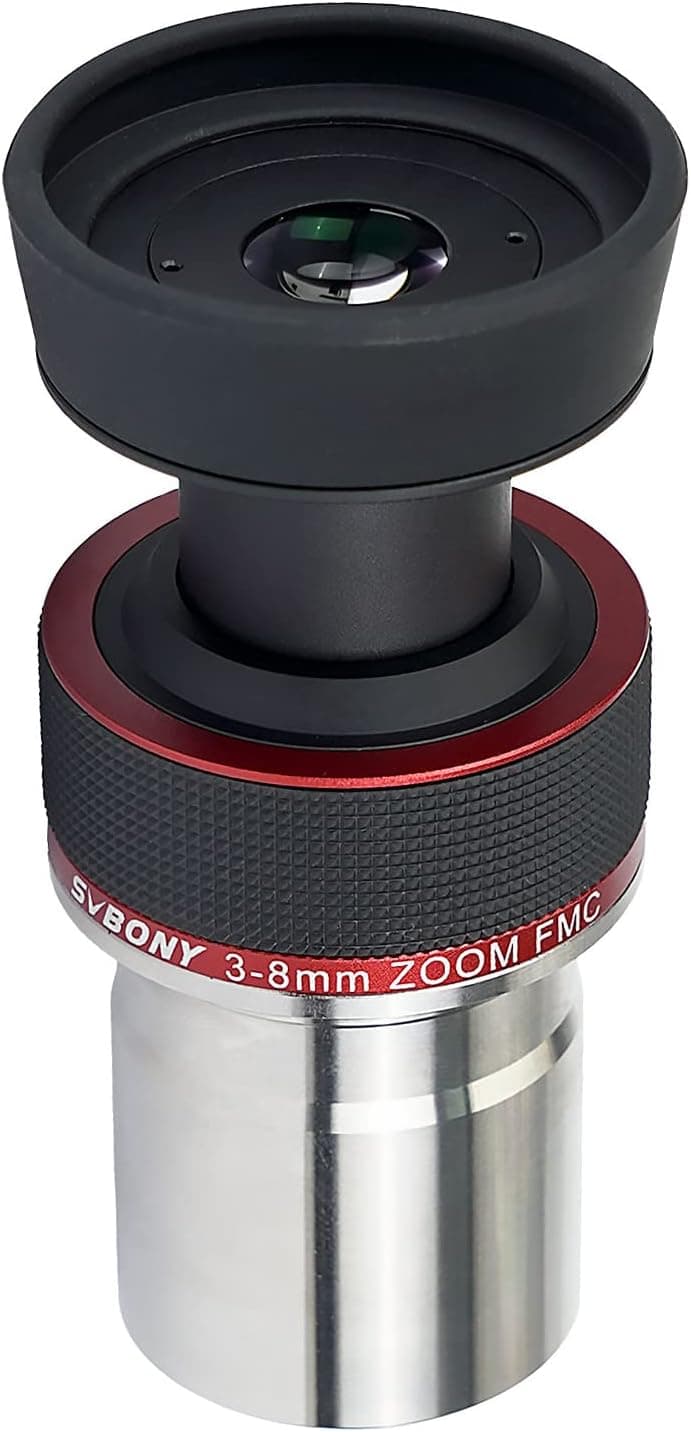


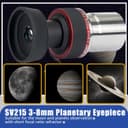
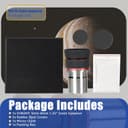
Svbony SV215 zoom eyepiece 3–8mm for lunar viewing 🔭

Description:
This compact zoom eyepiece brings adaptable high magnification for lunar and planetary viewing, combining a 3-8mm focal range with a parfocal design to reduce refocusing when switching powers. It is intended for short focal length refractors where contrast and detail on planets and the Moon are priorities, and it helps observers move quickly between magnifications during a session.
Key Points
The eyepiece keeps a consistent apparent field of view of 56 degrees, which helps maintain a comfortable viewing window as you zoom between focal lengths. Its parfocal behaviour means you normally do not need to refocus after each change of focal length, saving time when tracking fast moving targets. The barrel clicks at each millimetre, so adjustments are tactile and repeatable even in low light. 🔭
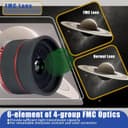
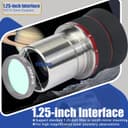
Anti-reflective coatings and a multi-element construction support better contrast for planetary features. The 6 element 4 group optical layout with FMC coatings reduces internal reflections and increases light transmission, according to the manufacturer. This improves image crispness when observing fine surface details on the Moon and the brighter planets. 🌕 The compact design is lightweight and easy to fit into standard 1.25 inch focusers.
Technical Specifications
- Name: SVBONY SV215 Zoom Eyepiece
- Focal length: 3-8 mm
- Barrel size: 1.25 inch
- Apparent field of view: 56°
- Optical design: 6 elements in 4 groups, FMC coatings
Usage Recommendations
Use the narrower focal lengths for higher magnification views of lunar craters and planetary limbs, and the longer end of the zoom when you want more context around an object. For quick planetary sessions start at a medium setting to centre the target, then click up or down to refine the image while tracking the object in the eyepiece. For best contrast, pair the eyepiece with a telescope that has good optical quality and sufficient aperture to support high magnification without excessive seeing limitations.
Consider that extreme zoom settings place greater demands on atmospheric stability. In poor seeing conditions, the highest powers may not yield extra detail and can make the image appear unstable. Also bear in mind that the eyepiece is optimised for planetary and lunar observation, and may not be the preferred choice for wide field deep sky work where lower magnification and a wider true field are beneficial. ✨