

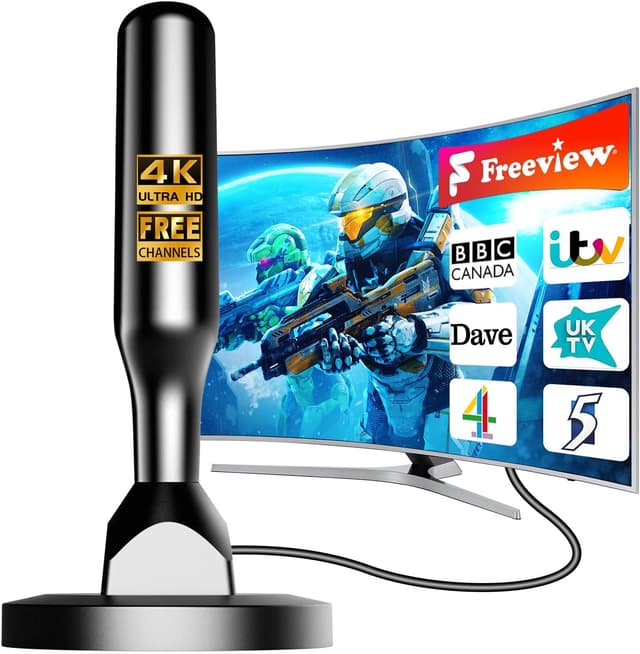
Indoor TV Aerial for Freeview (Long Range 360°) with Magnetic Base and 5m Coax Cable
Product description
The essentials
If you’re trying to get Freeview channels without relying on a wall socket, a complicated setup, or something that only works “most of the time”, an indoor aerial like this is the sort of practical fix worth considering. The idea here is straightforward: put an aerial where reception is best, run the included coax lead, then scan your TV for channels.
On paper, this model leans towards long-range use with a 360° reception approach and a magnetic base for positioning. It also claims strong VHF/UHF reception and support for modern picture formats (4K/1080p HD is mentioned). That matters if you’re buying once for a range of TV setups, including Smart TVs and older HD-ready models.
One caveat though: “long range” doesn’t override local signal conditions. Indoor reception can vary a lot depending on your area, building materials and how you position the aerial—so it’s not guaranteed to be a miracle solution everywhere.
What to know before you buy
This product is specifically presented as an Indoor TV Aerial for Freeview, with instructions to check channel availability in your area via freeview.co.uk or digitaluk.co.uk before purchasing. That’s a sensible step, because Freeview availability isn’t identical across the UK.
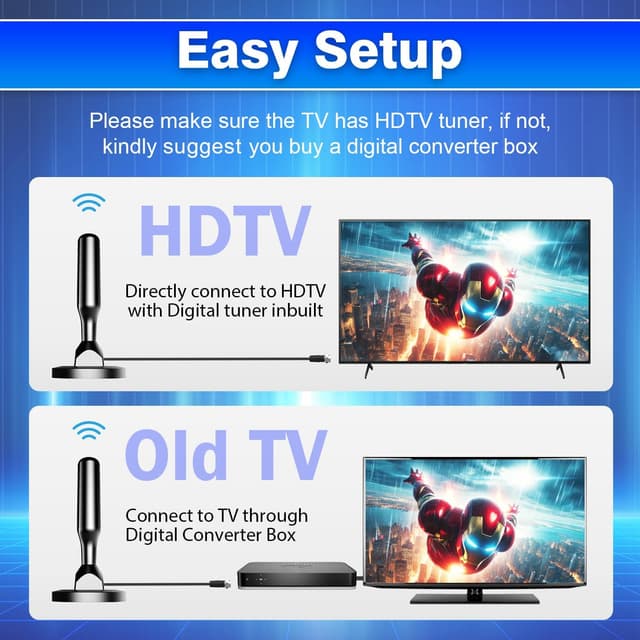
It also asks you to confirm whether your TV is an analogue or digital TV, and to look for markings indicating a digital tuner. In practice, most people buying an aerial for Freeview are using a digital tuner, but it’s still worth checking to avoid a frustrating “scan found nothing” situation.
For connection, it’s described as using a standard coaxial input. The base setup is presented as plug-and-play, with the suggestion that no amplifier is required.
Key features that affect day-to-day use
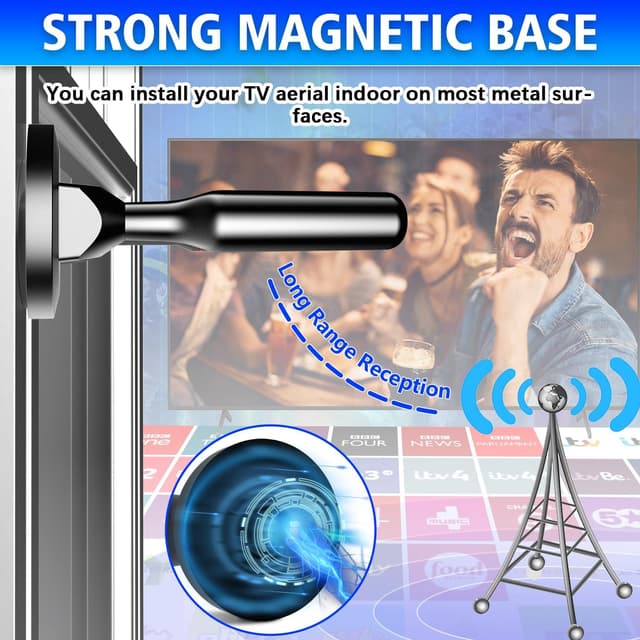
Where this aerial feels designed for real life is in placement. The magnetic base is meant to help you position it quickly near a window, on a shelf, or where the signal is strongest, without needing tools or mounting hardware.

The included coax cable is listed as 5m, which is a meaningful detail: it gives you some room to move the aerial rather than being stuck next to the TV. If your TV is not near a window or door, that extra length can be the difference between acceptable reception and constant drop-outs.
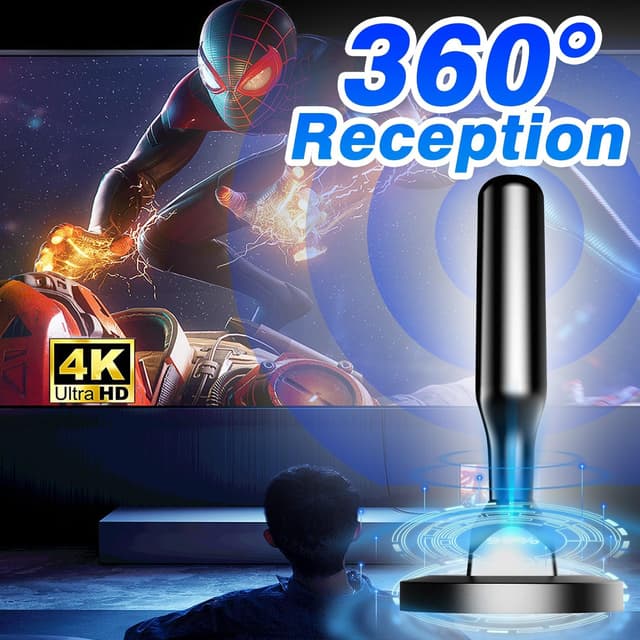
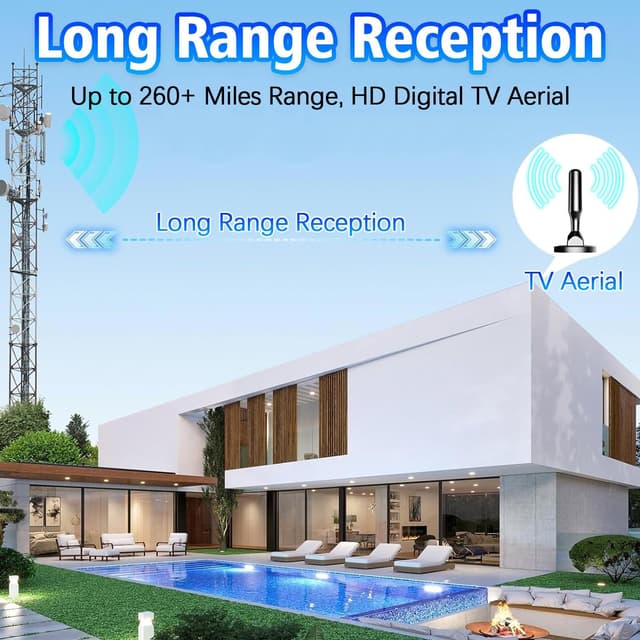
It also claims “Long Range 360°” reception and support for VHF/UHF. Those are the types of specs that can be helpful if you’re in an area where you want flexibility in antenna orientation.
Tech specs
- Type: Digital TV aerial (Freeview)
- Coverage: Long-range 360° reception
- Reception bands: VHF/UHF
- Supported picture formats: 4K and 1080p HD (also mentions 8K)
- Base: Magnetic base
- Coax cable length: 5m
- Connection: Standard coaxial input
Getting the most from installation
Aerials are a bit like Wi-Fi extenders—placement is often the whole game. With this one, the practical approach is:
First, connect the coax cable to the TV’s coaxial input, then place the aerial where reception is likely best (often closer to a window). Since the base is magnetic, you can adjust position while you’re scanning for channels.
Next, run the TV channel scan and don’t just assume the first result is the final one. If some channels are weak or missing, try moving the aerial slightly and rescan. The “360°” angle is useful in that you’re not purely relying on a single direction, but you’ll still want to optimise placement.
A micro-example: if you have your TV in a bedroom and the only good window is opposite the set, a 5m lead allows you to move the aerial without having to drag the TV around. Put the aerial near the window, scan, then fine-tune by shifting it a small distance.
Strengths and where it may fall short

What stands out is the focus on easy setup and flexible positioning—magnetic base plus a decent cable length makes it easier to experiment with placement. It’s also described as compatible with both Smart TVs and older HD-ready models, as long as your TV has the right digital tuner.
However, it may not be a great match if your local reception is very marginal. Indoor aerials can be sensitive to walls, distance from the transmitter and even how the aerial is oriented in the room. Also, while it’s said to be plug-and-play with no amplifier, that doesn’t mean it will perform well in every reception scenario.
It’s not the best choice if you’re expecting a guaranteed signal boost regardless of geography. If you’re already getting solid Freeview reception, you might find a simpler or already-installed solution makes more sense.
In the box / compatibility considerations
The description focuses on an indoor aerial with a magnetic base and an included 5m coax cable. It also highlights that you connect to any TV with a standard coaxial input, including Smart TVs, older HD-ready models, and Freeview boxes (assuming you’ve got the right digital tuning setup).
Because the instructions explicitly point you to freeview.co.uk and digitaluk.co.uk for available channels, it’s worth treating this as a reception tool for your specific area, not a universal guarantee.
Mini FAQ
Should I check Freeview availability before buying?
Yes. The product notes recommend checking freeview.co.uk or digitaluk.co.uk first, since channel availability varies by location.
Do I need a digital tuner?
The instructions say to check whether your TV is analogue or digital and look for markings indicating a digital tuner.
Can I use it with older TVs?
It’s described as compatible with older HD-ready models, as long as they support the coaxial input and have the right digital tuner.
Is it really plug-and-play?
The setup is presented as plug-and-play: connect via coax, scan for channels, and start watching. If reception is weak, you may still need to reposition the aerial.
What if the TV is far from the aerial?
The included 5m coax cable is there to help with that—so you can place the aerial where reception is best rather than being forced to keep it right next to the TV.
Final verdict
This indoor Freeview TV aerial is worth considering if you want an easy-to-position option with a magnetic base and a 5m coax lead, and you’re prepared to spend a few minutes optimising placement during channel scanning. It’s a sensible pick for homes where indoor reception is likely workable, including situations like a bedroom TV where the aerial can sit near a window.
You may want to skip it if your local Freeview signal is borderline, because no indoor aerial can fully ignore building shielding and distance effects. Also, if you haven’t confirmed digital tuner support on your TV or checked channel availability in your area, you might end up buying the right aerial for the wrong setup.
When it makes sense
Buy it when you want a straightforward Freeview aerial for indoor use, you have a coaxial input, and you’re willing to trial a couple of positions to get the best scan results. Avoid it if you need a guaranteed high-strength signal regardless of your reception conditions.