

How to Stack Savings on UK Online Shops (Without the Checkout Chaos)
A practical UK guide to combining voucher codes, cashback, gift cards and loyalty perks—plus how to avoid common tracking and returns pitfalls.
Stacking savings sounds simple: find a code, click a cashback link, pay with a discounted gift card, and walk away smug. In reality, it’s easy to break cashback tracking, accidentally invalidate a voucher, or create a returns headache.
This guide is about doing the “stack” calmly—so you get the discount you expect, the cashback you’re owed, and a checkout that doesn’t fall apart at the last click.
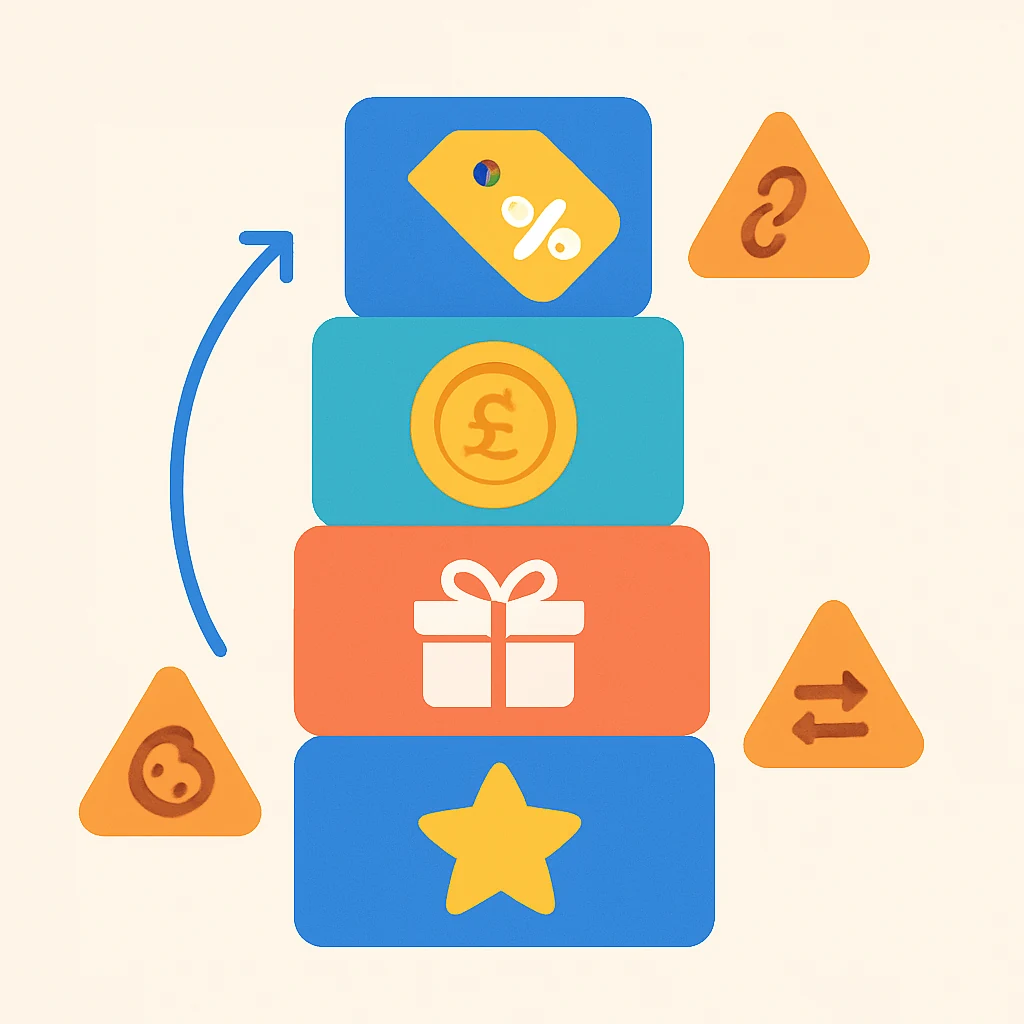
What does “stacking” actually mean in the UK?
Stacking is combining more than one type of saving on the same online order. In the UK, that usually means mixing some of the following:
- a voucher/discount code at checkout (or an automatic code applied by a browser extension)
- cashback through a cashback site, an app, or your bank’s cashback offers
- paying with a gift card (sometimes bought at a discount)
- loyalty points (retailer points, card-linked offers, or membership perks)
- free delivery thresholds or Click & Collect to avoid delivery charges
Not every retailer allows every combination. Some actively block cashback when you use certain codes; others allow it but only if the code is “approved”. The goal is to choose a stack that’s likely to track and that you can still unwind if you need to use your returns rights.
The “safe order” to stack savings without losing cashback
Q: Is there a best order to do things in?
There isn’t a universal rule, but there is a reliable approach that avoids the most common tracking failures. Think of cashback as the most fragile part of the stack: it’s usually dependent on tracking cookies, referral links, and a clean journey from click to checkout.
Here’s the cleanest sequence for most UK purchases:
- Decide the product, options and size first (so you’re not hopping between tabs later).
- Choose your voucher code strategy (none Ofertas retailer code Ofertas “approved” code).
- Start a clean session (incognito/private window helps) and click through from the cashback site last, right before you add to basket and pay.
- At checkout, apply the voucher code (if you’re using one) and pay.
If you do it the other way round—trying codes first, clicking around comparison pages, then clicking cashback—you’re more likely to overwrite the tracking.
Voucher codes: how to tell which ones are worth trying
Q: Why do some voucher codes “work” but leave me worse off?
Because “works” can mean different things:
- It applies a discount, but it excludes sale lines you were already buying.
- It blocks cashback (or reduces the cashback rate).
- It swaps a better offer for a worse one (for example, you lose free delivery over £X because the discount drops you under the threshold).
A practical approach is to treat voucher codes as a test, not a promise. If a code takes £5 off but costs you £8 in cashback and delivery, it’s not a win.
Q: Are browser extensions for codes safe to use?
They’re convenient, but they can interfere with cashback tracking because they inject affiliate links or change the referral path. If cashback matters on this order, keep it simple:
- either don’t use an extension for that purchase
- or apply a code you already trust (ideally from the retailer, a student/NHS portal, or the cashback site’s “approved codes” section)
You can still use extensions for low-stakes purchases where cashback isn’t part of the plan.

Cashback: how to stop it getting declined later
Q: What actually causes cashback not to track?
Most “missing cashback” cases come down to a messy click path. Common culprits include:
- switching devices mid-purchase (click on mobile, buy on laptop)
- opening multiple tabs and checking out in the “wrong” one
- applying lots of codes via third-party sites
- using certain payment options that don’t qualify (the retailer’s T&Cs will say)
A good habit is to do cashback purchases in a fresh session and complete checkout in one go.
Q: Can I use cashback and voucher codes together?
Sometimes. Retailers often allow cashback only with:
- no code at all, or
- specific codes listed as eligible
So before you commit, check the cashback page’s notes for that retailer. If it’s vague, the safest play is: pick either the strongest voucher or the cashback—whichever gives you the bigger guaranteed saving.
Q: What about my bank’s cashback offers?
If your bank offers card-linked cashback, it can stack nicely because it doesn’t rely on the same click tracking. But it can have its own rules (activation required, specific retailers, time windows). Treat it as a separate layer: check it’s activated before you pay.
Gift cards: the underrated “quiet discount” (with a couple of traps)
Q: Is buying a discounted gift card worth it?
It can be, particularly for planned spends (big household buys, kids’ clothing before term starts, seasonal bits ahead of Christmas, or a Boxing Day purchase you already know you’ll make). The key is not the discount itself—it’s whether it complicates the rest of your stack.
Two practical checks before you rely on a gift card:
-
Returns: if you return an item, you might get refunded back to a gift card rather than your bank card. That’s fine if you shop there regularly, annoying if you don’t.
-
Cashback eligibility: some retailers treat gift-card payment as ineligible for cashback, or only award cashback on the amount paid by debit/credit card. Always check the cashback notes.
Q: Can I pay partly by gift card and still earn cashback?
It depends on the retailer’s tracking rules. Some award cashback on the full basket value, some on the amount actually paid after gift cards, and some exclude it entirely. If the purchase is mainly about cashback, consider paying normally and saving the gift card for a separate order.

Loyalty points and member pricing: should you log in?
Q: Does logging into my account break cashback?
Usually not, but it can if it triggers extra redirects (apps are the big culprit here). For a straightforward, trackable purchase, it’s often better to:
- use the retailer website in a browser rather than their app
- log in only after you’ve clicked through from cashback, not before
Member pricing can be worth it, but watch the trade-off: some “member deals” are essentially the voucher code in another form, and may affect cashback.
Q: What about student/NHS/Blue Light discounts?
These can be excellent because they’re often a clean, approved discount route. However, they sometimes require you to go through a specific portal that acts like its own referral link—meaning it can clash with cashback.
If the discount is strong, take it and forget cashback. If it’s small, compare both options and choose the one you’re more likely to actually receive.
A quick “checkout sanity” block (use this when you’re in a rush)
If you only remember one thing, remember this: pick a main saving, then add one extra layer that won’t break it.
Quick tips:
- If cashback matters, don’t “code hop” across five voucher sites first.
- If you’re using a gift card, double-check the returns/refund route.
- If delivery is pushing the total up, try Click & Collect before you abandon the basket.
- Screenshot (or save) the offer terms and your order confirmation—useful if you need to query missing cashback or a discount not applying.
Returns, refunds and VAT: what changes when you stack?
Q: If I return something bought with a voucher code, do I lose the discount?
Retailers usually refund what you actually paid, not the pre-discount price. If it was a multi-buy or “spend £X, get £Y off” offer, returning one item may change the calculation. That’s not a scam; it’s how the promotion is structured.
Q: What happens to cashback if I return the order?
Cashback is typically reversed if you return all or part of an order (because the retailer isn’t keeping the sale). If you do a partial return, the cashback may be reduced.
Q: Do I need to think about VAT when comparing deals?
For most UK consumer shopping, prices are shown inclusive of VAT. The useful bit is reading the small print around delivery charges and returns costs, because those can wipe out a “deal” quickly.
If you want more UK-focused deal guides, you can browse the latest posts from the homepage: /

FAQs people don’t ask until something goes wrong
Q: My cashback didn’t track—what should I do first?
Before raising a claim, wait the retailer’s stated tracking window (it varies). Then gather your basics: order number, order value, date/time, and confirmation email. If you used a code, note which one. Claims are much easier when you can show a clean timeline.
Q: Should I use PayPal, Apple Pay or Klarna if I care about cashback?
Sometimes these payment methods are excluded, sometimes not. Don’t guess—check the cashback page notes. If it’s a high-value purchase, it can be worth choosing a plain debit/credit card payment to reduce the number of moving parts.
Q: Is it better to buy during Black Friday/Cyber Monday or wait?
Those events can be good for specific categories, but the best strategy is still “buy when the price is genuinely good for the item you need”. Stacking works in any season—Back to School, January sales, Bank Holiday events—so don’t force a purchase just because the calendar says it’s deal time.
Q: How do I stop impulse ‘deal’ buys?
Make stacking a little bit inconvenient. If you’re doing a clean session and checking eligibility notes, you’ll naturally pause long enough to decide if you actually want the item.
The calm way to win the stack
The most reliable “stack” isn’t the fanciest one. It’s the one you can complete in a single, trackable journey, with terms you understand, and with returns that won’t turn into a headache later.
Aim for one strong saving (a solid voucher or cashback), then add one extra layer that doesn’t conflict (gift card or loyalty points or delivery savings). Do that consistently, and you’ll save real money without living in your checkout basket.
You may also be interested

The UK Wishlist Method: Plan Your Next Online Deal (No Panic Buying)
A practical UK step-by-step guide to saving online by setting target prices, tracking drops, and buying at the right moment—without falling for “was/now” hype.
Marketplace vs Retailer: How UK Shoppers Pick the Real Deal
A practical UK guide to choosing between marketplaces and direct retailers—price, delivery, returns, warranty and hidden costs—so the ‘deal’ stays a deal.
After You Buy: UK Tricks to Save with Price Drops & Returns
A practical UK guide to saving after checkout: price-drop checks, delivery refunds, returns timing and safe ways to re-order for less.